Sunday, October 09, 2011

Sermon on Third Commandment on 10/9/11


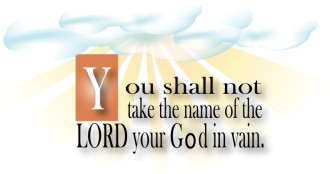
Thou shalt not take the Lord’s name in vain--The third commandment. What does that mean? Many other versions besides the King James phrase it differently. The New International Version says “misuse the name of the Lord”.  The New Century Version says, “not use the name of the Lord your God thoughtlessly”. The Common English Bible says, “use the LORD your God’s name as if it were of no significance”. And perhaps the New Revised Standard offers the best translation when it says, “You shall not make wrongful use of the name of the Lord your God”.

But again I must ask, “What does that mean?” What exactly is the third commandment talking about, and why is so very important to God, and why should it be so important to us.

Most of us grew up with the understanding that taking the Lord’s name in vain referred to an excited utterance of the divine name in a moment of frustration or great excitement.  Probably the best illustration of how this kind of behavior is demonstrated by a story a pastor friend of mine told.

Pastor Mark accepted Christ when he was 17. He grew up in Jerome, Idaho. Jerome had a strong Mormon influence, and this pastor friend of mine loved to play basketball. It so happened that the Mormon church in town, like most Mormon churches, was built with a gym inside it. And in the summer it is where most of the kids in town would play in the evenings.

Well, soon after his conversion, Pastor Mark made a strong effort not to exclaim the divine name unnecessarily. Especially while he was playing sports (If you have ever had to struggle to give up cussing, the athletic arena may be one of the hardest places to exterminate the habit).

Well, most of the LDS kids were taking the Lord’s name in vain while they were playing ball. And he decided he would do something to make a point. Every time he missed a shot he would shout, “Joseph Smith” or “Brigham Young”. Needless to say, my friend did not make many friends, but he did make his point.

I was a spirited, strong-willed child as a little one. A fact that I am often reminded of. Because I was a spirited child, and because I was raised in a traditional, old-fashioned manner, I was often spanked as a child. I do not remember all my beatings, but I do remember a few. The first one I remember was from my father for pushing my sister off of the top bunk after placing her inside a cardboard box. I had told her she could achieve space flight. She did not. She got a bloody nose. I got a very sore rear end from a very spirited spanking.

The second spanking I remember recieving was for utterance of the divine name upon entering our home. Our dog had gotten into toilet paper and strewn it all over the house. I walked in and uttered the second person of the Trinity’s full-name. I was promptly swatted by my mother and sent to my room. She washed my mouth out with soap. She asked me where I learned to talk like that. I told her I had learned such language from her, which she firmly denied using. It was such a strange question in retrospect. All of our family friends were redneck loggers, who spoke the Lord’s name as often as took a swig of cheap beer. Which was quite often.

Certainly, when trying to understand what it means to use the name of the Lord in vain, such uses of the divine name as if it were a cussword are an appropriate example of how people treat the name of the Lord as if it is worthless or useless. But, it certainly is not the only way a person can take the Lord’s name in vain. It may not even be the primary way this is done.

As I began to study this issue, I discovered that many of the Reformers and early commentators on this commandment understood taking the Lord’s name in vain quite differently than we do today. Both Luther and the early Presbyterians in the catechisms of the 1500s and 1600s related the third commandment to taking oaths.

Haven’t you ever heard someone say, “I swear to God”? Or seen someone swear that they are going to tell the truth, the whole truth, and nothing but the truth with their hands on the Bible? Or say, “God as my witness”?

Have you ever seen someone do all of this, and then go ahead and do something false?

This is, in many ways, the way that several people have interpreted the commandment. They have believed that making dishonest oaths and living dishonest lives before God is a violation of the third command.

I agree that this also is a form of taking the Lord’s name in vain. I do, however, think taking the name of the Lord in vain is about more than an excited utterance, or a concern about oaths.

When one digs into this verse and does a little bit more of a word study, then one discovers some interesting insights. You see the word for “vain” is an interesting word. You might have guessed that from the varieties of translation of that one word that I read earlier.

The word “vain” is related to several concepts. One is a “lie”. The other is related to “emptiness”. It also has the connotation of being narcissistic, that is overly-concerned with self.

Thus, one of the ways that people have also understood taking the Lord’s name in vain is misusing the Lord’s name for personal benefit. Certainly, Jesus says this is especially common among church leaders. Jesus said that many people will come to him and say, “Lord, Lord….I cast out demons in your name.” and that he will have to say, “depart from me, I never knew you”. They acted like they knew God. But, they really did not.

Certainly, in our world we see people who use the name of God to shadily garner business through the name of Jesus.  I see it all the time. Especially once people find out I am a pastor, or are eager to do work for the church. Either way, they tend to visit a lot about how godly they are, or what church they go to, or how they govern their company on Christian principles. I remember when Craig Manchego and I were out trying to get some exercise. We came around the corner to the house. And we saw the man making his way down the street. He was going to be at the parsonage about the same time as I was. We knew what he was. He was a guy hired by a roofing company to go door to door and rustle up roofing work for some company based out of town. We visited with him.  Before he left, he shared he was utterly surprised that the parsonage was in fact a parsonage. He also shared that he was studying for the ministry, and that his school was named “Charis” just like our daughter. In other words, he was pimping Jesus for his own benefit.

It gets to the point that if someone is trying to sell me something, and then they start talking about their faith, and how Christian their business is, and where they go to church, I immediately view them with suspicion. I believe that they cannot be trusted. I believe that they are using their supposed Christian faith to sell me something for selfish gain. I am usually right. A lot of people take the name of God in vain in this way.

What about those people who protest military funerals, seminary graduations, and people being put on trial for murdering homosexuals? You know who they are. They are from Westboro Baptist Church in Topeka. They are all trained lawyers, which means that they are very skilled in their abilities in suing people. And so they go to funerals saying God hates soldiers and gays and about anyone else they can think of. They speak the name of the Lord. They decide to speak for God is ways that do not honor him, and that allow them to have substantial financial gain when people touch them, bump into them, get angry with them. They say they are God’s voice. In fact, they are taking the Lord’s name in vain. They are using the Lord’s name for empty lies and selfish gain.

In the New Testament, there was a couple named Annanias and Saphira that conspired to lie to the church by selling their land, and then telling the church they had given all their money when in fact they had held some back for a rainy day. When they chose to come into the sanctuary and lie about it, each of them were struck dead right on the spot. Don’t think that this is just an Old Testament concept. The commandment to not take the Lord’s name in vain makes its way to several places in the New Testament as well.

Besides the word “vain” the other word we obviously need to look at in this commandment is the word “name”.

One thing we know about the word “name” is that names actually meant something in Bible times. How you named a person had power. It is not like our time, where we often choose a name because it sounds cute, or because it is common or popular, or the same name of a favorite sports star or actor.

Knowing someone’s name gave you power. And the name you had branded you one way or another for your entire life. Thus it is interesting that God changed Abram to Abraham, Sarah to Sarai, Saul to Paul. It is also evident that a name is more important to us than we might expect.

One’s name also spoke of one’s familial identity, as it still does today.

My last name lets people know that I am descended from Walker men.

But one’s family name can also mean something very special and powerful.

One’s name can establish a culture. For instance, at one point I will probably say to my beautiful daughter, “That is not the way we as Walkers do things’

Taking on a name implies ownership and power.

Also, we can sometimes in business authorize other people to speak on my behalf. To do things in “our name”. We give them power to speak for us and to be our representative. When we do this, our good name depends on the reputation of those we have given the power to do work in “our name”.

As the people of God, we are people of God’s name. As believers in Jesus, we call ourselves Christian. We take on God’s name. As a church we are called to live and work on God’s behalf, as God’s representitives in this world.

Throughout the Old Testament, God keeps telling the Israelite people that they were called by HIS NAME. Jesus says that we need to minister and do things in HIS NAME. What they are saying is that we are called to live in this world as his children AND his representatives.

Thus, when we are commanded to “not take the name of the Lord in vain” a big part of what we are asked to do is to not take our role as God’s children and as God’s representatives in the world for granted. Instead, we are to live and speak in a way that brings honor to God. We are to make commitments that bring glory and honor to God. We are to uphold our family name as Christians in word and action.

We are coming here today, in part, to gather together to support Shelby and Macenna in baptism. They are having the courage to stand up in front of everyone, and say that they are not taking God’s call to be obedient disciples for granted. They are not taking the Lord, or his work, in vain. They are taking on the name of Jesus, in public. They are saying, yes, I stand with Jesus.

Both of them have accepted Christ a few years ago. They have quietly taken time to listen and learn. They have not rushed to be baptized. They have prayerfully made the decision to follow Christ in this way. Now, they are standing up and saying that they are committed to publically take on the name of Jesus. To not take his gift of salvation for granted. And thus, they have to obey the call of Jesus to be baptized publically. They have chosen to claim Jesus, and to let him claim them.

As Shelby and Macenna are baptized, we are challenged to remember rightly. To not take our faith for granted. To not take God for granted. As they are baptized we are challenged to remember who we are. We are God’s children. We are people he has given his name to.

And as they are baptized, we are prompted to remember who we are. We are Christians. We are people who have taken on the name of Jesus. We are people who have been called to be his hands and feet here on earth. To live and work on his behalf as long we have breathe.

In this tender moment, we are reminded to not take our faith for granted. To not take the name, the name that is above all names, the name that has saved us, the name that has freed us, the name that has mended our brokenness, and found us in our lostness, we are encouraged not to take the name of God in vain. Instead we are called to honor God’s name by how we live, love, trust and follow the one in whom, as Paul said, “we live, and move, and have our being.” Amen.

Saturday, October 08, 2011

Interesting Article by a Well-Known Minister's Offspring

There is an interesting article about a Pastor's Kid who shares about the mixed blessing of growing up in a family of ministers in a mega-church:

I’ve always hated the term “PK.” All my life, people have felt total license to use it with my siblings and me — a knowing glance, a faked camaraderie. “You’re a PK, too? Isn’t it the worst/best?”
Laura%20Ortberg%20Turner.JPG
Well, yes. And no. And why are we having this conversation in the first place? We never, after all, refer to a dentist’s child as a DK or the child of a homemaker as an HK. Why do the children of clergy get such special designations — and such a specific template into which they must fit?

We PKs have two choices, according to television and popular belief. Either we grow up sanctimonious, carrying the mantle of our fathers — in the mold of Martin Luther King Jr., Reinhold and H. Richard Niebuhr, and Franklin Graham — or, we are Katy Perry or pre-conversion Jay Bakker, tattooed and seductive and rebellious and raising hell in ways specifically contrived to reject our parents’ beliefs (call it the Pastor’s Kids Gone Wild trend, as Jon Acuff recently did).

Supreme Court decision that will effect the church....

A Tony Jones post on the "ministerial exception" being under scrutiny by the Supreme Court. Here is an excerpt:

 .
America’s religious institutions have long been able to stand apart from federal laws in the hiring and firing of employees crucial to their mission. Churches with male-only clergy, for example, can exercise that right to religious freedom despite the gender bias.

But on Wednesday, the Supreme Court will hear a case in which, for the first time, the justices could lay out rules for government to decide if a group’s theology and practices are out of step with laws that bar discrimination.

The case involves the dismissal of a fourth-grade teacher by a church-run Lutheran school after she took a leave of absence for a sleep disorder. Concerned about her condition to teach again, the church asked her to resign. She threatened to file a discrimination case under the Americans with Disabilities Act (ADA). The church then fired her, claiming she had violated church teachings on resolving resolve disputes internally with Christian principles.

A district court judge ruled against the teacher, Cheryl Perich, who was “called” by the church as a commissioned minister. But an appeals court found the Hosanna-Tabor Lutheran Church can be charged with retaliation under the ADA, claiming the teacher’s job was mostly secular – despite her duties to also teach the Bible and act as a Christian role model for students in teaching secular topics.

Friday, October 07, 2011

Book Review for THE GOOD AND BEAUTIFUL GOD by James Bryan Smith


As most of the regular readers of this blog know, I have recently attended the Aprentis Conference in Wichita, Kansas. The Aprentis Institute and James Bryan Smith have developed a curriculum that takes much of the theology and spirituality that Renovare has been teaching for a number of years, and distills it into a series of books that are designed to be used as a curriculum for spiritual formation in the local church.


This curriculum is called the Apprentice Series, and every book in the trilogy begins with the phrase "GOOD AND BEAUTIFUL" in the title. While at the Aprentis conference, I was able to pick up the book GOOD AND BEAUTIFUL GOD on audiobook. I listened to it with my wife on our little mini-vacation this week.

Much of the content in the book is summarized by the subtitle which says, "falling in love with the God that Jesus knows." Thus, what much of the book does is address mental narratives we have accepted about God. It addresses false narratives that the world around us or we create, and replaces them with a new narrative that Jesus taught about that runs counter to those false narratives. Then, at the end of each chapter there is a "soul training" exercise that reinforces the lesson through the taking on of a spiritual practice for a week.

The soul training exercises may be challenging for some of us, but Smith is very realistic about how to integrate them into our lives. He takes his time, and he goes slowly. He explains them simply, and attempts to calm his readers anxiety. He begins his soul training exercises by encouraging people to sleep well for a week, which I thought was absolutely brilliant.

After listening to this book, I am eager to try it out in a church setting, and I am eager to read the next books in the series. I would also be excited to use these books in a together in ministry group at some point.

Wednesday, October 05, 2011

The difference between admiration and imitation

Timothy Dairymple, on his philosophical fragments blog, had this to say...which I found quite intriguing,

The Danish religious writer Soren Kierkegaard — on whom I wrote my doctoral dissertation — draws a helpful contrast between imitation and admiration. Christ calls for us to take up our cross daily and follow him. Following, in this case, means to put our trust in him and his guidance and leadership, and to become like Christ in living a life like Christ led. Christ calls for us, in other words, (and among other things) to be imitators. Christ does not ask for admirers. In fact, when he has admirers who have no interest in becoming imitators, he tends to drive them away.
Yet too many people, Kierkegaard says, want to admire Christ but not imitate him. They suspect that if they admire Christ enough, speaking movingly of how important and wonderful and beautiful he is, if they can summarize Christ’s teachings and the significance of his life, then they may be excused from the call of Christ to take up our crosses and follow (imitate) him. Admiration becomes a refuge against imitation, and Christ becomes an object for our appreciation instead of a Person who rescues us from sin and calls us through an intimate relationship to be his feet and hands and lips to a perishing world.

What was the Aprentis Conference Like: Day 1


A mentor/group leader/ friend of mine asked me to share more about my experiences at Aprentis. I thought it was a good idea to share some of my gleanings from the conference, and think through why I liked it so much. Also, since it is a first year, it might be helpful to think through what I would like to see done differently.

FRIDAY

Conversation with Dallas Willard and James Bryan Smith--This was mainly Dallas speaking. I thought it was helpful, but I was discouraged that a lot of what we got seemed to be more "stock" answers and talk. I thought Dallas was insightful with a lot of what he had to say though.

Some thoughts that stood out to me:
  • Are we practicing spiritual disciplines as a means of spiritual transformation, or is the experience an end of itself. It should be the former rather than the later.
  • We need to train our bodies in disciplines that we form our spirit.
  • "In the living of life one of the most important things is to do without the things you want....this is central to true spiritual formation and transformation"
  • Evangelism is most effective when it is done by transformed people
  • "Instead of asking 'if you die tonight' ask 'if you don't die tonight' when you are attempting to reach someone for Christ
Ministry Demonstration--Aprentis. I found this workshop to be enormously helpful. In it, a church that used the Aprentis program sucessfully demonstrated and explained how it was used by their church to grow believers into Christlikeness. I got a feel for how the series came about, how it was designed for small groups in the church, and how it could be a great tool in the church I served. Since this meeting, I have listened/read about half of THE GOOD AND BEAUTIFUL GOD on CD. I think I am going to use it with our church after the beginning of the year.

General Session--Dallas Willard--For me, this was helpful review. Dallas presented his vision-intention-means understanding of how true spiritual transformation takes place. This is written about in depth in his book RENOVATION OF THE HEART, which I read several years ago. I needed the VIM reminder as I look at my own life, but also as I look and where I am leading others. Dallas pointed out that churches often move past vision and intention, and try to push "means" (i.e. program or system) on people in order to grow them. This, he suggests, short circuits the VIM process. A great quote during this talk, "Spiritual formation is not a set of practices, it is what happens as a result of participating in those practices." For several of the chats after the talks on the stage, Willard kept asking the question, "Does God let us 'get away' with anything? It was a thought-provoking question as we probed deeper into the issue.

General Session--James Bryan Smith--A great speaker, Jim Smith has a top notch mind, and a youth pastor like charm when sharing what he knows with people. One of Smith's helpful approaches, both in his books and in this speech, is that spiritual transformation does not happen unless we have healed and healthy narratives about who God is, who we are, and what our role is in the body of Christ and the world. His system for helping people grow spirtually is great, and I am appreciating a lot.

Well...that is all I have time for. Maybe I will try and share more later in the week....


Sunday, October 02, 2011

Battle of the Bulge: A Day Early post


I have simply been slogging along for the last month or so with weight loss. I got down to my best weight at the first of August with a loss of 91 pounds, and reached that again last week. I believe I am almost certain to gain or stay the same this week. It makes me wonder...what is wrong with me? Why am I so...stuck?

I have pondering this concern a lot lately, and while I don't have every answer, I do have some.

One reason that I am struggling is that significant weight loss takes a significant amount of control of my time and environment. The last month and a half for me has been full off a lot of stress and a lot of struggle. Over and over again, circumstances have taken my eating environment, my eating experiences, and my eating choices out of my control.

Another reason is this busyness has pushed me away from making taking my medication a priority. I think when I fail to take my medication, I struggle.

More than anything though, I think that I am struggling because I need to step up my weight loss game. I need to exercise more. This is hard to when I am overwhelmed with a crazy schedule. It is also difficult because I need someone to exercise with me, to keep me accountable, and to make my exercise a social event instead of a drudgery. It is actually quite remarkable that I have lost 91 lbs with little or no commitment to exercise.

So, tomorrow I will swallow a bitter pill of weight gained. Then I will begin again to try and lose a few more pounds. And hope that at some point I reach my far off goal.

Saturday, October 01, 2011

Book Review of From the Garden to the City by John Dyer

  FROM THE GARDEN TO THE CITY


By John Dyer

ISBN 978-0-8254-2668-1

Published by Kregel

Reviewed by Clint Walker


I vividly remember my first visit to the OB/GYN with my wife. We had just discovered that she was pregnant, and we were sitting down with the doctor to allow him to define our relationship with him for the next nine months. I expected him to sit facing us, look at us, and possibly even perform a physical examination on my wife. Instead, he went to his computer, and talked through a series of questions that the computer prompted him to ask us. At least half of the visit had him facing away from us, so that he could look at his computer screen. I could not help but think this kind of doctor visit was qualitatively different than the doctor visit my mother had with her doctor before I was born.


Certainly, as Jennifer’s pregnancy had complications, we became thankful for the technology that God had given us in obstetrics. Still, sometimes you have to wonder, is all technological change a good thing? How does technology change us? How do the gadget that we feel we cannot do without form our souls?


This is the kind of question John Dyer loves. In his book From the From the Garden to the City he attempts to explain how technology is neither value-neutral, nor is easily placed in categories such as “good” or “bad”. Instead, the use of technology calls for discernment and wisdom, as well as constant vigilance. This is especially true in the life of the church.


From the Garden to the City is well-researched. Albert Borgmann, Marshall McLuhan, and Neil Postman are cited, among others.


Dyer also writes in a way that is easy to relate to. In his book, he gives many personal examples from his own life. He is honest about his struggles and his questions. From the Garden to the City is an excellent, thought-provoking book that will be a challenge for nearly every individual or church that reads it. I highly recommend it.

(thanks to Kregel Publishing for free book in exchange for an honest review)

Thursday, September 29, 2011

Book Review of The Liberating Truth by Danielle Strickland


The Liberating Truth: How Jesus Empowers Women

By Danielle Strickland

ISBN 978-0-85721-019-7

Monarch Books

Review by Clint Walker


Over the last few years, I have been amassing a several books just on the issue of equality for women in the church. I live in a community where my commitment to Biblical equality is not always well-received, and I need to be well-versed in why I believe what I believe about women’s equality in and out of the church. Recently I was able to add The Liberating Truth by Danielle Strickland to this section of my library. It is a great edition.


Danielle Strickland is a skillful and passionate writer. She is an officer in the Salvation Army, and has spent much of her ministry reaching out to women in an intercultural and global manner. She communicates several cases of gender injustice that most of us should be shocked by, and shares anecdotes on how she brings Jesus into those extreme situations with her.


Her global observations about the oppression of women make Strickland keenly aware that oppression of women is a huge global problem. As she sees these situations, she finds clear hearings for the good news of Jesus, and how his gospel is a call of good news and equality for women.


Unfortunately, she is also able to notice that there are many anti-gospel messages in Christian circles. One of those anti-gospel messages are the messages that women are to be meek and subservient, supporting their men in their dreams but never submitting to the callings God may have put on their own hearts to preach and to lead. She challenges these anti-egalitarian viewpoints Biblically.


Throughout The Liberating Truth, Strickland tells many interesting stories about experiences she had while she was in the ministry. She writes captivatingly, and with true passion. The Liberating Truth is a tour de force in what God calls the church to be, and what God calls the church to do in relation to this call. An excellent book that I will return to again and again.

Book Review of the Beginning and the End of Wisdom by Douglas Sean O'Donnell

It is obvious that Douglas Sean O'Donnell loves the Word of God. It is obvious, in particular, that O'Donnell loves OT Wisdom literature, and relating OT Wisdom literature to the work and person of Jesus Christ. The passion of O'Donnell is obvious from the beginning to the end of his new book THE BEGINNING AND THE END OF WISDOM, which focuses on preaching Christ from the books of Proverbs,Ecclesiastes and Job.

The first six chapters of the book give examples of preaching OT Wisdom literature from the first and last chapters of Job, Ecclesiastes, and Proverbs. The final chapter of the book discusses the hermeneutical task of connecting Wisdom passages to the words and work of Christ.

Then, nearly half of the printed texts are notes and appendices. The book is heavily footnoted. There is a guide to preaching Hebrew poetry. One appendix simply focuses on summaries of each of the books covered in the text. The bibliography and notes are both extensive.

While I enjoyed the book, and will use it as a resource, I did not think THE BEGINNING AND THE END OF WISDOM accomplished the goals that are communicated in the title. I thought the book was thorough in offering guidance in interpreting texts in Scripture, but it did not offer near as much help in crafting the actual preaching event. For example, should one preach through these books verse by verse, or select certain passages that summarize the whole book? Should one preach Proverbs topically? Am I supposed to glean how to preach the passages simply by reading these rather lengthy sermons?
So, grab this book. But realize you are buying a book that is more about the hermeneutical task than a text on preaching methods and techniques.

Wednesday, September 28, 2011

Book Review of King Solomon by Phillip Graham Ryken

Israel was never more powerful than in the years when Solomon was their king. Having had his predescessor and father David establish the kingdom, Solomon was able to grow the nation of Israel in power and wealth. Yet it is the lust for power, wealth, and sex that ended up poisoning Solomon's life, and diminishing the kingdom for each generation that followed.

KING SOLOMON chronicles the life of Solomon. It in author Phillip Graham Ryken shares about how blessed and gifted Solomon was by God as a leader of Israel. He shares the different ways that Solomon starts well in relationship to God and his subjects. Then it shows how Solomon's life was diminished by allowing himself to be subject to the desires for wealth, power and sex.

This book, while telling the story of Solomon, makes quick work of drawing parallels between the life of Solomon and the temptations he faced with the plight of Western Christians and Western Christendom as a whole. Many in the church, and much of the church as a whole, is also easily tempted to surrender their mission in order to be sucessful, powerful, and financially secure. KING SOLOMON teaches us that comprimise to these temptation ultimately destroys lives, kingdoms and cultures, so we better be beware.

In the book KING SOLOMON, Ryken has written and intelligent and prophetic book that will challenge many of us. With a study guide in the back the book would be great for individual study and for group study. The book is an easy read, but its message is not easy to hear. We would, however, be wise to heed it.

Book Review of MOVE by Greg L. Hawkins and Cally Parkinson

Move: What 1,000 Churches Reveal about Spiritual Growth
by Greg L. Hawkins and Cally Parkinson
ISBN 978-0-310-32525-3
Published by Zondervan
Reviewed by Clint Walker

This year, when I attended a simulcast of Willow Creek Church's Global Leadership Summitt, I heard the leadership of the church talk about this recent study they had done about spiritual growth, and how the people at Willow Creek wanted to share what they learned about spiritual transformation with leaders everywhere.

Now, they have recently released their gleanings of their study on how people grow spiritually in the new book MoveMove shares about a well thought out, revealing, and somewhat surprising picture of how people grow. One thing the study revealed is descrete describable phases of spiritual development. Another thing that the study revealed were best practices of churches that effectively help people mature in their faith, instead of feeling "stuck" in an immature, stagnant faith journey.

Many churches feel stuck. This fine book will be helpful for many leaders in identifying where their church has stalled, and it will help those leaders to think through how to wisely lead people to take thei next step(s) in their faith. A great purchase for pastors and churches across the country, and well worth the cover price.


Sunday, September 25, 2011

Book Review of Sanctuary of the Soul: Journey Into Meditative Prayer by Richard Foster

SANCTUARY OF THE SOUL
By Richard Foster
ISBN 978-0-8308-3555-3
Published by Intervarsity Press (Formatio Imprint)
Reviewed by Clint Walker

I love just about everything that Richard Foster writes. So, when I saw that he was writing a new book on meditative prayer I pre-ordered it immediately. It came out a little early, and I have been slowly plodding away at reading this book. I just finished Foster's book, and I have to tell you, it exceeded my expectations.

Sanctuary of the Soul is a guide to help believers in understanding and practicing meditative prayer. I have always found meditative prayer and contemplative prayer difficult. This is because I both have some emotional discomfort with the practice of mediation in a secular/interfaith context, and because I feel like a failure when I attempt to understand and practice contemplative prayer.

Many of the practices of slowing in meditative prayer that people find helpful are true across religious groups. These practices include manipulation of one's posture, the use of relaxation techniques, the intentional slowing and measuring of one's breathe, and other similar things. Having been exposed to transcendental meditation, and believing it to be a non-Christian form of worship, and seeing similarities between common practices of TM and some forms of what Christian leaders call meditative prayer, I find myself immediately off-put by the way I have been led in "contemplative" spiritual exercises in a Christian context.

Also, I have studies several books on meditative prayer, and I find the descriptions of these kinds of prayer difficult. Books like The Cloud of Unknowing, Madame Guyon's Experiencing the Depths of Jesus Christ, and Merton's Seeds of Contemplation make me want to give up on the contemplative journey altogether.

Thankfully for me, God has raised up men like Richard Foster to write books like Sanctuary of the Soul. Foster's brilliance in his writing is that he makes challenging spiritual practices understandable, and in a small way attainable. Often as I read Foster describe a spiritual practice, I recognize that I have already prayed in that fashion. Then I read on, and I find that he often gives me very practical help in how to pray better and more meaningfully.

I found this process I described happened often as I read through Sanctuary of the Soul. For instance, Foster gives clear instructions in how to enter into meditative prayer effectively. Specifically he speaks about walking your way into meditative prayer, or reading poetry as a way to slow your mind into a more contemplative state. These are basic instructions and helpful advice in the life of prayer, but they are also things we ofen forget when we want to become more prayerful.

I discovered that there were several times where God was leading me into meditative prayer, and I did not know it because I did not have the words for it. I felt less discouraged that I could not "do mediative prayer" right, and I felt encouraged to do it in my own way. The result is a sense of grace and peace in my walk with God, and that a new way of praying can "make sense". And this is truly a gift.

I recommend many of you go out and purchase this fine book. It will be treasured in my life and on my shelf.


Friday, September 23, 2011

Two Songs I Someday Hope to Hear Sung in Christian Worship


ALRIGHT BY DARIUS RUCKER

Alright, Alright
Yeah it's alright, alright

Don't need no five star reservations
I've got spaghetti and a cheap bottle of wine
Don't need no concert in the city
I've got a stereo and the best of Patsy Cline
Ain't got no caviar no Dom Perignon
But as far as I can see, I've got everything I want

Cause I've got a roof over my head,
the woman I love laying in my bed
And it's alright, alright
I've got shoes under my feet
Forever in her eyes staring back at me
And it's alright, alright
And I've got all I need
And it's alright by me

Maybe later on we'll walk down to the river
Lay on a blanket and stare up at the moon
It may not be no French Riviera
But it's all the same to me as long as im with you

It may be a simple life, but that's okay
If you ask me baby, I think I've got it made

Cause I've got a roof over my head,
the woman I love laying in my bed
And it's alright, alright
I've got shoes under my feet
Forever in her eyes staring back at me
And it's alright, alright
And I've got all I need
And it's alright by me

It's alright by me, yeah yeah
When I lay down at night I thank the Lord above
For giving me everything I ever could dream of

Cause I've got a roof over my head,
the woman I love laying in my bed
And it's alright, alright, alright, alright
I've got shoes under my feet
Forever in her eyes staring back at me
And it's alright, alright, alright
And I've got all I need, yeah
I've got all I need
And it's alright by me
Oh yeah, it's alright by me

WONDERFUL WORLD BY LOUIS ARMSTRONG

I see trees of green, red roses too
I see them bloom, for me and you
And I think to myself
What a wonderful world

I see skies of blue, and clouds of white
The bright blessed day, dark sacred night
And I think to myself
What a wonderful world

The colors of the rainbow, so pretty in the sky
[| From: http://www.elyrics.net/read/l/louis-armstrong-lyrics/what-a-wonderful-world-lyrics.html |]
Are also on the faces, of people going by
I see friends shaking hands, sayin', "How do you do?"
They're really sayin', "I love you"

I hear babies cryin', I watch them grow
They'll learn much more, than I'll ever know
And I think to myself
What a wonderful world

Yes, I think to myself
What a wonderful world
Oh yeah

Flashes of Insight

One of the things that I started this blog for nearly 7 years ago was to capture thoughts that might otherwise escape me. Sometimes these were flashes of insight, other times pithy quotes, and still others were beginnings of lessons or sermons. I got tired of saying, "I was thinking about that the other day, and I had some good ideas, but I can't remember what went through my mind now." Thus the name FRIAR TUCK'S FLEETING THOUGHTS.

Today I carried a notebook with me. A little moleskine in my pocket that would help me remember stuff to think more about later.

Here have been some of my thoughts as I moved through my day:

  • Why do I often find ways to make things easier and less costly for people, instead of calling them to greater and more meaningful things?
  • Why do I spend so much of my time running errands for my congregation (making copies, cleaning and setting up classrooms, running interference for people), and so little time becoming to person and the leader God calls me to be and the church needs me to be?
  • How do I unite my calling to be an invested and godly father with my calling to be a thoughtful, yet industrious pastor for my congregation? (still have not figured out the work/family balance in relation to the ministerial life)
  • I am moved by the culture of kindness at this conference. I am moved because I don't really experience this in the same way at home even though I live in a small town where nearly everyone knows my name. I think this is partly because we are at a conference about being formed by the Holy Spirit. I think this is also partly because although I hate midwestern humidity and propriety, I honestly crave midwestern kindness and hospitality. Kansans are good at kindness and friendliness. Better than us Rocky Mountain folks and West Coast people. I also think part of this is my role as a religious functionary, which in my context means  that it is my job to care for my church and community, but not their I found myself getting emotional because someone stopped and asked ME about me, smiled, acted interested in my thoughts and feelings. Other than my wife, does not happen very often in my life.
  • Today, while at the conference, I felt myself experiencing this happiness and joy for no reason. I just could not help but smile. Can't tell you why.

Quotes from Dallas Willard at the Formation in Christlikeness conference

Today and tomorrow I am participating in a conference on Spiritual Formation called Formation in Christlikeness: The Process of Change. It is a discussion of how people grow to be more like Jesus.

Tonight, we had two speakers in the general session. The first was Dallas Willard. Dallas is the scholar and one of the "founding fathers" of the contempoary movement in churches toward spiritual formation. He spoke on the "VIM" (Vision, Intention, Means) process of change that is most directly taught in hsi book Renovation of the Heart.

Dallas is rather difficult to take notes with. The outline for his talk was given to us, but as I tried to fill it out I discovered he didn't fit into my structured notetaking method as well as I hoped he might.

What I did garner were several pithy quotes from his talk, and his conversation with James Bryan Smith afterward. Here are some of the quotes:

  • "A sure way to be miserable is to try and be happy" (I think this is so true!)
  • "To much of our time (as Christians) is spent answering questions nobody is asking"
  • "Why fast? Fasting trains you to be sweet and strong when you do not get what you want"
  • "Don't worry about perfection, work on progress"
  • "There is not a single problem in the church that discipleship in Christ will not cure"
  • "The Church is in the business of character transformation"
  • "The Romans Road--and similar methods of evangelism--are designed to deliver us from guilt, and not sin"

Monday, September 19, 2011

Book Review of On The Verge by Hirsch and Ferguson


ON THE VERGE
By Alan Hirsch and Dave Ferguson
ISBN 978-0-310-33100-1
Published by Zondervan
Reviewed by Clint Walker

What is the future of the church? How is the church going to reach coming generations for Christ? And what does that mean for the congregations we see today?

These are the thoughts and questions that Alan Hirsch and Dave Ferguson attempt to address in their book On the Verge. Written in part as a missiologial guide for church planters of missional churches, the authors attempt to craft a guide for church leaders to help them establish and maintain an “apostolic” vision for their congregation. While created by and for church planters, this book has excellent insights to think about and ponder for pastors of established churches as well.

Alan Hirsch is one of the leading voices in the missional church movement. As he has grown in influence, he has become less of a practicioner of congregational ministry, and more of a scholar/leader/visionary for missional churches as a whole. This is why he writes with Dave Ferguson, who is a church planter and currently trying to lead his congregation to continue their thrust toward reaching and influencing their communities for the Kingdom of God. The blend of consultant and practicioner, theory and hands on ministry is ingenious, and a good reason why this book is not only inspirational, but has the possibility of presenting a vision that actually works.

At the heart of the book is a four step system for establishing a continuing culture of innovation for churches that want to maintain their missional integrity within their ministry context (p. 46-47). The first step involves imagining what could be. The next step is shifting one’s thinking to accommodate and understand the new vision and paradigm the imagining process discovers. After that, one needs to take action. Then, as the church takes the steps to reach out and take action, they need to move and grow to both accommodate the new world the missional community is living in, and to also repeat the process of innovating once again. This sounds pretty basic, but harder to actually create this momentum in a congregation one is leading.

The text is fun, and thought provoking. As a pastor of a more historic church, I think creating this kind of culture would be more difficult for me than for a church leader who is beginning a new congregation. Nevertheless, moving congregations from being institutionally focused to mission focused is something we all must do in our own way, and help our churches continue to do long after our ministry is through. On the Verge helps people like me think through ways we might do just that.

Saturday, September 17, 2011

My newest realignment predictions for NCAA DI FBS

With the ACC going to 14 teams with Pitt and Syracuse, it begs the question: Who is going where with the football conferences. My latest prediction:


Where will teams in the big 12 go?

Big Ten--will add Iowa State and Missouri, then later Kansas and Kansas State

Pac 12--will add OU, Oklahoma St. Texas Tech, Texas


This leaves Baylor the odd man out. Baylor can see the handwriting on the wall. That is why they are threatening to sue


SEC--as Big East disintegrates, will pick up West Virginia to make a 14 team conference.
Which then leaves us with two 16 team conferences and two 14 team conferences.

What do the ACC and SEC do? Stand pat or get two more teams each?


I think the SEC, in part to avoid a lawsuit, and in part for recruiting, picks up Baylor and possibly TCU.


I then think the ACC picks up Rutgers and Conneticut. This solidifies the Eastern Seaboard for their conference. (this puts duke, uconn, pitt, north carolina and syracuse in the same basketball conference)

Here is what will then get interesting...do mid-majors make themselves superconference sized? Or does the independent school rise again with more independents?
Strangely enough, many of the mid-majors like the MAC (13), Conference USA (12) are already supersized.

I think the rest of the Big East stays in the Big East for Basketball, but that the Big East disolves in football. This leaves Cincinatti, USF, and Louisville without a football conference. Although it makes no geographic sense, I think they look to jump into the Mountain West for football only--which will give the mountain west 10 teams, and give the the eastern teams the most competitive conference outside of the big 4.
How do you think teams will realign?

Thursday, September 15, 2011

Book Review for Young and In Love


YOUNG AND IN LOVE


By Ted Cunningham

ISBN 978-0-7814-0447-1

Published by David C. Cook

Reviewed by Clint Walker


Much of our culture, both inside and outside of the church, tends to believe that getting married young is not a wise idea. There are a number of reasons for this. Many statistics tend to lead us to believe that marrying young will lead more easily to divorce. Many counselors teach that persons need to get to “know themselves” before they enter into a marriage covenant, and thus should delay marriage at least until college is completed and a career has begun. Financial counselors warn that early marriage dooms husband and wife to poverty. Ted Cunningham seeks to tell us and then teach us that everything we have heard about the wisdom of delaying marriage is completely wrong. In his book Young and In Love, Cunningham argues in favor of Christian couples marrying young. He believes that young marriage is the most wise and God-honoring way to approach marriage, and that most of us have been lied to about the benefits of delaying marriage. Although I believe that Cunningham overstates his case, he does have many valid points.


Cunningham believes that teaching people to delay marriage demeans the institution of marriage on several fronts. He believes that delaying marriage increases the frequency of cohabitation. Then, as cohabitation increases so does divorce. Young and In Love also argues that “delaying marriage delays adulthood” (p. 68). As long as people delay marriage, Cunningham argues, they have a license to be selfish and “self-centered” (p. 70).


To Cunningham’s credit, he carefully acknowledges some of the ways that people rush into marriage, and some of the necessary delays for marriage. He is forthright about the truth that some people, especially young, chaste Christians, rush into marriage just because they do not want to wait to have sex any longer. He also wisely counsels against couples who marry young because it brings financial benefit (p. 85).


Young and In Love goes on; however, to argue against many of the prevailing arguments for delaying marriage. The arguments Cunningham disagrees with include increasing one’s financial health (p. 102-104), and waiting until one is through with college (p. 105-106).


I have enjoyed reading Cunningham’s arguments, although I think at times the book is overly repetitive. I agree with him on several points, and I disagree with him on others. You may agree or disagree with him, but I think if you read what he says you will agree with me that he has some intelligent arguments, and his point of view should be heard. Much of what we hear about delaying marriage is not value neutral, but driven by fears and agendas that may not be Scriptural or godly. Personally, I got married rather late (age 34), but I certainly would not resent anyone or blame anyone for choosing to marry at a younger age if they were ready and had found the right partner. If nothing else, Young and In Love can challenge prevailing thought enough to rejoice with those who marry at a young age, and support them instead of gritting our teeth believing that their marriage has no chance because they are too young.

Wednesday, September 07, 2011

Book Review of Playing Hurt by Brian Goins

PLAYING HURT
 By Brian Goins
ISBN 978-0-8254-2673-5
Published by Kregel
Reviewed by Clint Walker

 Ephesians 5:25 says, “Husbands, love your wives, just as Christ loved the church and gave himself up for her.” This is the starting point for Brian Goins’ Playing Hurt strategy to help men to be better and more effective husbands. The idea is to communicate sacrificial love to men in a way they can more easily relate to. Thus, the idea of “playing hurt” that many men have experienced or observed in athletic competition is tied to “taking one for the team” in a marriage relationship.

Playing Hurt is an ingenious metaphor for sacrificial love. Brian Goins does an admirable job of extending the metaphor throughout the whole book. He speaks of overcoming difficulty and the adversary through sacrificial love, and of being a servant leader for one’s household. He also challenges men to find a support team to help them be a better husband and father. His wisdom is witty, engaging, thought-provoking, and inspiring. As a husband with young children, I found the book to be a great encouragement.

However, I do have some honest concerns about the text. First, will very many men actually take the step to grab the book and read it? About half of the guys I know are not really committed readers. Of those that actually do enjoy reading books, very few of them are eager to read a “relationship book”. Because of this, I have concerns about whether Playing Hurt will actually get to its intended audience.

I also wonder if all of the athletic stories and metaphors are, at times, a little overdone. I know these kinds of stories are supposed to draw guys like me in, but at times it feels like the author is trying too hard to make the book too manly and cool. This feeling may be due to my experience as an athlete. I, at times, get tired of the some of the motivational tools coaches use with athletes, and some of those find their way into this text.

Also, when people would find out that I was an athlete, they would often try to communicate their point of view through athletic metaphors with me, assuming that I was not smart enough to figure out what they were saying otherwise I believe that Brian Goins has written the best book for Christian men on being a good Christian husband that I have ever read. It is easy to understand yet profound. Readers will find Goins easy to relate to, and will find his illustrations and stories especially helpful. It is definitely worth a read!

Tuesday, August 30, 2011

Book Review of Mugabe and the White African by Ben Freeth


Mugabe and the White African
By Ben Freeth
ISBN 978-0-7459-5549-9
Published by Lion
Reviewed by Clint Walker

Recently, a documentary called Mugabe and the White African began to garner awards across the globe. Now, the companion book written by the “White African” in the documentary named Ben Freeth has hit the presses.

Mugabe and the White African recounts the compelling story of one man’s struggle to maintain his land and way of life in the face of great adversity. In Zimbabwe, where this book was written, land owned by white persons was being taken from whites and given to blacks in an attempt to reverse the influence of colonialism. The leader of this movement was a man named Robert Mugabe, who eventually became President of Zimbabwe, and remains in that position to this day. This unlawful seizure of land and property was often violent. Ben Freeth and his father-in-law Mike Campbell have stood boldly against this policy that they believe to be unjust, and in the process have also managed to establish a strong, loving Christian witness with many around them.


(PICTURE OF BEN FREETH)


As one reads this story it is easy to notice several things. First, the Campbell/Freeth clan has truly been treated unfairly. Their struggle is epic, and Freeth’s command of the details makes it clear he has been careful to stick closely to the facts of the situation he is in as best as he knows it. Your heart breaks for the family. They are simply seeking to make a living and build a business in a country they have always called their home.

Although the story is compelling, the actual text of Mugabe and the White African is poorly written. Often the details of legislation are overly explained, bogging down the reader. Also, details of what happened to Ben and his family are given interpretation by Mr. Freeth in an awkward, stilted, and self-promoting kind of way. In other words, there were times I felt like this text would be a better political tract than an autobiography that needed to be marketed.

Also, one must be warned, as this story makes it to an American audience, not to make straight line comparisons between the racial and political tensions in Zimbabwe to those we experience in the United States of America. Some may try to compare the plight of the whites in Zimbabwe to minorities in America. This does not work because of the history of each of the nations. Blacks were forced to America in slave ships. Whites in Zimbabwe colonialized Africa. Also, others may want to compare the more progressive policies to address social inequities of our African-American President with this African leader. This is an unfair as well. Mugabe is a totalitarian dictator. President Obama is our elected leader. Mugabe has killed thousands of innocents to accomplish his goals of power and control over a nation. Our president has done nothing of the sort.

Nevertheless, despite the textual weaknesses of the writing style of Mugabe and the White African, this is really a story that has been forgotten by our media and the church, and a story we need to hear. It helps to remind us that evil and bigotry lurks everywhere, and wherever we see it, we as Christians need to fight against it.

Thursday, August 25, 2011

Book Review of Route 66 by Krish Kandiah


Route 66
By Krish Kandiah
ISBN 978-0-85721-018-0
Published by Kregel
Reviewed by Clint Walker

For years, I have been eager to find a strong curriculum that gives an overview of Scripture in a way that is both thorough and easy to understand for everyday people sitting in the pew. Krish Kandiah has put together just such a book, newly released with Kregel Publishing, and I could not be more pleased.

Route 66 is a neat little book. It serves as both a curriculum piece, and as a book someone can read as a regular book. It covers 8 major genres of Scripture, clearly going over the basic distinctive characteristics of each type of writing. Then, at the end of each chapter, there is both a small group study and a set of lessons to be engaged on a personal level. The idea is that each person can read the text, and go through the personal studies during the week, and then join together to discuss what they have learned and grow even more with the small group study once a week.

The book is full of charts, side notes, and helpful little tidbits that are fun to read as you study. There are also a few appendices that are also helpful to guide people in further study. I am impressed with the tremendous amount of useful tools that this relatively small book has to offer.

As a matter of fact, I am thinking about presenting this to my Sunday School class as a study to kick off our year together. I highly recommend everyone who wants to have a tool to help people they lead have a bigger picture of what is going on in the Bible, or who wants that overview themselves to grab this book quickly. It WILL deepen your knowledge of the Word, and how to read it.

Wednesday, August 24, 2011

Book Review of A Meal with Jesus by Tim Chester


A MEAL WITH JESUS
By Tim Chester
ISBN 978-1-4335-2136-2
Published by Crossway
Reviewed by Clint Walker

I have been on a diet lately. In discussions about food and diet, two opinions predominate. One is that the world would be healthier and a better place to eat in if people gave less thought to food, and simply saw food as fuel to keep our body going. The other side of the discussion says that what we need in this world is people who make their eating choices more intentionally, thoughtfully, and wisely. According to this second group, one achieves weight loss by thinking more about food and what and how they eat.

Related to this discussion are the social implications of how, when, where and what we eat. For example, In his book Eating Animals, progressive activist Jonathan Foer argues for veganism as an act of social justice. In Rich Christians in an Age of Hunger Ronald Sider argues that American beef production and consumption may be greedy in light of global poverty. In his new book A Meal with Jesus, Tim Chester argues that there are spiritual implications related to how we eat.

Chester focuses in on the gospel of Luke and six specific passages where Jesus either was at a meal or discussing something relating to a meal. He argues that how Jesus ate his meals, with whom he at his meals, and the lessons that he taught at those meals demonstrates key theological concerns of his ministry. Furthermore, A Meal with Jesus argues that as we put some of Jesus’ lessons around the table into practice with our table habits, we will be better disciples and better witnesses to the gospel of Jesus.

The introduction to this book is better than most introductions. Any reader would be wise not to skip over it. In it the author considers the statement by Jesus that “the Son of Man came eating and drinking”, and discusses the centrality of the meal to the gospel message.

The individual chapters will be wonderful not only for personal edification, but for a Bible study group or even as the basis for a sermon series. Each chapter examines one passage more in depth, and shares more about how what happens in that passage ties into the expressed mission of Christ on earth. I plan on using this book at one point for sermons related to the Lord’s Supper.

I encourage anyone who struggles with eating, loves to eat, or is curious about how food consumption relates to the gospel to read this book. What the reader will discover is that the meal is about far more than putting food in one’s mouth.

Tuesday, August 23, 2011

Book Review of PUJOLS by Lamb and Ellsworth


PUJOLS: MORE THAN THE GAME
By Scott Lamb and Tim Ellsworth
ISBN 978-1-59555-224-2
Published by Thomas Nelson
Reviewed by Clint Walker


I grew up reading sports biographies. I still remember details about Brian Bozworth and Reggie Jackson through the autobiographies they wrote. I also learned a lot about players that I never had a chance to watch play on television and in person through books. The nice thing about reading a sports biography is that you get to understand the story behind the story about what drove athletes to greatness, and what makes them tick today. PUJOLS: MORE THAN THE GAME draws us into the life and the career of Albert Pujols. What we discover is an athlete of fierce determination on the field, and a strong Christian faith that he lives both on the field and off the field.

I have enjoyed this biography, which tracks Albert Pujols from early days in the Dominican Republic, his adolescent years in Kansas City, and throughout his career to the present day. It was informative, and made me more of a fan of “The Machine”.

This book, however, may not be for everyone. The authors are very frank about Pujols’ Christian faith, and put that front and center when they communicate about this great baseball player. They believe that Albert Pujols’ deep Christian faith is foundational to his success on and off the field, and this is a big part of the reason why Lamb and Ellsworth write this book. To me, the sometimes polemical book is encouraging and inspiring. You will have to decide if this works for you.

Monday, August 22, 2011

The Great Preaching Battle: Manuscript vs. Outline


I have been, for most of my 17 years of preaching, a manuscript preacher. I have chosen this route in the past for a multitude of reasons. First, I am not good at "ad-libbing". When I speak off the cuff I feel I am unclear. I feel that I do not speak well when I don't have my manuscript. I use fillers like "umm" or "rrr" a lot when I do not have a script to refer to. Also, I like to be precise in what I am saying. Off and on for years, people have asked me what I said. When I have a manuscript I can refer back to it. If there is controversy, there is a clear source to return to. Also, most great speeches were done by manuscript. Our current president is well-spoken, and he almost always has a teleprompter with a script uploaded to it.

This year I set a few goals to stretch my preaching skills, and to move me out of my comfort zone. One was choosing to do a set number of sermons with a one page outline. Two of the Sundays I have used this outline have been this Sunday and the Sunday before.

Here are a few things that I noticed:

1. The sermon takes less time to prepare.
2. The one-page part of the format pushes me to focus my thinking more. This allows me greater clarity in what I am saying. The sermons are easier to digest for the most part.
3. I am more free to move, interact, gesture, and make better eye contact.
4. My sermons take about the same amount of time

ON THE DOWN SIDE
1. I feel less confident and more vulnerable
2. I think I use less "illustrative" content with this style of preaching
3. I do use more "fillers"--and I repeat key points over and over--maybe too much

Some have commented favorably on my recent sermons. Most have no comment. My wife likes the outline sermons better because they are more conversational. I think I will, most likely, blend styles in the future.

Which form of speaking notes do you use most often. Which do you prefer? Why?

Tuesday, August 16, 2011

Book Review of Don't Check Your Brains At the Door


DON’T CHECK YOUR BRAINS AT THE DOOR
By Josh McDowell and Bob Hostetler
ISBN 978-0-8499-3234-2
Published by Thomas Nelson
Reviewed by Clint Walker

Josh McDowell has been working hard to challenge teenagers and young adults to be fully committed to Christ, and intellectually grounded in their Christian faith. Many of his books handle apologetics in depth, or otherwise teach believers to hold on to uniqueness of their faith. DON’T CHECK YOUR BRAINS AT THE DOOR is not that much different. As a matter of fact, this book is a reprint from work the two authors did together nineteen years ago. The text is repackaged and reworked for a new generation of teens that are more adrift in a relativistic culture than they have ever been. It will be a valuable gift to give to intellectually curious teens, or even for creative Sunday School teachers to use with their teenage classes.

Each chapter in the book addresses a specific myth about God, Christianity, or the Bible that a reader or their friends may hold. In two to three pages, Hostetler and McDowell correct that myth, and then give the readers baby steps in following through with what they have learned through Bible Study and/or journaling.

I like the witty names for each chapter. I also think the short, quick hit format is very appropriate for teens who read less and less than the teens that came before them. I would recommend middle school kids and high school students use this book for a devotional, especially if they are curious about the world and/or struggle with doubt.

DON’T CHECK YOUR BRAINS AT THE DOOR may be a reprint, but it contains information that is just as important to understand today as it was twenty years ago. With its new packaging and set-up, it should make a difference in people’s lives all over again in this generation.

Sunday, August 14, 2011

Mamma Maggie Gorban on Silence and Spirituality


When one has nothing, God is everything

In silence you leave the many to be with the one

To be in silence is to be fully inside your own self

Silence your body to listen to your words;
Silence your words to listen to your thoughts;
Silence your thoughts to listen to your heart
Silence your heart to listen to your spirit
Silence your spirit to listen to His Spirit.

Read more about her work and ministry HERE

Quotes from Global Leadership Summit: Steven Furtick


I don't believe God has called me to survive this world, but to change it.

How do you get from inspiration to implementation? THE CHALLENGE

If your vision is not intimidating to you, it is probably insulting to God

We tend to compare our behind the scenes faith and life to everyone else's highlight reel.

Life can beat the audacity out of you

Notes and Quotes from Global Leadership Summit: Les Schlesinger


Who he is:

  • Harvard Business Professor


  • President of Babson College--#1 Entreprenurial School in the World


  • Author of 10 books, including ACTION TRUMPHS EVERYTHING


  • Quotes:


  • "Failure does not mean game over, failure means try again WITH EXPERIENCE"


  • "Believe in the future by creating it first"


  • "If you cannot predict the future, create it"


  • "Treating an uncertain world as if it were predictable only gets you into trouble"


  • "You cannot get THERE, without being clear what is unacceptable about HERE"


  • "Stop worrying about what you want to do, and start worrying about what you want to do NEXT"


  • "Action trumphs everything because it gets you more times at bat"


  • Notes:


    Method for innovation/entreprenurial leadership


    1. Know what you want

    2. Stop obscessing about what you can't do

    3. ACT

    4. Take steps based on your means and what you can afford

    5. Focus on baby steps and small wins

    6. Bring others with you and remain flexible

    7. Repeat process


    Tuesday, August 09, 2011

    Battle of Bulge: Before and After

    Here is a helpful set of pictures of last year at this time verses this year at this time with my weight loss. Long way to go, but perhaps there is a noticable difference. Click to enlarge.


    Posted by Picasa

    Monday, August 08, 2011

    Bubba's Birthday List

    If you are having a hard time deciding whtat to get me for my birthday......

    Here are some ideas

    Amazon gift card
    IPOD
    IPOD plug in to play music in car
    Oregon Ducks Hoodie
    Oregon Ducks flag
    Oregon Ducks t-shirt
    Casual Male gift card
    Seahawks t-shirt
    hangover babywear tshirt
    hawaiian shirt
    seat covers for the van
    Casual male pocket ts
    sleeveless tshirts in white and black


    will add more later

    Saturday, August 06, 2011

    Keystone Beer and Bluegrass Festivals--Beer Reviews


    Unfortunately, I cannot remember all the beer I had where. I had a few more reds than I could find online, and some of the beers that the companies served were not on their regular sales list.

    I learned a lot about beer and the kinds of beers that I like. With a few exceptions I discovered I like Hefeweizen better than a Pilsner. I also tend to gravitate toward maltier beers as opposed to hoppier ones. I thought I would not like stouts, but I had at least 3 samples of stouts and liked them all. I liked the wheat beers a lot. I like a smooth beer, more than a bitter beer.

    I tend to like red beers, ambers, wheats. I hated IPAs, ESBs, and the like. I enjoyed the earthier stouts, and I did not think I would like them. And there were some beers that were just a little to bland for me. The biggest surprise for me were the chili beers, and I liked them A LOT. I like most mexican style beers. Also like the fruitier beer mixes, even though that may lose me respect with more macho beer drinkers.


    AC Golden Brewing Company—Handcrafted Amber Lager. All elements from Colorado. Decent but not spectacular
    Dillon Dam Brewery-- I had the pilsner. Did not like it very much
    Durango Brewing Company--I went back twice for the blueberry wheat ale. It was wonderful!
    Pug Ryans-- I had a Helles Bock beer and loved it!
    Back Country Brewery --I had the Wheeler Wheat and it was quite tasty
    Grand Teton Brewing Co.--I had the Sweetgrass APA. Good stuff.
    Tall Grass
    --I had an IPA from Tall Grass and I hated it. I am learning I don't like Tall Grass
    Crazy Mountain --I had a stout and it was better than average.
    TommyKnocker Brewery--I had a Whacker Wheat. It was a nice smooth beer.
    Oskar Blues Brewery--I had a pilsner from this fine brewery. And they gave out lots of stickers and toys!
    San Luis Valley Brewing CO--I had a scenic rail pale ale and it was delicious. My wife had a kiwi based beer and it was even better. Best beer company in my opinion.
    New Belgium --I had the sunshine wheat here. Good, smooth, and basic beer. Nothing spectacular.
    Breckenridge Brewery --Agave Wheat Beer here. Yummy stuff.
    Palisade Brewery--I drank the Dirty Hippie Beer. It was good, but not great.
    Odell Brewing--I had an IPA here. Didn't like it. Thinking I don't like IPAs.
    Wynkoop Brewery--Perhaps the best beer of the day was my last. I LOVED the chilie beerthey offered.
    Grand Lake Brewing -- This stop had a Milk Stout. Loved it.
    Great Divide Brewing -- I had a rice ale here. It was different but yummy.
    Del Norte--I sampled bothe the Manana and Orale Mexican style beers. Good stuff.
    Bristol Brewing
    Boulder Brewing—I had a wicked red beer at Boulder Brewing. It was excellent.
    Twisted Pine Brewing Co.—I had Billy’s Chilis Beer. It was quite good

    What beers are your favorite? Why?

    Thursday, August 04, 2011

    Book Review of Safe From the Past by Patricia Miller Mauro


    Safe from the Past Written by Patricia Miller Mauro
    Published by The P3 Press.
    Reviewed by Patricia Walker
    ISBN 978-1933651842

    This is the author’s own story of growing up under difficult and stressful circumstances that never seem to end. Yet she finds her strength in faith and determination to overcome many difficult circumstances despite roadblocks. Through her faith in God and with the help of friends she is able to change her life.
    This story is a good example of what people can accomplish even under the most difficult of circumstances. After her parents’ divorce her mother struggled with providing even the basic needs for the author and her sister. The girls were often left alone in a home without heat or lights. Her mother tells them that their father no longer cares about them. Daily life was a battle for all of them.

    After her mother remarries, life seems easier at first, but soon becomes even worse for the girls than before. Both adults start drinking heavily and become physically and mentally abusive to each other and the girls. Throughout this time, Patricia’s mother kept telling her to go to school so that she could have a better life. Finally Patricia is sent off to find her own way through school…with only enough money to pay for the first term and with the hurtful warning from her stepfather to not come back home. She is in a strange place and on her own.

    This is an easy book to read and I enjoyed it. There were some repetitive phrases such as, “…huddling around a space heater for warmth in the winter with blankets that hung at every doorframe to trap the lukewarm air that it provided.” But for the most part it was a good story. Patricia’s life could have led her to repeat what she knew, but is a good example to others that you can change direction if you have faith and determination.

    (This book was provided to me by Litfuse publicity in exchange for an honest review)

    Book Review of Larkspur Cove by Lisa Wingate


    Larkspur Cove
    Written by Lisa Wingate
    Published by Bethany House
    ISBN 978-0-7642-0821-8
    Reviewed by Patricia Walker


    This is an enjoyable book which may seem like a typical romance at first. But it surprises you with a mystery that becomes dangerous and suspenseful in the story. The main character, Andrea has a lot to deal with and since her faith was destroyed she is trying to do it all on her own.

    Andrea has just moved to Moses Lake after a humiliating, life-changing divorce. Her faith is shattered, her new job is a struggle, her parents annoy and criticize her and her teenage son gives her attitude. She doesn’t think things could be much worse until the lake Game Warden brings home her son who was caught in the wrong place with the wrong crowd.


    The Game Warden is also there to escape his past. But the story puts the two together as they try to solve the mystery of a little girl who appears to be abandoned to an unlikely person. The mystery expands to a suspenseful conclusion as both characters realize that they need to reclaim their faith and forgive themselves.

    Larkspur Cove is a great story and I will be looking for more books to read by Lisa Wingate.

    This book is reviewed by my mother Patricia Walker, and given by Bethany House in exchange for an honest review

    Wednesday, August 03, 2011

    Further Reflections on Got Style?: Assesment Questionairre

    The final two chapters of Got Style? Are directed toward walking people through a questionairre that will label them with an evangelism style, which they then in turn can begin to implement.

    These two chapters are very helpful. Many evangelism tests/assesments tend to charge the reader a little extra money somewhere. Johnson includes the assesment, in its entirety, right in his book and encourages each reader to use it.

    Other evangelism tests are long on questions, and short on how you evaluate and understand the assesment you just have taken. Got Style?'s explanation of the assesment and how to interpret it is thorough.

    Make sure you do not miss this section of this book. It might be the most important of the whole text.

    Book Review of Words Made Fresh by Larry Woiwode


    WORDS MADE FRESH
    By Larry Woiwode
    ISBN 978-1-4335-2740=1
    Published by Crossway
    Reviewed by Clint Walker

    Once in a while, when you spend a lot of time out of the suburbs, you happen to drop into a restaurant that you only eat at because you are eager to discover something novel, or because it is your only visible option and you are hungry. And whether it is a small Polish diner in the inner city, or a greasy hamburger joint on the edge of logger country, you discover that in your desire for mere sustenance you have stumbled on some sort of culinary perfection.

    Stumbling onto WORDS MADE FRESH was just such a surprise. Given to me by Crossway Books via LibraryThing in exchange for a free review, I was not expecting what I received. Crossway Books generally publishes books designed to elucidate basic Christian teachings. And Larry Woiwode was an author I had never heard of before. However, as I started reading, I discovered a highly intellectual, thoughtful read about how certain authors and issues in academic and literary culture speak to a thinking Christian faith.

    The first few chapters ground the author of this collection of essays in the Western rural landscape of North Dakota. Well travelled and full of insight, Woiwode shares personal reflections from his experience as well as deft analysis of a diverse collection of authors such as John Updike, John Gardner, Shakespeare, Bob Dylan, and Wendell Berry.

    I especially enjoyed WORDS MADE FRESH’s discussion of rural culture, Western culture and the relationship and the challenges in that culture to living out one’s faith authentically in that setting. My favorite chapter in the book, though, was the stirring argument that Woiwode makes in his essay “Deconstructing God”. Essentially, in this text, Woiwode argues for the inclusion of non-sectarian religious education in public schools, and in a return of schools in many ways to the local community and culture from whence it has sprung.

    I would recommend this book for anyone who loves literature and the Lord, or for anyone who loves to take time to consider the world of ideas that literature of all kinds leads us to be curious about.

    Reformation Commentary of the Bible: Old Testament Volume XIII--Psalms 73-150

    Reformation Commentary of the Bible: Old Testament Volume XIII--Psalms 73-150  Edited by Herman J. Selderhuis IVP Academic ISBN 978-0-8308-2...