Wednesday, July 29, 2015

On preaching....


In 2008, after a dozen or so years in youth ministry, I chose to move into a solo pastorate, and then into what would probably be called a senior pastorate. I believe it is what God called me to do, in large part because I believe that I am called to preach.

I don't know why I feel called to preach. I think I have teaching gifts to be exercised in the church. I struggle with doubts, though, about whether I am really all that good at what I do, and whether God is continuing to call me into this kind of ministry. But, I try and be faithful to the call, and people seem to respond with feedback that tells me that my preaching is making its way into their hearts and lives.

Having said that, I have been thinking a lot lately about my preaching methods and habits. I have found that each time I am in a different community, it is important that I learn to alter how I communicate to each group. Belgrade Community Church wanted to be inspired to live the Christian life with enthusiasm, and so they preferred a more conversational approach from me--even though that was neither of my senior pastor's styles. In Colorado Springs, people wanted to connect with the heart and head, so the preacher was challenged to be open enough to vulnerable (but not too vulnerable), but also handle the word with intellectual rigor and clarity. Fowler wanted to hear the Word, plain and simple. Fowlerites liked it when you got excited, and responded when you challenged them from the pulpit, but most of all, they just wanted to hear a clear gospel message. Here in Hot Springs, this church at this time is hungry for sound, understandable teaching on basic Christian living. Many of the folks in church seem to respond well to sermon outlines, with blanks to fill in. They like sermon series' on relevant issues and basic discipleship. Last year I did an "Under Construction" theme. The summer before that a "Together in Christ" series highlighting the important issues related to life together (like forgiveness for example). This year I have preached through the Fruit of the Spirit. Even though attendance has not been as strong this summer, I feel like the 9 week series has been my best two months of preaching since arriving at United Churches.

Having said that, I focus my work in the contemporary service in the evening doing more of what I did in Fowler. In Fowler, I preached through Bible books in a sequential fashion, thus drawing messages from Scripture and applying them to life. This has the function of teaching the Word the way it was presented, and educating the parishoners on Bible content while inspiring them to connect with God and live their life based upon the Word. There are times, however, where it can come across like more "bible-study" and less "preaching".

Now, both my seminary training and some of my members, especially those from traditions other than my own in this multi-denominational church, really value use of the Revised Common Lectionary (RCL) in worship. (The RCL is a selection of 4 texts chosen by an ecumenical ground of mainline leaders that rotates through selected texts every three years with a Psalm Reading, and Old Testament reading, a Gospel reading, and an Epistle Reading. The order the texts around the seasons of the church year, and tying together themes from Biblical literature in each section of Scripture.)There have been times when I have been able to tie a theme to the RCL, and work that together pretty well. But the RCL often is neither sequential in its study of specific parts of Scripture, nor easily able to work into a "thematic unit" that really works for those "teacher types" in my congregation.

Now that I am nearing Fall, and coming to the place of sermon planning, I am at a crossroads. Our church has structures our lay leadership around an RCL preaching schedule and methodology. I don't mind the RCL a lot of the time. And, I believe the practice of the church year (Advent to Pentecost especially) is an important spiritual rhythym that the RCL honors and assists with. But, more and more, I wonder if my preaching gifts and the church's learning style's are ripe for a change in our adherence to the RCL for most of the year.

So I wonder, can I move in a more independent direction full-time without upsetting key leaders in my congregation. How important is the RCL to the congregations identity and self-understanding of what worship should be like for them? Should I continue to seek out series material, or is that pushing me away from "preaching the whole counsel of God?"

Just things I am thinking about. The reader's comments are always appreciated, as is the banter back and forth that will follow.

Monday, July 27, 2015

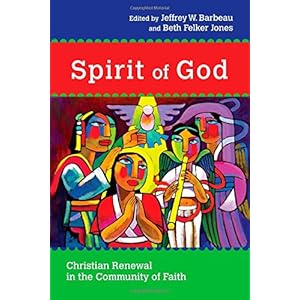
Book Review of Spirit of God ed. by Barbeau and Jones


Spirit of God: Christian Renewal in the Community of Faith


Spirit of God: Christian Renewal in the Community of Faith
ed. by Jeffrey w. Barbeau and Beth Felker Jones
ISBN 978-0-8308-2464-9
IVP Academic
Reviewed by Clint Walker

Spirit of God: Christian Renewal in the Community of Faith is a wonderful monograph about the theology of the Holy Spirit in the community of faith. In this text, the development of the theology of the Holy Spirit across a number of traditions as well as a number of epochs in Christian history are discussed (I found the discussion of the Wesley brothers' doctrines of the Holy Spirit fascinating).

This book is a treasure trove for the discerning reader. Do you wonder how Orthodox spirituality and Catholic spirituality developed different traditions, and how their theology of the Holy Spirit contributed to that? Have you wondered how the Reformed and the Wesleyan tradition approached the spiritual life differently? Have you thought about how a person could learn from a liturgical approach to Christian spirituality, as well as a Pentecostal understanding of the spirit at the same time? This book will guide you into a spirituality with stronger intellectual underpinnings, while at the same time helping you to grow deeper in your journey with God through the power of the Holy Spirit. I highly recommend it!

Book Review of The Master Musician by John Michael Talbot


The Master Musician: Meditations on Jesus
by John Michael Talbot
ISBN 978-0-8308-3697
IVP Books

When I was growing up, John Michael Talbot was a CCM artist. Of Methodist background I believe. Then, at some point, he converted to Catholicism. He has since went on to continue developing music, albeit with a little lower profile, and to develop a community called the Brothers and Sisters of Charity. In recent years, he has been using his gifts in communication to write books that challenge people to understand the spiritual journey in a thoughtful, contemplative, and yet contemporary way.

Talbot's latest book (which is reworked from an older version of the same text) is entitled The Master Musician: Meditations on Jesus. The book is a simple description of one's journey with Christ in three phases, guided by the metaphor of musicianship. Talbot says in the introduction:
"This work is divided into three main sections: God's grace, our human response, and life in the church. The first is liked unto the crafting of a fine guitar by a Master Musician. The  second, unto learning how to play under the Master's instruction. The third, unto learning how to play with others in the symphony orchestra or band."
I found this book educational, thought-provoking and spiritually nourishing. I learned a lot about the development of musicians, and how that process parallels the spiritual birth and growth of individuals. Particularly intriguing in this sequence to me was the movement from a "personal" relationship with Jesus, which is essential, to a relationship with God within the context of a community, and how the later step is the next step in spiritual maturity. This left a lot for me to consider in leading others to faith and to maturity in Christ as a pastor.

I recommend this book for people who are charged with helping believers grow, and especially for musicians and music teams which will be challenged in unique ways to help their teams grow in their faith.


Wednesday, July 15, 2015

Its gonna be alright--reflections on the Supreme Court's decision legalizing gay marriage


It was about two years ago when I was sitting with a group of ladies I lead Bible Study with on Wednesday morning. Several of our  ladies expressed concern about the liberal gains on the issue of gay marriage through the legal system. Fueled by the anxiety from their favorite news channel and political activists doing direct mail campaigns, the concern showed on their faces and could be heard in the elevated pitch of their voices.

My response was something like this, "Like it or not, this issue is not going to go away. As a matter of fact, it will not be long before homosexuals can marry in all 50 states. We as a church need to spend less time dreading the inevitable, and more time figuring out how we will respond to the world we live in."

As a Christian who believes that the Bible is my authority for faith and life, I believe that homosexual behavior is sin. There are times, when I am in a place of deep compassion for my LGBT friends and acquaintances that I struggle to understand why God's Word teaches so clearly on this matter. Once in a while I wish Scripture said something different because I think it would make things a lot easier. But God is God. I owe my allegiance to Him. I trust him, and I trust the Scripture as his authoritative Word. It is not my place to judge homosexual persons (or yours), to treat their sin as any more "dirty" and evil than any other sin, or to pretend like my struggles are any less profound. As both a believer and a church leader, though, it is my job to stand where Scripture stands on morality, and no amount of hermeneutical-hoop jumping can convince me that the Bible says anything other than behavior in the LGBT spectrum is contrary to faithful Biblical teaching.

The truth is, there are a lot of behaviors that are legal that are contrary to Biblical teaching. You can get drunk without going to jail. You can charge usurious interest rates, and be within the law. A person can solicit a prostitute in a legal brothel in Nevada. People shack up, commit adultery, gossip and cuss out folks, others let the hungry starve, and still others covet their neighbors oxen and asses. Just because something is legal, my friend Randy Rasmussen reminded me a few weeks ago, doesn't mean that it is right.

Just because we as believers cannot dictate ethics to our society through the legal system does not mean that we are at a disadvantage as a church, or that the rapture must be coming in the very near future, or even that we should be angry, concerned, or fighting for our rights more vigorously. There is no need to be anxious. God is on the throne. He is still our God. We now have an even clearer understanding of a truth we may have forgot. The United States is not God's chosen nation. We are not a theocracy. We don't obey the laws to worship the state. We are subject to civil governments in order to be good witnesses and so that we can live at peace with others.

Furthermore, while the state has "ordained" marriages that I do not recognize as biblical, it has done a great service to the cause of justice by allowing persons in same-sex relationships the same civil rights as persons who have covenanted together in more traditional marriage. Just because a person does not approve of same-sex marriage as a sacramental act of the church does not mean that that same person cannot celebrate the fact that same-sex couples can now have the property rights, taxation rights, and rights relating to health care as those who are in marriage covenants that conform to the biblical standards.

God designed the church from the beginning to be a counter-cultural movement. To have a set of standards and values for those that covenanted with them that was contrary to the world around them. We have an opportunity as God's people to stand apart. To shine like light in the darkness. To engage persons who live in all sorts of different ways that leave them in bondage to sin, and share with them a different way--namely the way of Jesus. We don't have to scream or fight for our rights. We can simply stand apart as God's holy people. This is something that we have always been called to do.

Is the Primal Church the best church?

Image result for early church fathers

Lately I have been reading through the book Spirit of God: Christian Renewal in the Community of Faith (edited by Barbeau and Jones). As I have been reading through some of the analysis of the Patristic theologians, I began to ponder, "What if the early church is not necessarily the ideal church?"

Maybe the Holy Spirit has a unique way of working throughout history to help the community of believers grow in their faith in certain ways throughout the centuries. Certainly, there are ways that believers throughout different epochs of history, including our own, have drifted away from the true message of the Gospel and true practice of the faith. But, is the early church really our role model of what the church should be about? It seems to me they got a lot of things right, but they had a lot of struggles in their time, perhaps as many as we have today. Why do churches make such a strong appeal to say that they are the most like the first church, and therefore their expression of the faith is the most valid?

Just a thought.

Tuesday, July 14, 2015

Best Time of the Day

What is the best time of your day? What part of the the day are you most "on"? When is that time when you are the most thoughtful, productive, and in the best place emotionally and spiritually? In the old days I might have said that would be from about 10pm to 2am. I would settle in from a day of work and running around, grab a bag of Doritos and a Slurpee or a Mountain Dew, and start plugging away. This is the time when I could write the best, and it was also the time when I was most creative.

Now, a few years later, after having kids and while I am still struggling through some trying times in our life together as a family, I am left to ponder, what is the best, most productive time of the day. I am not sure I can answer that. In the early morning it takes we awhile to get up and get going. I can still get some good stuff done in those late hours, but most of the time I am too tired to do much after I get the kids to bed. 

If hard pressed to say when I can get my best work and thinking done, I would say right now it is somewhere between 10am and 2pm.

What is your best time of the day? And how has it changed over the years?

Friday, July 03, 2015

On being a ministry screw-up


I feel like a failure. My wife says I am not. My executive minister says I am not. My mentor says I am not. (Ok, my mentor and executive minister are the same person) It does not help much. I have prayed something similar to the prayer that J.R. Briggs quotes in his book "Fail" lately,
"Lord, I will do anything--make deliveries for UPS, sell insurance, work in a warehouse, work construction, substitute teach. I'll do anything, except ministry."
I say this for a while, and mean it. But, deep down, I don't feel like God has relinquished his call on me, either in this place or in ministry as a whole. But, there are days and moments where all I want to do is run as far away from here as I can.

Part of the reason I feel like a failure as a pastor and worthless as a human being has to do with the measurable statistics of ministry. Attendance is down at my church from 5 years ago (I got here 3.75 years ago). We struggle with giving, although this is the first year we have been in the black at this point in over a decade. Baptisms are not plentiful. Professions of faith are few and far between. Ministry initiatives often show short-term momentum, but fail to develop long term viability. Its heartbreaking. And, it is clear, everyone thinks it is my fault. And much of the time I am a part of the "everybody".

If I was smarter, better, more charming or more energetic then.....

I go to ministry workshops. They seem to be designed to hone my skills. Instead I go deeper into the hole of despair, hearing the success stories of churches around the country. Their programs and methods don't seem so viable in my setting. We are trying new things, but the decline continues, ever so slowly.

 I don't know how to turn it around. In my head I don't believe it is all my fault. I tell myself I can't do everything--because I can't. Our church is aging. Decline and growth in churches is exponential. Exponential forces are challenging ones to fight against.

In my heart I feel I am to blame. People are eager to point out why they think I am to blame as well. My weaknesses are apparent, and I was upfront about them from the start when this church hired me. Managing administrative details is not my gift.

I'm just a frickin loser.

Another reason I feel like a failure is that I feel very alone in the work I do. In the last four years I have had to confront several difficult leadership decisions and wave after wave of challenging circumstances.

The challenging professional circumstances include:


  • A decision to change from two services to one service after I had agreed to candidate at the church and before my arrival.
  • Blatant lies stated about me and my family by staff people and people in lay ministry leadership. Some of these people harassed my family around town, threatened bodily harm, and engaged in stalking behavior outside of my home.
  • Key lay leadership who brought me into service here in South Dakota has continually tried to undermine me. Behaviors such as having the previous pastor talk to me about how he did certain ministry work, refusal to follow through on commitments in a way that left me holding the bag at the last minute wondering what happened, occasional boycotting of church, vicious gossip, working behind the scenes to sow discord, and frequent volital emotional outbursts directed toward me have made my work extremely difficult
  • Having to confront religious groups attempting to take over outreach ministries that were housed in our church. These religious groups had a different faith perspective and mission than our own, and were even invited to participate if they would take specific steps not to identify or promote their religious perspective in our congregation. They refused, and several people are still angry with us for asking them to do so.
  • Staff member compelled to resign because of clear boundary violations with people in ministry care
  • Another staff member publically shaming me in worship, disregarding and disobeying direct instructions, and taking leave without communicating with me about it beforehand. Church leadership on such matters instructed me to ask her about her work agreement about such matters. I was told that it was unfair to ask about these things, and that she would take leave whenever she felt she needed to, but that no provision about paid leave could be a part of her job description. For probing for clarity about this situation, I was confronted in my evaluation forcefully, and mandated by the committee to find a mentor pastor as a punitive and remedial measure. Initially, further more aggressive punishment was mandated and the pastors mentioned below were suggested as mentors, but when this was confronted in a follow up meeting those items were rescinded.
  • An inability of the previous pastor and family to either fully engage or completely disengage from the church while still living in the community. They are incredibly gifted and likable people. I like them. But, they kind of hover around. and I find their continuing engagement with both difficult issues and with people in the church challenging and troubling. Ministry is challenging enough without having to compete with the former pastor who has a lengthier relationship to the people there. Also, the family's continual engagement with difficult people causing problems in the congregation fuels their disention instead of healing it.Then, they were also placed in another church in this community by their denomination, bringing some constituents of their former church (where I serve) to their new church. 
  • Another pastor affiliated with our congregation that takes funerals of church members without even including me in part of the service, a clear violation of his denomination's code of conduct, and a clear affront to me.
  • The recent resignation of an under-performing staff member still has me reeling. I am struggling with this not so much because of the difficulties that staff member had, but because of the way that the committees I am accountable to on such matters have responded. I checked and double checked with them to make sure my response to circumstances was in accordance with what they wanted done. Then, when I followed through with doing things the way that they requested, they would not stand with me or take any responsibility for addressing the shortcomings that they wanted me to confront. The team handing such matters kept concerns secret from me from over a month, meeting in the room with one another and the employee directly outside the parsonage window. They gave me a little helpful constructive criticism. They told me to continue the process of confronting and documenting her, but wanted a paragraph added to a disciplinary letter that none of them would sign there name to. In addition, they wanted to send me to class to address short-comings that they would not clearly identify for months, and still are not in agreement about. They also developed a lengthy manual about how to deal with these matters and other matters in the future.
  • We are criticized about not bringing in enough young people, but when we do so, and they attend church, many of them are treated coldly and not greeted by many in the congregation, which makes them feel unwelcome
  • In addition to this, with our lack of lay initiative and leadership, and our demands to get things done, I feel like everybody expects everything of me, and I have very few standing with me or beside me. And some of the people that are really pushing hard are stretched pretty thin too. I like working and leading collaberatively. I haven't found a way to pull that off here.
In addition the following personal challenges have also had to be dealt with:
  • A difficult pregnancy, a baby born and placed in NICU, followed by post-partum depression with Jennifer
  • My wife developing cancer and going through cancer treatment. I am not supposed to feel any sense of difficulty through this time, but I do. I feel like I did a lot to hold things together. I was glad to do this. I love my wife and my kids. But, I also felt like I was never able to recover, heal, or whatever from everything that I experienced in my role as a caregiver. Everything just went full on ahead, and I was left behind, exhausted, emotionally spent, and alone. None of this is really anyone's fault. I am not wanting to express blame here, but the circumstances do contribute to my sense of failure and aloneness. Why couldn't I be stronger? Why can't I adapt better? What's wrong with me? I feel I am a selfish jerk for ever having difficulties with this. After all, I wasn't the one that was sick.
  • My wife's job switching from part time to full time soon after she recovered from cancer surgeries and treatment, which meant her being gone 7 weeks so far in the last 9 months for training and meetings. This has also been challenging because my parenting philosophy and my wife's are different in this matter. I believe kids need more time with parents and family at home. My wife feels that two working parents with children in daycare is normative. My views of family responsibility are enmeshed with who I believe I am supposed to be as a minister and who we are supposed to be as a minister's family, as well as deep seated feelings of issues of abandonment and loss from my childhood.. I am unable to communicate this effectively, which leads to alternating feelings of anger and despondency. 
  • Because of my wife's success in her job, which I am very proud of her for, I feel like we are committed here for a while. This makes me feel trapped and doomed for failure. I can't run away to the next challenge so easy.
  • My father has made contining efforts to disconnect from me personally, emotionally and socially. This makes me feel deeply ashamed of myself as a person. Why am I so vile? Why have I constantly just been thrown away like this by someone who is supposed to accept, love, and care for me no matter what? My father has not made an effort to even meet my youngest child. My reactionary mind tells me that my child is enduring this because I am such an awful son and person.
  • Difficulty on my part to truly make friends in the community or develop any more locally based professional or peer networks. I am social with folks. I am friendly. But I am also isolated in my role as a pastor, have nobody to really just hang out with as an average guy who also wants to be around me, and thus feel not so much lonely, as very isolated and alone in life. I don't know if that makes sense to anyone else, but it makes sense to me.
The other day, when I told one of the denominational supervisors I was discouraged, he asked if I was discouraged or depressed. I said I wasn't sure I could answer that in the moment, but that I would consider his question. It was an insightful question. There may be depression I am dealing with, but I guess I prefer to call it discouragement because its triggers seem to be external, and in my experiences most people who are clinically depressed have internal stuff going on that does not allow the cloud to lift even when circumstances are more ideal. I think I am more prone to a melancholy personality. So...anyway.


Saturday, May 09, 2015

Book Review of A Second Shot of Coffee With Jesus by David Wilkie


A Second Shot of Coffee with Jesus
by David Wilkie
ISBN 978-0-8308-3693-2
IVP Books
Reviewed by Clint Walker

For a few years I was a devoted follower of Coffee with Jesus on Facebook. Then, the first book came out, my friend list increased on Facebook, and I did not see much from my Radio Free Babylon feed. So, when I got A Second Shot of Coffee with Jesus I was excited to see what the latest Word was from the witty and somewhat offbeat comic strip.

I was pleasantly surprised that the strip maintained its high quality, and yet at the same time Coffee with Jesus seemed to grow up a little bit as well. In my opinion, the early version of the messaging of Wilkie tending to lean heavily on pointing out some of hypocrisy and ideosyncracies of the contemporary Christian church. The strip certainly continues this theme from time to time, but it has developed depth and breathe that I did not anticipate. Wilkie has continued to be humorous, but has also mixed in some general cultural criticism and some pretty thoughtful messages about God's grace and love. Also, some thought provoking insights about spiritual warfare. I have enjoyed this book thoroughly.

For those who enjoyed the first book, this "second shot" eschews thematic messaging for volume of comic strips. Some of them have appeared online, but there are others that were saved specifically for this book.

My only criticism of the book has to do more with my age. The print seems awfully small in this book (with the strips), and it takes some effort for me to read that print at times. Nevertheless, it will sit out on my desk, and eventually my coffee table, should I ever get one.


Thursday, May 07, 2015

Book Review of Spiritual Equipping for Mission by Ryan Shaw


Spiritual Equipping for Mission: Thriving as God's Message Bearers
by Ryan Shaw
978-0-8308-3672-7
IVP Books
Reviewed by Clint Walker

I recently went to a wonderful retreat led by a missionary serving my denomination in Mexico. He began to share about how he had been serving tirelessly on the mission field, and encountered a good measure of success in his ministry there. Yet, at the same time, he felt he was spread more and more thin in his ministry. He was doing and going for the Lord, and yet he felt less connected to the practices and disciplines that brought him strength and spiritual health in his missionary journey. The retreat leader spoke about how God led him to a place of spiritual renewal in his ministry, and how he has been called to help other ministers and missionaries grow deeper in their spiritual journeys as well.

Ryan Shaw in his book Spiritual Equipping for Mission has similar concerns to my new friend. As a leader of a student missionary movement, he sees that many people on the mission field need equipping to grow deeper in their faith if they are going to have sustainable journeys as message bearers of Jesus and if they are going to form disciples instead of simply making converts. This book is focused on helping cross-cultural ministry servants, but it could be equally helpful for gospel message bearers in local churches in the United States.

Shaw chooses to use the term "message-bearers" to refer to missionaries. He discovered that the term "missionary" has a top-down, negative, and colonial connotation. So the term message bearer is used for those in cross-cultural ministry in this book. This terminology has the added benefit of being more holistic. It speaks of a missionary as one who comes and lives and embodies the kind of life that Christ offers by what they say but also by how they live. It speaks in terms of identity instead of task. I think this is brilliant.

Most of the book details each of the 10 spiritual disciplines of cross-cultural message bearers. These include:


  • Being saturated in the powerful presence of God
  • Embracing humility
  • Hungering and thirsting for God
  • Being clothed in God's Word
  • Discerning God's Guidance and Revelation
  • Pursuing a Lifestyle of Prayer
  • Cooperating with God's twofold purpose
  • Understanding the Times and Seasons of God
  • Persevering with Steadfastness and Stability
  • Pursuing a Focused Life
This will be a great guide, not just for international missionaries, but for each believer on a mission to bear the message of Christ to the world.


Friday, May 01, 2015

Book Review of Busyness: Finding God in the Whirlwind by Juanita Ryan


Busyness: Finding God in the Whirlwind
by Juanita Ryan
ISBN 978-0-8308-3107
IVP Connect (Lifeguide Bible Studies)
Reviewed by Clint Walker

Ever felt like you are so busy that it is difficult to discern and sense the presence of God in the middle of the whirlwind of activity and conflicting expectations? Juanita Ryan has too, and she has developed a Bible Study for people and groups of people that struggle with finding God in the midst of a hectic life.

While I might council many people living in the middle of a whirlwind that they need to ruthlessly eliminate hurry from their life, as Dallas Willard once advised someone he was mentoring, I do think Ms. Ryan presents to the church a valuable resource. She speaks to people in the midst of their busyness, and challenges them to set priorities, rest, and choose joy and service over bitterness and being self-serving. Since so many people feel so very busy in our world, this might be a good place to start to connect with people and begin to challenge them to bring Christ-centered practices in the midst of their personal chaos and find refreshment and healing.

A great new resource for small groups from IVP!

Book Review of Feasting on the Word: Guide to Children's Sermons by David L. Bartlett and Carol Bartlett


Feasting on the Word: Guide to Children's Sermons
by David Bartlett and Carol Bartlett
ISBN 978-0-664-23614-8
WJK Books
Reviewed by Clint Walker

Much of the Feasting on the Word resources feature highly practical worship resources for mainline churches. While focused on a practical matter of worship, the particular resource is more of a training manual on how to develop and present children's messages in church services. At the end of the text, there are a few dozen children's message manuscripts.

As one reads through this thoughtful book, one is challenged to think through a number of questions that the author's present in training their readers to work through the service. Some of those questions included are:

  • Should the person doing the children's message focus on the lectionary texts?
  • How do we develop intergenerational connections during worship?
  • What is the role of story in relationship to the children's message?
  • What issues and stories are appropriate for a children's message and what ones are not?
  • How should developmental concerns influence how you present children's messages?
  • How do you craft an effective children's message?
I enjoyed this book and its challenging the church to create better children's sermons. Yet, at the same time I know that what is here will be too heady and conceptual for many folks who deliver children's messages. This is not a book that will give you a quick fix for grabbing a children's message just before church on Sunday morning, but it will help pastor's craft children's messages with theological integrity and meaningful teaching for youngsters. All in all, a great book to have on my shelf!


Monday, April 27, 2015

Book Review of Pray for the World


By Jason Mandryk
ISBN 978-0-8308-3686-4
IVP Books/WEC International
Reviewed by Clint Walker

Many Christians over the years have been blessed with the ministry of Operation World and their production of an extensive prayer guide that teaches us to pray for our world, while at the same time educating us to what is going on in the world. That guide leads prayer warriors through a daily prayer routine that helps them pray though the year for each country alphabetically.

Pray for the World is a more succinct prayer guide from the people at Operation World. This abgridged resource will be helpful for many people who want to pray for the world, but found carrying around a book much larger than their Bible a little cumbersome. Pray for the World organizes prayer themes by location in the world instead of by alphabetical order, thus giving its reader a guide to pray for a specific region through going to a certain section within the book. And the way it is organized lends itself to people being able to use this prayer guide as a reference source for global prayer, instead of a daily devotional guide. I really like it.

This, is a great resource to use in the life of the church. One could easily resource prayer groups, worship teams, and small groups with this guide to prayer. It would also be a great orientation to prayer for people in your churches that are considering short-term missions in an area of the world. I will keep this next to my denominational guide for prayer and missions, and refer to it often. 

Tuesday, March 17, 2015

Book Review of Money and Your Ministry by Margaret Marcuson


Money and Your Ministry: Balance the Books While Keeping Your Balance
by Margaret Marcuson
ISBN 978-0-97643566-4-5
Published by the Marcuson Leadership Circle
Reviewed by Clint Walker

In the last couple of years I have read several books on church stewardship and finances. Since there was very little education about such matters in my ministerial preparation and theological education, I have had to learn as I go on such matters. Margaret Marcuson is a writer I am acquainted with, She is a member of my denomination, and works in a part of the country that I was born in and would love to return to. She is a strong and gentle soul. I have learned to trust her wisdom.

Much of her work has been about helping ministers be more effective in their work by helping people be more aware of how the church functions as a social system and a family network of sorts, and this continues her work in that vein. Specifically, this book addresses how churches, leadership boards, and pastors function around the issue of money. True to form, Marcuson encourages churches and church leaders to come to know themselves and their history(s), learn what deeper meaning financial issues have for your faith community, and know where God is leading you and your church, and to adopt some basic principles and practices that will help you in your journey toward a healthy approach toward church finances in the future,  Ms. Marcuson's wisdom will not help your congregation get rich quick, but it might help your church deal with habits, challenges, and opportunities in church financial management with discernment, unity, and intentional wisdom that you may not have approached such matters with before.

Each chapter, in addition to having good insight, has a checklist that will help its readers implement the principles in the ministry of the reader's church. I thought this was very helpful. Not heavy handed at all.

I recommend this book to church leaders of all sorts of backgrounds. It has a lot of helpful words, and some thoughtful guidance on a challenging issue for most churches.


Wednesday, February 25, 2015

Book Review of Feasting on the Word: Lenten Companion edited by David Bartlett, Barbara Brown Taylor, and Kimberly Bracken Long


Feasting on the Word: Lenten Companion--A Thematic Resource for Preaching and Worship
edited by David Bartlett, Barbara Brown Taylor, and Kimberly Bracken Long
ISBN 978-0-664-25965-5
WJK Books
Reviewed by Clint Walker

Quietly, Feasting on the Word and Westminster John Knox Press are becoming the go-to resource for pastors and worship leaders who are seeking high quality, biblically-grounded resources to guide them their study and liturgy. This newest Lenten Companion is another great piece to an already irreplaceable series of resources.

The Lenten Companion, like the Advent companion, does not directly follow the Revised Common Lectionary (RCL). Instead, provides readings, resources, and commentary based on a set of Lenten readings that focuses on the Gospel of John on Sunays, and on a broad view of fasting through Midweek services. For Weekend services, there is also an old Testament text that is provided, but there is a strong emphasis on the word and works of Jesus during Lent, as is appropriate.

The resources are organized in chronological order. The weekend service materials begin the companion and include liturgical resources, a children's sermon guide, song suggestions, and a fourfold biblical commentary for both the Old Testament and New Testament texts.

The midweek resources are more scripted. They do not include items such as a children's message. They do include a homily that is already written for the preacher to use if they choose.

The Tridium resources are also available for Holy Week (Maundy Thursday, Good Friday, Holy Saturday). They are similar to the midweek service materials, but with a little more depth, in my opinion.

I am not using this resource this year. I was already hard at work planning Lent and its accompanying programs by the time I go to work on it. But if given the opportunity, I do plan to work with this resource in 2016. In fact, I am looking forward to it!

Monday, February 23, 2015

Book Review of Building Your Volunteer Team by Devries and Stratman


Building Your Volunteer Team: A 30 Day Change Project for Youth Ministry
by Mark DeVries and Nate Stratman
ISBN 978-0-8308-4121-9
IVP Praxis
Reviewed by Clint Walker

I was a youth pastor in some form for 13 years. For the last 7 years I have been a solo pastor of churches in Colorado and South Dakota. The last three school years I have been assisting with our youth ministry program while serving as the pastor. If I were to jump back into youth ministry again, I would grab a hold of this book and run with it, implementing the 30 day plan at some point very early in my ministry at my new church.

This book is written by the fine folks at Ministry Architects, a wonderful, thoughtful, research based operation that offers the best in consulting ministry for churches striving to build and grow their youth program. My experience with this organization was very affirming and helpful in my ministry. This book will be a great resource for people eager to build a team of youth ministers, and who at the same time are unsure on how to accomplish that lofty goal of building a ministry team.

Each week has a particular segment of this job to work on, and each day has steps to take in order to build the team in a month. By the end of the month, you should see progress. The back cover guarantees the process. If you purchase the book and don't like the results after thoughtfully implementing the steps, simply return the book and get reimbursed.

This book needs to be on every pastor's bookshelf, and every youth minister's bookshelf as well. It is just that helpful of a book.

Book Review of Faith is Like Skydiving by Rick Mattson


Faith is Like Skydiving And Other Memorable Images for Dialogue with Seekers and Skeptics
by Rick Mattson
ISBN 978-0-8308-4411-1
IVP Books
Reviewed by Clint Walker

When I was in college, my friend was trying to figure out relationship issues. He became my roommate, and we would check out Gary Smalley videos from the local library and discuss them. Smalley's videos described the process of using "emotional word pictures" with one's spouse and children in order to effectively communicate what was on one's heart. The idea was that the communication was more effective when one used these word pictures than when one simply used concrete statements. Rick Mattson takes a similar approach, and strangely enough he applies this approach to the task of Christian apologetics in Faith Is Like Skydiving.

Each chapter in Faith is Like Skydiving takes on a different issue in explaining and defending the faith. Each chapter has a phrase that is an easily memorable title. That phrase addresses a certain objection to the Christian faith with a word picture than serves as shorthand for an intellectual argument against the objection to faith. It is a brilliant idea. And it helps folks communicate what they believe well and remember what they have learned about defending the faith easily.

This would be a great book to read alone. It would be an even better book to go through in a group and discuss chapter by chapter.


Book Review of The Evangelism Study Bible


The Evangelism Study Bible
Notes by Evantell
ISBN 978-0-8254-2662-4
Kregel Academic and Minstry
Reviewed by Clint Walker

Each year there are several new study Bibles that hit the market. Some of them are oriented toward niche markets (hunters, housewives etc), while others of them are paired with new insights. The Evangelism Study Bible is oriented toward a mission, namely reaching unbelievers and convincing them to place their faith in Jesus Christ as their Lord and Savior.

Somebody did a lot of work in putting the notes to accompany this NKJV bible. There are several "verse notes" at the bottom of the page like a traditional Bible. There are many helpful cross-references. There are several larger articles within each book of the Bible speaking to how specific texts will be helpful to evangelistic endeavors or insightful in showing God's mission throughout Scripture. There are also several helpful devotional articles that one could use even in teaching and preaching.In addition to this, there are evangelism "tips" throughout the notes as well. The back of the bible has a guide to sharing one's faith with others. This study Bible also have a helpful concordance

I think this would be a great study Bible for either a person that wants to become a better evangelist, or someone who wants to use the many resources enclosed to reach their friends and neighbors and teach others to do the same.


Reformation Commentary of the Bible: Old Testament Volume XIII--Psalms 73-150

Reformation Commentary of the Bible: Old Testament Volume XIII--Psalms 73-150  Edited by Herman J. Selderhuis IVP Academic ISBN 978-0-8308-2...