
Showing posts with label books. Show all posts
Showing posts with label books. Show all posts
Friday, May 16, 2008


Monday, March 24, 2008
Sherman Alexie

I have been on a little bit of a binge on reading an author named Sherman Alexie. I recently read Reservation Blues, and loved it. I am now reading Ten Little Indians, which is a collection of short stories like The Lone Ranger and Tonto get into a Fistfight in Heaven. I also recently bought The Absolutely True Diary of a Part-Time Indian.
I love Alexie's writing for a number of reasons. First of all, as evidenced by a recent appearance on CSPAN, Alexie is just really darned funny. This comes through a lot in his writing.
Alexie is also really brilliant in how he does character development as well. When you listen to Sherman's characters, it isn't long until you feel like you know them. And if you are like me, you can easily identify them with people you know.
Another thing I love about his work is that most of it takes place in a place that I know and love, the Pacific Northwest. Having grown up in Oregon, went to high school in Alaska, and served a church for five years in Montana, I can picture the places and hear the voices he speaks about.
Personally, what I love the most about Alexie is that his protagonists are always outsiders. The are outsiders in the Indian world they belong to, and they feel like outsiders in the mainstream society of the United States. Whether is the the bookworm that loves poetry going to WSU, or the Urban Indian adopted off the reservation from Seattle, I feel a kinship with these folks because they are loners and outsiders like me. Whether it is black-native mixed political operative, or a miserable working mother who strives to escape her family and job through letting them assume she died in a terrorist attack, Alexie's characters seem to have a sense of not feeling completely at home anywhere, and yet becoming more and more at home in their own skin and their own identity.
I like this outsider motif because I also often feel like an outsider. And yet, I am becoming more and more comfortable in my own skin. In high school I was the athlete and the honor student at the same time, but never completely in either circle. I am an intellectual with a master's degree, yet was raised around loggers, mill workers, fishing guides. I love the country and rural america, but yet I do not have country boy blue collar skills.
Yet nowhere do I feel more like an outsider than in my calling. I serve churches as a pastor, and yet I am not a very churchy person. I believe that the Bible is the the Word of God and seek to live by it, yet I often feel discouraged as I see people trust in interpretations of Scripture from people like Tim Lahaye (Left Behind) or James Dobson (Focus on the Family). I don't fit as a liberal or conservative, a mainliner, emergent, or evangelical. The church in many ways is my home and my love, and yet I am perpetually an outsider to it. At the same time, my deep faith and my peculiar ethical commitments make me an outsider to the rest of the world as well. Alexie speaks to this journey, and teaches through his fiction about how you can live that journey with a unique joy and passion in the midst of the sense of grief and frustration one may have as an outsider.
Tuesday, March 18, 2008
"What About Hitler?" Book Club

I am a part of a book club looking at an interesting book called What about Hitler: Wrestling with Jesus Call to Nonviolence in an Evil World.We are taking the book one chapter at a time.
The first chapter of the book was about foundations of Just War Theory. Specifically, the author Richard Brimlow compares Tertullian's pacifism (pre-Constantinian) to Augustine's just war thinking (post-Constantinian).
One of the things that Brimlow shares that I think is accurate is that Augustine's development of Just War Thinking was really an apology for Christianity during the decline of the Roman Empire. Christians were being labeled as bad citizens, mostly because of the historic position of the early church to not participate in the military of police force of the Roman Empire. (p 23)In developing this apology, he goes against the historical teachings of the early church. In doing so, he also seems to go against the plain teachings of Jesus counseling non-violence that we see throughout Scripture.
This raises all sorts of questions for us today. First of all, it raises all sorts of questions about how we do theology, ethics and mission. I am firm believer that all good theology is theology that can be lived in one way or another. Yet, I wonder in what ways we also adapt our theology and ethics to fit our context, even when it goes against what appears to be the plain teaching of Scripture? It seems here Augustine clearly moves against the clear teaching of Jesus in order to make Christianity more pallatable to a nation that has adopted Christianity as its official religion. Does the gospel ever win when the interests of the state/government are enmeshed with the beliefs and mission of a community of Christ (the church) which is called to be prophetic and countercultural? I doubt it.
I wonder personally if I approach this issue faithfully here in Colorado Springs, CO. In our city so many people are either millitary or ex-millitary. And in this context, I do not stand on the street corners and preach the Biblical worldview of non-violence. I have shared my pacifist views with my senior pastor and some close to me here, but I do not go out to make it a focus of my teaching. It seems a little condescending to tell the Gulf War amputee that he was wrong to be in Iraq when I am just getting to know him.
Another interesting point that Brimlow brings to the forefront is the dualistic, platonist, and somewhat gnostic line of reasoning that Augustine expresses in the City of God, and specifically in his reasoning about "just war". Augustine seems to locate sin in sinful motive, and fails to recognize that some actions are sinful regardless of the motive of the heart. He specifically uses this line of reasoning in relation to warfare. Brimlow states his concern well when he says,:
It makes me wonder where we tend to do the same thing as well. How do we separate what we do from who we are, instead of seeing ourselves as whole persons? A biblical worldview does not let us choose with what part of ourselves to love God, but calls us to love God with our whole heart, mind, soul and strength. We cannot segregate our bodies from our minds, and label our bodies as bad and our minds and motives as good. This is true whether we are speaking about warfare, substance abuse, sexuality, or any other behavior. Because all of our lives in our bodies are spiritual lives, and all of our actions have spiritual and material consequences.
What do you think? How do you process through following Jesus who calls us to love our enemies and following a military leadership that urges us to kill our enemies on our nations behalf? What are your thoughts?
The first chapter of the book was about foundations of Just War Theory. Specifically, the author Richard Brimlow compares Tertullian's pacifism (pre-Constantinian) to Augustine's just war thinking (post-Constantinian).
One of the things that Brimlow shares that I think is accurate is that Augustine's development of Just War Thinking was really an apology for Christianity during the decline of the Roman Empire. Christians were being labeled as bad citizens, mostly because of the historic position of the early church to not participate in the military of police force of the Roman Empire. (p 23)In developing this apology, he goes against the historical teachings of the early church. In doing so, he also seems to go against the plain teachings of Jesus counseling non-violence that we see throughout Scripture.
This raises all sorts of questions for us today. First of all, it raises all sorts of questions about how we do theology, ethics and mission. I am firm believer that all good theology is theology that can be lived in one way or another. Yet, I wonder in what ways we also adapt our theology and ethics to fit our context, even when it goes against what appears to be the plain teaching of Scripture? It seems here Augustine clearly moves against the clear teaching of Jesus in order to make Christianity more pallatable to a nation that has adopted Christianity as its official religion. Does the gospel ever win when the interests of the state/government are enmeshed with the beliefs and mission of a community of Christ (the church) which is called to be prophetic and countercultural? I doubt it.
I wonder personally if I approach this issue faithfully here in Colorado Springs, CO. In our city so many people are either millitary or ex-millitary. And in this context, I do not stand on the street corners and preach the Biblical worldview of non-violence. I have shared my pacifist views with my senior pastor and some close to me here, but I do not go out to make it a focus of my teaching. It seems a little condescending to tell the Gulf War amputee that he was wrong to be in Iraq when I am just getting to know him.
Another interesting point that Brimlow brings to the forefront is the dualistic, platonist, and somewhat gnostic line of reasoning that Augustine expresses in the City of God, and specifically in his reasoning about "just war". Augustine seems to locate sin in sinful motive, and fails to recognize that some actions are sinful regardless of the motive of the heart. He specifically uses this line of reasoning in relation to warfare. Brimlow states his concern well when he says,:
When Augustine argues that it is the internal disposition of the soldier that makes the warfare either right or wrong, he introduces a division in our conception of persons and what it means to be a disciple of Christ that plagues the church to the present. To argue that the church is concerned with our souls while the state is concerned with our bodies...is to introduce a dichotomy that yields all sorts of dilemmas and unltimately leads us further from the Lord. This view can be used to sanction the participation of Christians not only in warfare but in other forms of violence as well, from recognizing the legitimacy of abortion to the exploration fo workers and eventually the commodification of all God's children. What matters, on Augustine's view, is the Chritian's internal disposition: all is permissible if we are only disposed to the right way.
It makes me wonder where we tend to do the same thing as well. How do we separate what we do from who we are, instead of seeing ourselves as whole persons? A biblical worldview does not let us choose with what part of ourselves to love God, but calls us to love God with our whole heart, mind, soul and strength. We cannot segregate our bodies from our minds, and label our bodies as bad and our minds and motives as good. This is true whether we are speaking about warfare, substance abuse, sexuality, or any other behavior. Because all of our lives in our bodies are spiritual lives, and all of our actions have spiritual and material consequences.
What do you think? How do you process through following Jesus who calls us to love our enemies and following a military leadership that urges us to kill our enemies on our nations behalf? What are your thoughts?
Friday, March 14, 2008
What Book Are you
You're Catch-22!
by Joseph Heller
Incredibly witty and funny, you have a taste for irony in all that you
see. It seems that life has put you in perpetually untenable situations, and your sense
of humor is all that gets you through them. These experiences have also made you an
ardent pacifist, though you present your message with tongue sewn into cheek. You
could coin a phrase that replaces the word "paradox" for millions of
people.
Take the Book Quiz
at the Blue Pyramid.

ht Marko
Monday, February 25, 2008

Friday, February 22, 2008

Thursday, February 21, 2008
Book Finished

'One of my goals in the coming year is to finish more of the books that I have started. This is a book I just finished, which was something I was reading and studying for Lent. Here are a couple of quotes:
Make no mistake! Sin isn’t a concept. It’s a living organism. (138)
Those with deep spirituality have a stong conviction abou their sinful natures (147)
The goal of righteousness is Jesus. (139)
Sometimes as we grow in grace, we get the feeling that we’re growing in sin. When this happens we shouldn’t yell to high heaven, we should give thanks. We should be grateful that God has saved us and called us to a righteous life. Now we understand Paul when he says to the Romans, “There sin increased, grace abounded all the more” (Rom. 5:20) (148).
Those with deep spirituality have a stong conviction abou their sinful natures (147)
The goal of righteousness is Jesus. (139)
Sometimes as we grow in grace, we get the feeling that we’re growing in sin. When this happens we shouldn’t yell to high heaven, we should give thanks. We should be grateful that God has saved us and called us to a righteous life. Now we understand Paul when he says to the Romans, “There sin increased, grace abounded all the more” (Rom. 5:20) (148).
Tuesday, February 12, 2008


Tuesday, February 05, 2008
Quotes from Deep-Rooted in Christ by Joshua Kang

God is more concerned with who we are than who we think we are. He doesn't care how many talks we do or how big they are. What matters is that we become what God wants us to be. (75)
Every spiritual leader needs discernment about God's time..God uses those that understand the times. (77)
To become a servant of God requires advanced study in how God uses lonliness; thats to say, how he teaches his students to reach spiritual maturity. (79)
Wilderness and Word have the same orgin in the Hebrew language (81)
Even Pharoh knew Moses was a man of prayer. When the Egyptians were suffering from the swarming flies, he asked Moses to pray for him. (85)
Before trying the hearts of other people, we should try and move the heart of God. (86)
Wednesday, January 30, 2008
Expose Yourshelf

I have recently become acquainted with Sue Spengler via blogland. She is working on a project called "Expose Yourshelf" where she is attempting to have the largest collection of visual bookshelf space in the world, or something like that. She recently added my bookshelves to her collection.
She would love to have you help her build her collection, just read the rules and send her a story with some pictures.
She also has a regular blog. I was touched by a recent post that I think you all should read about her spiritual journey.
She would love to have you help her build her collection, just read the rules and send her a story with some pictures.
She also has a regular blog. I was touched by a recent post that I think you all should read about her spiritual journey.
Thursday, May 24, 2007
On Religion by John Caputo
I picked up one of the books that was on my "order from the library", and it is a fun book to write. Written by the man who is the foremost interpreter of Derrida to America, Caputo here does some intelligent deconstructing of religion as a means of preserving the truth of the religious impulse. Very interesting and very accessable for a theology book.
Here are some quotes:
"Religion is for lovers"
"The opposite of a religious person is a loveless person" (he means this in a way that is meant to be inclusive of people from non-institutional religious structures).
"There is no merit in loving moderately" (4)
"Love is not a bargain, but an unconditional giving; it is not an investment, but a commitment come what may" (4)
"The religious sense of life is tied up with having a future"(9)
"Religion...is for the unhinged" (he means unhinged as a positive virtue)
"Religion on my telling is a pact or covenant with the impossible" (15)
I have been made a question unto myself (Augustine)
Non-Knowing is the inescapable element in which decisions are reached, which intensifies their passions (19)
The people of the impossible are also the impossible people (32).
Here are some quotes:
"Religion is for lovers"
"The opposite of a religious person is a loveless person" (he means this in a way that is meant to be inclusive of people from non-institutional religious structures).
"There is no merit in loving moderately" (4)
"Love is not a bargain, but an unconditional giving; it is not an investment, but a commitment come what may" (4)
"The religious sense of life is tied up with having a future"(9)
"Religion...is for the unhinged" (he means unhinged as a positive virtue)
"Religion on my telling is a pact or covenant with the impossible" (15)
I have been made a question unto myself (Augustine)
Non-Knowing is the inescapable element in which decisions are reached, which intensifies their passions (19)
The people of the impossible are also the impossible people (32).
Thursday, April 05, 2007
The Gospel According to Starbucks
 Just finished this book. It is, in many ways, a book that takes Sweet's method of coorperate spirituality set out in postmodern pilgrims and repackages it for personal spirituality, with the metaphor of Starbucks as a way to discover EPIC spirituality. Perhaps the most interesting chapter was the epilogue, called "Jehovah Java" which shared about the history of coffee in relation to both relgious expression globally, and the development of Western Civilization. I recommend at least picking the book up in Barnes and Noble and reading the epilogue.
Thursday, March 29, 2007
Lost In Translation

I had an interesting conversation with a friend of mine the other day. My friend has never really been that familiar with church, though she is growing to a place where she is getting more involved. Part of her journey is feeling like she needs to be a part of a Christian community and make her commitment to follow Jesus more formal and public.
As I was sharing how that would be done in our church, I came to the point where I felt compelled to share with my friend how to communicate her thoughts and desires to folks if she were to do that. I may have not needed to be a translator, but I think in the end if my friend decides to become a part of our church community what I shared will help her understand how to make that relationship a committed one. "Its sounds to me like you need to say that you have accepted Christ but feel like you want to make a 'profession of faith' and have never done that." Perhaps the reason I felt compelled to explain is because most of the lingo that our church uses here was foriegn to me when I came. As we were talking, I began to wonder, how many people are more than willing to be invested in a Christian community, but have their heart and desires lost in translation of a "Christian culture"?
This is what a lot of the book "They Like Jesus But Not the Church" is about. How do churches and Christians begin to break down barriers that are invisible to them but obvious to those who choose to avoid Christians and churches in the first place.
Something interesting to think about.
Tuesday, March 27, 2007
Purpose Driven Life

At our church we are just finishing up with the Purpose-Driven Life campaign. All in all it has been a very good experience for us. Worship has experienced a renewed vitality, and having our church all on the same page for several weeks has renewed our committment to one another. (This in spite of several challenges that have been set before us).
I just finished the book as well. I was dreading having to read the book and excited about digging into it at the same time. Most of the dread came from the fact that my theological/intellectual bent sees this book as kind of lowbrow and overly programmatic. Overall though, it was an excellent book and program.
I was especially moved today as I thought about the testimony of Rick Warren's dad as he died, and how he had to be restrained from his bed and desprately wanted to get up and find "one more for Jesus". Wow.
Friday, March 23, 2007
Book Review of Bell's Sex God

I just finished my study of the new Rob Bell book SexGod:Exploring the Endless Connections Between Sexuality and Sprirituality. All in all, I highly recommend it as a good read.
First of all, I think it is important to note, as Ben Witherington III did, that Bell's writing has greatly improved. Purely for reading sake, I enjoyed reading this book more than I did Velvet Elvis. While Bell's first book has some insightful, helpful words about what he thinks and believes, this book shows the heart of a pastor serving in a congregation of believers that struggle with their sexual ethics and behavior. In a graceful and compassionate way, he lays out what he believes to be a biblical view of sexuality.
Bell uses the word "sex" as a metaphor to communicate our embodied nature, and our desire to connect with one another in deep, meaninful ways. He spends a lot of time discussing romantic and marital relationships, but he also spends a lot of time connecting our ways of relating as sexual, embodied beings to the world around us in platonic, non-genital ways.
He tells some powerful stories, and does a good job at relating things that one would not connect with one another. Whether he is talking about Jessica Simpson and Nich Lachey, or he is talking about a releasing balloons at a wedding ceremony he officiated, he has a way of touching your heart and making you think at the same time.
My favorite chapters are "God wears lipstick", "Worth Dying For" (must read stuff for teen girls), and "Under the Chuppah".
I recommend taking the time to read and think on Rob Bell's new book, which I enjoyed as much if not more than the others.
Sunday, February 25, 2007
More Thinking on the Issue of Homosexuality

I have recently completed two books on the subject of homosexuality. One is edited by Walter Wink, and is called HOMOSEXUALITY AND THE CHRISTIAN FAITH. The other is called WELCOMING BUT NOT AFFIRMING and is written by the late Stanley Grenz.

Wink's book is affirming of homosexual behavior in the Christian community as an ethical lifestyle. Grenz seeks to have the church be as welcoming as possible without affiming that homosexual behavior is ethical according to biblical standards.
Wink's book had a few excellent points that I will have to give serious consideration to, however, I tend to lean more toward Grenz's book as the one that is more faithful to Scripture.
The affirming book tended to have a lot of good sentiment, but not a lot of strong theological foundation. It too easily skimmed over the writings of Paul on the matter, and then made an argument based on the silence of the gospels on homosexuality.
The welcoming book was well-written with cogent arguments, but needs a revision that speaks a little more to recent developments in historical scholarship on the issue of same-sex marriage.
All and all, the books when put together give a good picture of the issue as a whole.
Friday, January 26, 2007
Surrendering

I have been reading THE PURPOSE DRIVEN LIFE in preparation for our 40 DAYS OF PURPOSE here at First Baptist. And I was just reading the chapter about the importance of surrendering ourselves to God's will. In the chapter, it emphasized the concept (although this was not explicitly stated) of downward mobility. Simply put, downward mobility means that part of following Jesus is being willing to surrender ourselves to God's will no matter where that leads us. Often that means being in places that are insignificant, doing things that seem insignificant, instead of pursuing things like financial security, power, and the noteriety and admiration of others.
When I came here, I kept feeling like I was supposed to go to the place I was most needed for God's , a place where there were challenges, instead of a place of glory and significance. So I came to Colorado Springs, feeling like I was surrendering myself. I kept thinking that somehow, someway God would use me for his greater purpose. And then I would be rewarded.
I did not expect that the way of surrender and downward mobility feels like you are going through a very long tunnel, and that when you are in the middle of it your vocational hopes ahead look as dark as forboding as looking behind you. In other words, I thought the challenge would be to go somewhere where you were really needed , and then somehow the bliss of knowing you were in God's will and doing what God wanted you to do would carry you through. What I did not know was that somewhere in the middle of the journey of downward mobility you would feel alone, doubt you heard God right, and struggle just to keep your chin above water emotionally.
Yet, somehow thinking again of this decision process has given me encouragement and hope that I in someway was doing the right thing in at least attempting to be obiedient by coming here and staying here as long as I have. There is still the hope, though, that something new comes along soon.
Tuesday, January 16, 2007
Taken By Surprise
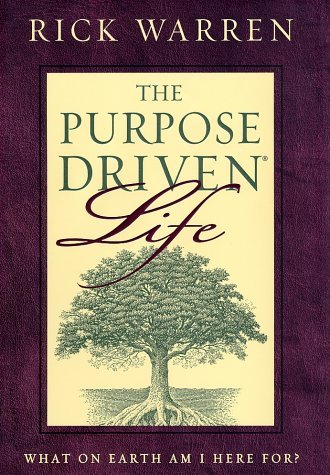
We are starting a Purpose-Driven Life Campaign on February 17th at our church. There are a lot of exciting things going on with the program, namely it is getting several of our church people off their rear ends and hard at work doing something productive to support their church instead of simply being pew fodder. Furthermore, we are all working together on something, which builds a little bit of momentum for us.
So, in order to be on top of things that are happening in my church, I have been reading ahead in the book. And, to my suprise, I am enjoying reading it a lot. Especially bit by bit as it is designed. Usually, I am a book snob, and choose not to read stuff that everyone is buying at the Christian bookstore. Thus, I had a little apprehension when I started reading it. But, I have been pleasantly pleased by what I have read so far.
One thing I like is that the book is written so that what you are to remember is in the first sentence of every chapter. It is a lot like most of us were taught to write two to three page essays in high school.
It is also good at relaying simple truths of what living the Christian faith is all about. It is not so much about twisting your arm into a decision to follow Jesus as it is inviting all people, no matter what age, into a process of choosing to follow Jesus by beginning to put some basic principles that he taught into practice.
Wednesday, December 13, 2006
Current Reading: Welcoming But Not Affirming
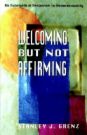
I just finished reading "Welcoming But Not Affirming: An Evangelical Response to Homosexuality". It is a comprehensive book that states this position well. It is written by the deceased Stanley Grenz, who was a prolific writer and theologian.
Perhaps most interesting in his thesis was the relationship throughout human history between faith viewpoints and the related sexual behavior to that faith viewpoint. His position is that one's views and behavior sexually in some strange way almost always integrated to one's spirituality/relationship with God. In the process, he shows historical basis for "ritual enactment" across cultures, and then points out Scriptures to show that one's sexual behavior is intimately tied to one's worship life. This kind of creeps me out, but it also seems to have a lot of truth to it.
Overall, it was helpful in giving me some perspective about related community issues and struggles our church is having.
Friday, November 17, 2006
Pretty much the best recording of the New Testament ever

I have been listening to the book of Acts with the Bible Experience and am amazed at the excellence of the Bible on CD that I am listening to.
Most Bible recordings of the Bible are a little bit cheesy. They have a few celebrity readers, but they tend to be overdramatized or just plain boring.
Neither is the case with the Bible Experience. The quality of readership and the production is unparelled in similar products. Listening to many of the best actors and artists of our time read the Bible is a sure treat.
Be sure to put this on your Christmas list if you have not already.
Subscribe to:
Posts (Atom)
Reformation Commentary of the Bible: Old Testament Volume XIII--Psalms 73-150
Reformation Commentary of the Bible: Old Testament Volume XIII--Psalms 73-150 Edited by Herman J. Selderhuis IVP Academic ISBN 978-0-8308-2...

-
On Getting Out of Bed By Alan Noble IVP ISBN 978-1-5140-0443-2 Reviewed by Clint Walker Have you ever gotten a good night’s sleep, and stil...
-
Book Discussion: The Shack Overview Questions If you were to rank the book: THE SHACK on a scale of 1-5, what would you rate it and why woul...

