A lot of people don't get their vocabulary right regarding the kind of guidelines and restrictions they are subject to with COVID-19. Here is a helpful reminder.
If you are in one of about six states that are simply enforcing the CDC guidelines, you are not under quarantine. You are under social distancing guidelines, or laws. You are able to get out. You are able to drive through the drive-thru for meals. You are able to order from Walmart online, and then run to town to pick up your order.
If you are on a stay-at-home order your life may truly suck. But you can still interact with your family. You can go for a walk. You can move freely about your property. You are simply not to congregate with others, and stay home as much as possible.
If you are quarantined, you are generally a COVID positive or a potentially COVID positive person. You are most likely banished to one room of your house, or if you have a big house perhaps the entire basement. You have restrictions on using the restroom, on how you touch door handles, etc. etc. This really sucks.
My pet peeve is persons who get frustrated about not going to church, or being able to congregate in a bar, and then say they are under quarantine. They are not. Quarantine is a much different thing.
End of rant.
Tuesday, April 28, 2020


Thursday, April 23, 2020


Friday, April 17, 2020
Book Reveiw of The Church of Us vs. Them by David E. Fitch

The Church of Us vs. Them: Freedom from a Faith that Feeds on Making Enemies
by David E. Fitch
ISBN 978-1-58743-414-3
Brazos Press
Reviewed by Clint Walker
Stanley Haurwas is quoted as saying, "I say I’m a pacifist because I am a violent son of a bitch." It is one of my favorite quotes from the highly quotable Hauerwas, and it is even better if it is quoted in its larger context. What he is saying, as I read it, is that the strongest core of his theological convictions are the truths that challenge and convict him the most, and call him into a deeper journey of Christlikeness.
I think if a person caught David Fitch in a candid moment, perhaps while drinking some wine and smoking cigars and swapping stories about fellow practicioners in the missional church movement, he might say something similar to Haurwas as it pertains to the content of The Church of Us vs. Them. Having spent his formative years in the Canadian industrial town of Hamilton, Ontario, Fitch's earthy vocabulary paired with his wiry physique reflect the scrappy nature of that blue-collar town. This book is a more accessible explanation of his thesis in The End of Evangelicalism? where Fitch challenges his readers to not get drawn in to the ideological antagonism that permeates both our political lives and our ecclesiastical enclaves. In both teaching and living these truths, it becomes easy to see how Fitch's naturally contentious temprament is mitigated by his conviction that God calls us to reconciliation and to embody God's gracious presence.
The Church of Us vs. Them calls us to a place beyond making enemies by making its readers aware of how ideology functions. Drawing closely upon the philosophical work of Slavoj Zizek, he presents examples of how groups of people lift up symbols, place upon those symbols their tribalistic ideology in such a way to where the object being argued over becomes emptied of its original meaning through how it is weaponized in social discourse.
One example Fitch used to make his point about enemy making and moving beyond enemy making is how we use the language of being "biblical". For most of church history, with some notable exceptions, the authority of Scripture could be assumed. As our culture has changed, and people's assumptions about truth have changed, Christian leaders have weaponized their understanding of Scripture of authority to create groups of "insiders" and "outsiders".
This is not the only way that the church resorts to idealogical tribalism. There are a number of practices and symbols that should unite believers that have been transformed by Christians, especially those seeking power, to create an "us" vs. "them" divisions among neighbors, friends, and siblings in Christ.
The position of this book is that we need to step aside from the antagonisms that divide Christian believers and neighbors by getting to know each other, listen to each other, and love one another by being present with each other and truly listening and understanding God and each other together. It is a lot harder to call someone an enemy when you have shared your table with them, and they have helped you reconstruct your deck after last windstorm blew over part of your tree on it.
I recommend this book highly. Even though it is a "dumbed down" version of another book, it is still challenging to both understand and apply the call that The Church of Us vs Them sets before us. It is not an easy promting from Fitch toward a deeper journey of discipleship, but it is an important one.
Book Review of A Life Without Lack by Dallas Willard

A Life Without Lack: Living in the Fullness of Psalm 23
by Dallas Willard
ISBN 978-0-7180-9185-9
Published by Nelson Books (Thomas Nelson Publishing)
Review by Clint Walker
This book is a collection of the teachings of Dallas Willard on Psalm 23. It has been published posthumously, and edited by a friend and a family member in order to present the material as a book.
This book shares some themes with many of Willard's earlier books, but with a focus on this classic Psalm as a guide for the abundant life that comes from faith in Jesus.
Perhaps because this book is drawn from a series of talks, it has the feel of a more intimate and personal conversation than many of his other books. It is also immensely practical, challenging his readers to engage in some practices to walk daily with God, the Good Shepherd.
I highly recommend this book!
Saturday, April 04, 2020
Ministry life in the COVID days
Ministry is different these days. We are under COVID restrictions. We cannot gather in groups (mostly), and we we need to stay 6 feet away from one another. Yet, here at First Baptist Church we are soldiering on, trying to keep people connected to God and to one another in love the best we can.
These restrictions mean that most churches, including ours, are suspending our weekly gatherings in the sanctuary. We have been keeping our office open, although this week we did have a person who was potentially COVID positive in our office space--which made things a little nerve wracking for a moment or two. Thankfully that person was negative, and the moment has passed.
There are a few things, as I reflect on ministry right now, that COVID has brought to mind.
- Ministry is about presence--I know this truth as a pastor, until you can't be present with one another. Then you realize how important being present, praying face to face, hearing one another's voices, and sharing embraces with one another really is.
- Ministry is about touch--I never realized how much I touched people until I could not touch them any longer. On March 15, we had a service together that was very restricted in touch and in movement. It was so hard not to shake hands, give hugs, put hands on shoulders, and have conversations that were socially distanced.
- Ministry is about rhythym--I don't mean that ministry has to have a good bass line in its worship sets. I think it does, and most Christian music fails in that regard, but that is another post. What it means is that most of us, despite the interuptions find a rhthym to how we do ministry. We get certain things done at certain times. We have part of our schedule routinized. We have time for study and prayer, and time for visits, time for community involvement, and time for leading meetings, studies, events, etc. And time to prepare for all of that. When COVID came, our rhythm changed. It forces us to be adaptable, which is good. But at times it feels like without a regular structure and rhythym, that my productivity and life-flow is messed up. My wife and I have been sharing, even with both of us working, that each week seems like a month or two when we are social distancing.
- Ministry is about relationships--This is so much harder when you can't have your breakfast together as a men's group, or when you can't visit the homebound.
- Ministry is about Jesus--One of the things to begin to consider, and it is hard in a traditional church like mine, is just how much of our experience in faith is grounded in tradition and an attractional business model, and what we should take the opportunity to change to be more about knowing Jesus and making him known in honest meaningful relationships and personal connections.
I still have hope that we will come out of COVID stronger. But it is, right now, a strange new world.
Wednesday, March 11, 2020
Ideology, Socialism, and American political landscape
The supervisor of my doctoral program, Dr. David Fitch, wrote a book that I plan on reviewing sometime very soon, that details how ideologies can and often do develop into enemy-making machines. It is a thought-provoking, brilliant book. I have been thinking a lot of it in relationship to the label "socialist", and the difference in policies between more conservative, moderate and more liberal persons in the political arena.
First of all, it is probably appropriate to share where I am coming from in the American poltical landscape. I was a registered Republican until 3 years ago. In truth, I am probably more independent, but I want a voice in the primary process so I chose the the Republican party. My ties with conservatism are fairly straight forward. I am pro-life and anti-abortion. Often I am for lower taxes and smaller government. In my time I voted for Republican candidates and Democratic ones. Where I grew up, Republican was synonymous with populist, and democrat with elitist. I changed my party affiliation a few years ago, reluctantly, because I felt the Republican party had drifted too far to the right, being driven by the racist and xenophobic leadership of Donald Trump.
Anywho, that is just so you know I have a point of view.
So, let me restart, I want to talk about the intersection of ideology and politics. Particularly as it relates to the term socialism. Because language meaning is fluid, socialism has come to have multiple meanings. Because of the nature of ideology, socialism has become a master signifier that has been stripped of a lot of its meaning as persons seek to villify others with the term.
Very few in our political world are completely against integrating elements of socialism into our government and society. Most Americans support social security, medicare, and many support medicaid. Most farmers support farm subsidies. Many businesses are beneficiaries of taxation and financial benefits that support corperations and businesses that could be labeled socialist. Other programs such as food stamps, unemployment insurance, subsidized housing, and help for those with disabilities are not as universally supported, but still offer some element of socialism through providind a safety net for the most vulnerable members of our society.
A majority of our citizenry also remembers Communism, and its toxic effect of nations and the economic engines of societies. Communism, as we know it, is an effort to make a governement purely socialist, with the government controlling the entire economy. As we have seen in the twentieth century in the USSR, China, and Cuba, it tends to breed oligarchical totalitarian regimes. Many conflate Facism and Communism in their totalitiarian nature. Communism, at least as a concept, tried be about making all of the people equal owners of societies resources. Facism was more boldly totalitarian, without a need to have a leveling effect of the citizenry.
In the American political process, socialism is a term that has been bandied about for most of the 20th and 21st century. Since the era of McCarthism, it has been used in every attempt to scare people away from any movement toward equal opportunity, justice, or any government program that attempts to help address issues of poverty.
Racial integration was labeled as socialist. The Civil Rights movement and their leaders were shamed with the label as well. As was the union movement was called socialist (ok, in part because they were infiltrated by socialist activists at times). The list goes on and on.
Here is the rub. Labeling every government program as socialist, which is then communist, which is then totalitarian, which is then Nazi, is unproductive to dialogue on both the conservative and liberal sides of social discourse. And it makes it so that we don't understand really dangerous, destructive socialism when it is right in front of us.
Enter the 2020 presidential election. Conservatives has successfully labeled every possible progressive program as socialist. In doing so, they have blinded a large part of the electorate to the danger of pure socialism by rendering the meaning of the term empty, especially for persons under the age of 40. So, when a socialist named Bernie Sanders comes on the scene, and he promises to nationalize health care, post-secondary education, and over-regulate industry to the point to where we are truly moving in a dangerously socialist, and approaching communist direction, the term has lost its meaning.
MORE LATER....
First of all, it is probably appropriate to share where I am coming from in the American poltical landscape. I was a registered Republican until 3 years ago. In truth, I am probably more independent, but I want a voice in the primary process so I chose the the Republican party. My ties with conservatism are fairly straight forward. I am pro-life and anti-abortion. Often I am for lower taxes and smaller government. In my time I voted for Republican candidates and Democratic ones. Where I grew up, Republican was synonymous with populist, and democrat with elitist. I changed my party affiliation a few years ago, reluctantly, because I felt the Republican party had drifted too far to the right, being driven by the racist and xenophobic leadership of Donald Trump.
Anywho, that is just so you know I have a point of view.
So, let me restart, I want to talk about the intersection of ideology and politics. Particularly as it relates to the term socialism. Because language meaning is fluid, socialism has come to have multiple meanings. Because of the nature of ideology, socialism has become a master signifier that has been stripped of a lot of its meaning as persons seek to villify others with the term.
Very few in our political world are completely against integrating elements of socialism into our government and society. Most Americans support social security, medicare, and many support medicaid. Most farmers support farm subsidies. Many businesses are beneficiaries of taxation and financial benefits that support corperations and businesses that could be labeled socialist. Other programs such as food stamps, unemployment insurance, subsidized housing, and help for those with disabilities are not as universally supported, but still offer some element of socialism through providind a safety net for the most vulnerable members of our society.
A majority of our citizenry also remembers Communism, and its toxic effect of nations and the economic engines of societies. Communism, as we know it, is an effort to make a governement purely socialist, with the government controlling the entire economy. As we have seen in the twentieth century in the USSR, China, and Cuba, it tends to breed oligarchical totalitarian regimes. Many conflate Facism and Communism in their totalitiarian nature. Communism, at least as a concept, tried be about making all of the people equal owners of societies resources. Facism was more boldly totalitarian, without a need to have a leveling effect of the citizenry.
In the American political process, socialism is a term that has been bandied about for most of the 20th and 21st century. Since the era of McCarthism, it has been used in every attempt to scare people away from any movement toward equal opportunity, justice, or any government program that attempts to help address issues of poverty.
Racial integration was labeled as socialist. The Civil Rights movement and their leaders were shamed with the label as well. As was the union movement was called socialist (ok, in part because they were infiltrated by socialist activists at times). The list goes on and on.
Here is the rub. Labeling every government program as socialist, which is then communist, which is then totalitarian, which is then Nazi, is unproductive to dialogue on both the conservative and liberal sides of social discourse. And it makes it so that we don't understand really dangerous, destructive socialism when it is right in front of us.
Enter the 2020 presidential election. Conservatives has successfully labeled every possible progressive program as socialist. In doing so, they have blinded a large part of the electorate to the danger of pure socialism by rendering the meaning of the term empty, especially for persons under the age of 40. So, when a socialist named Bernie Sanders comes on the scene, and he promises to nationalize health care, post-secondary education, and over-regulate industry to the point to where we are truly moving in a dangerously socialist, and approaching communist direction, the term has lost its meaning.
MORE LATER....
Thursday, February 27, 2020
Models of Education
My doctoral program is a different model of education than my Masters and Bachelors degrees. That is as it should be I suppose, but it still, in some ways, took me by surprise.
Both my classes are segmented into three phases. The homework we do before we arrive in class. the work we do during our hour intensives, and the work that we do after class. This is new to me because it is my first experience with any sort of distance learning. It is a change, but not the most challenging change.
What is challenging about classes is how loosely the material before, during, and after class fit in with one another. For instance, in my most recent class we have reading that we did, and then we develioped discussion questions about the text we read based on what we read. Yet, we did very little with discussing the context of our readings once we got to class.
Then, after class we have a large project. While the project relates the previous class content, it has really been, in both classes, a whole different animal. Expectations are communicated (length, some basic expectations), but there are portions of what we do later than we figure out on our own, and are not necessarily clearly communicated or understood. It is more of an art crafting your paper, expanding on what you have learned, and yet in many ways moving in different directions as well.
No complaints in any of this. Except maybe that I like more clarity than what I am often recieving.
Both my classes are segmented into three phases. The homework we do before we arrive in class. the work we do during our hour intensives, and the work that we do after class. This is new to me because it is my first experience with any sort of distance learning. It is a change, but not the most challenging change.
What is challenging about classes is how loosely the material before, during, and after class fit in with one another. For instance, in my most recent class we have reading that we did, and then we develioped discussion questions about the text we read based on what we read. Yet, we did very little with discussing the context of our readings once we got to class.
Then, after class we have a large project. While the project relates the previous class content, it has really been, in both classes, a whole different animal. Expectations are communicated (length, some basic expectations), but there are portions of what we do later than we figure out on our own, and are not necessarily clearly communicated or understood. It is more of an art crafting your paper, expanding on what you have learned, and yet in many ways moving in different directions as well.
No complaints in any of this. Except maybe that I like more clarity than what I am often recieving.
Wednesday, August 21, 2019
Just another awkward moment
So, last Sunday night at a BBQ I was in the midst of a conversation with a number of the forty-somethings from our church. One person was saying that she appreciated my nearly 70 year old mother hanging out with the teens and older kids, overseeing them and interacting with them while they were playing Monopoly. This made me smile. My mom is young at heart and loves kids. I still have a recording of her reading a Christmas book to Karis when she was a baby. Makes me cry nearly every time I hear it. So true to the beauty of who she is.
Anywho, the next thing took me off guard. Dude your mom is nice looking woman. I mean, she is a total MILF (if you don't know what this means it is an acronym, with the first word being mother and the last word a slang term for "relations"), ya know what I mean?
Well, on one hand I was honored that the folks in our church feel so comfortable in laying stuff out there for me. I mean, the language might have been an issue for some, but not so much for me. And I think the world of this person and their family. I feel very honored when people are authentic and vulnerable with me. Wouldn't want it any other way. It is actually a goal in each pastoral relationship to get to that point with people.
However, she was talking about my mother, and so because it was my mother, it was a little bit disconcerting.
Just had to share.....
Wednesday, July 31, 2019
Review of the Reformation Commentary on Scripture: Romans 1-8
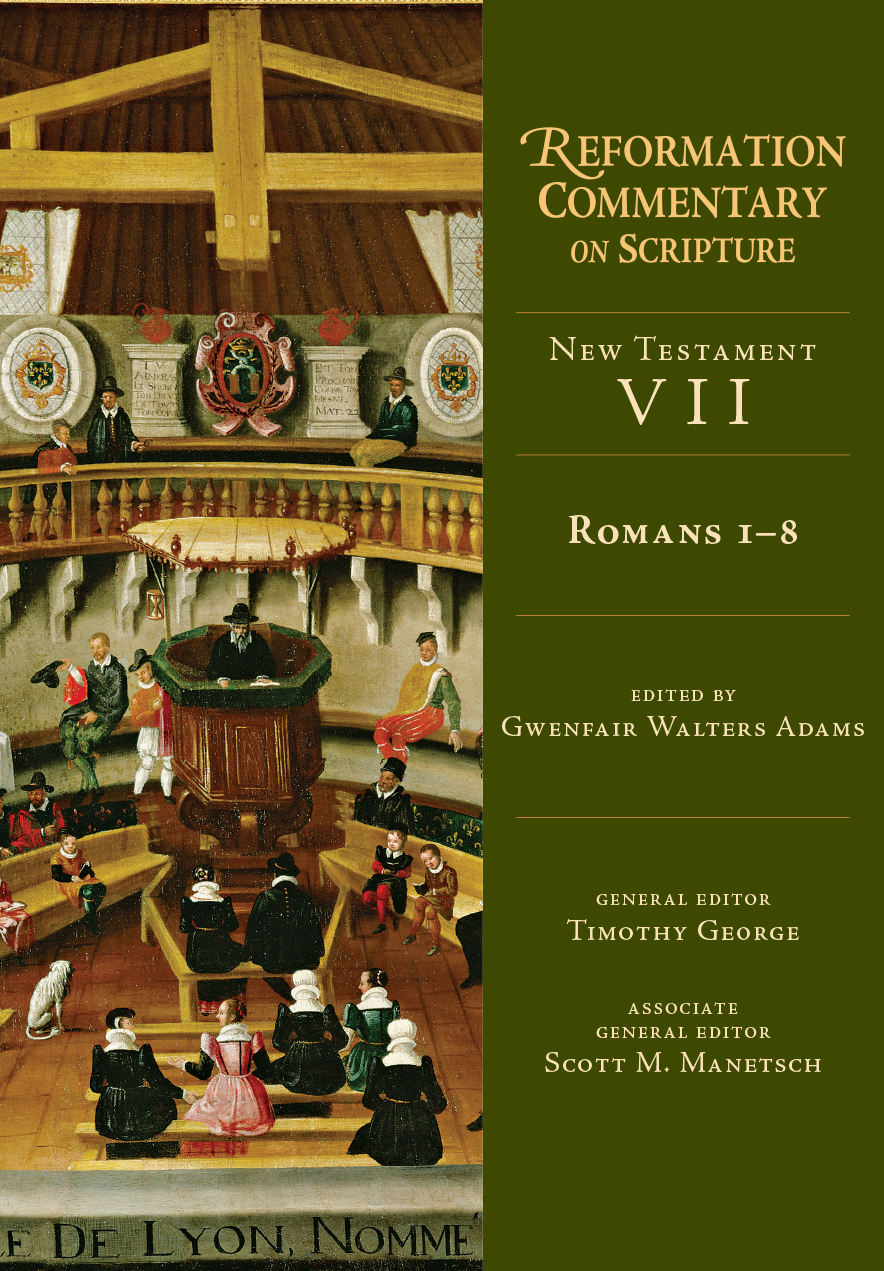
Reformation Commentary on Scripture: Romans 1-8
New Testament Volume VII
ed. by Gwenfair Walters Adams
IVP Academic
978-0-8308-2970-5
Reviewed by Clint Walker
One of my favorite things that IVP has done with commentaries is when they bring together anthologies of original sources from certain eras to show how people interpreted different sections of Scripture. Intervarsity Press started with the Ancient Christian Commentary on Scripture and has continued with the Reformation Commentary on Scripture from which this volume comes.
I am glad this commentary came out this year, because it completes the Reformation Commentary on Romans, and this seems to a big year for some studies on Romans. This particular commentary will help with historical context with some of those more innovative readings of the classic book in Scripture.
Romans is a watershed book in many ways for the Reformation, along with Galatians. In Romans, there is a particular emphasis on the primacy of faith, and the importance of salvation by grace through faith. This, as the Reformers rediscovered the text in its original language, brought up many questions about Catholic practices of penance, indulgences, and the like that then catapulted Europe into the Reformation.
This resource uses many of the more well known Reformers as they addressed Romans such as Luther and Zwingli, Calvin and Melanchthon. It also seeks to add diversity to the text with lesser known theologians that not only come from Reformed and Lutheran traditions, but also Puritan, Anabaptist, and Catholic perspectives as well.
This will be a treasured resource for me, and will sit in an easily accessible place in my library. I recommend not only using this as a resource, but also reading the introduction. It is both helpful for the common reader, and insightful for those who are well versed in the history of Biblical interpretation.
Tuesday, July 09, 2019
Day 1--Part 3--Moving from Christendom to PostChristendom---Examining and Evaluating Practices
Organizing the church for ministry is PostChristendom requires to do some different things. Dr. Fitch shared this slide which was helpful in understanding these changes.
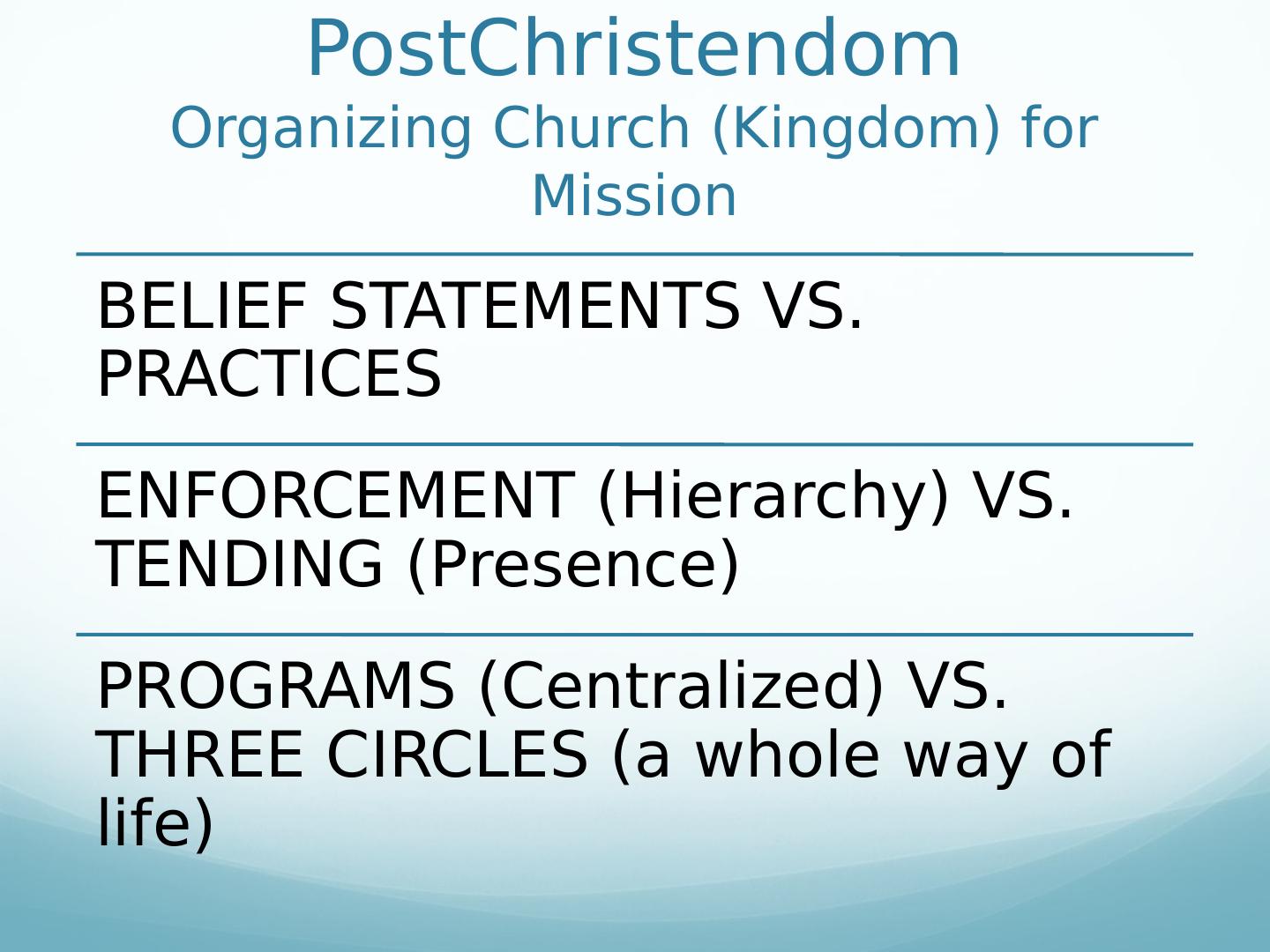
The church needs to be described in what purpose it serves in the world.
Describe churches in terms of community and witness.
Fitch then asked us to decide on an essential practice of the church, one that we felt passionate about and could write our paper on.
(This was my first major panic attack in the class. Already? I am just getting started? What if I don't choose the right thing? Oh no! Oh no! I am not ready for this)
Here were the examples of essential practices from different ministry practicioners throughout history.
Here they were:
The church needs to be described in what purpose it serves in the world.
Describe churches in terms of community and witness.
Fitch then asked us to decide on an essential practice of the church, one that we felt passionate about and could write our paper on.
(This was my first major panic attack in the class. Already? I am just getting started? What if I don't choose the right thing? Oh no! Oh no! I am not ready for this)
Here were the examples of essential practices from different ministry practicioners throughout history.
Here they were:
What are the
Non-Negotiables for your Church?
Biblical Appellations of the Church
Pick one (that best
describes your sense of your church)
o People
of God Acts 15:14 1 Pet 2:9
o Body
of Christ 1 Cor 12:13
o Ekklesia
(the called out gathering) 1 Cor 1:2
o
None of the above
Creedal Marks of the Church
Pick One (that drives
the values of your church)
o
One
o
Holy
o
Apostolic
o
Catholic
o
None of the above
The Marks (Lutheran/Anapbaptist)
Which one do your
start with and why?
Luther’s 7 ‘notes’ On the Councils and Churches 1539
o the preaching of the true Word
o The proper administration of baptism
o The correct form of the Lord's supper
o The power of the keys Matt 18 .. binding and loosing … discipline …
o The lawful vocation and ordination of
ministers
o Prayer and the singing of psalms in the
vernavular
o Persecutions … sufferings …
Menno Simons .. added the
following marks to preaching of the word/sacrament
o Holy living
- moral non conformity is indispensible to their witness…
o Brotherly love - moves locus from
administration of eucharist ..to meaning of it ..
o Unreserved testimony - witness …
o Suffering
- cross… discipleship
Others
o
Community/fellowship/brotherly
love
o
Worship
gathering
o
Discipleship
o
Leadership
o
Evangelism
(mission?)
o
The
ministry to the poor (justice)
o
Catechesis
Dever’s Marks
o Expositional
preaching
o Biblical
theology
o Biblical
understanding of the Gospel
o Biblical
understanding of conversion
o Biblical
understanding of evangelism
o Biblical
understanding of membership
o Biblical
church discipline
o Promotion
of Christian discipleship and growth
o Biblical
understanding of church leadership
jj
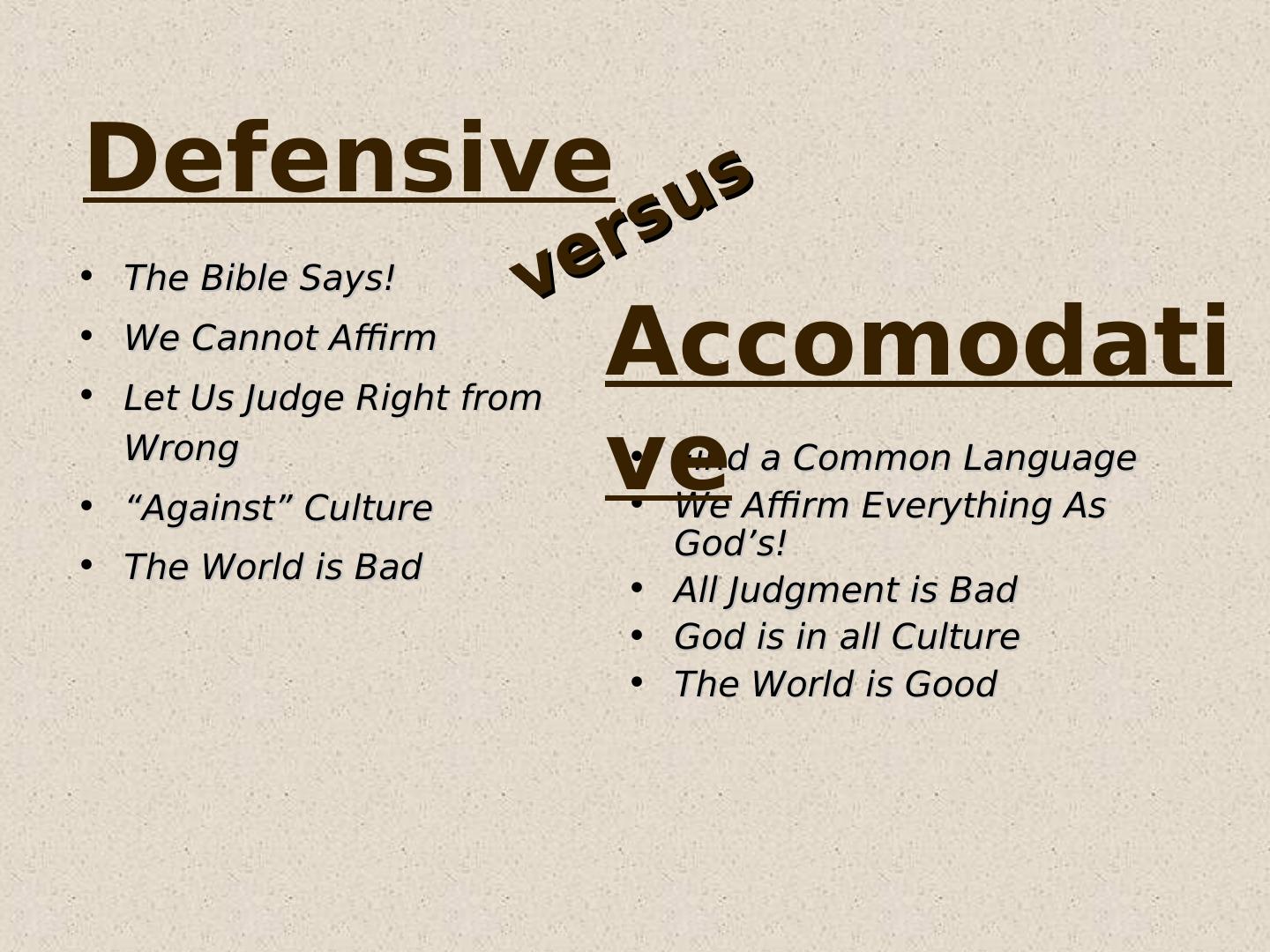
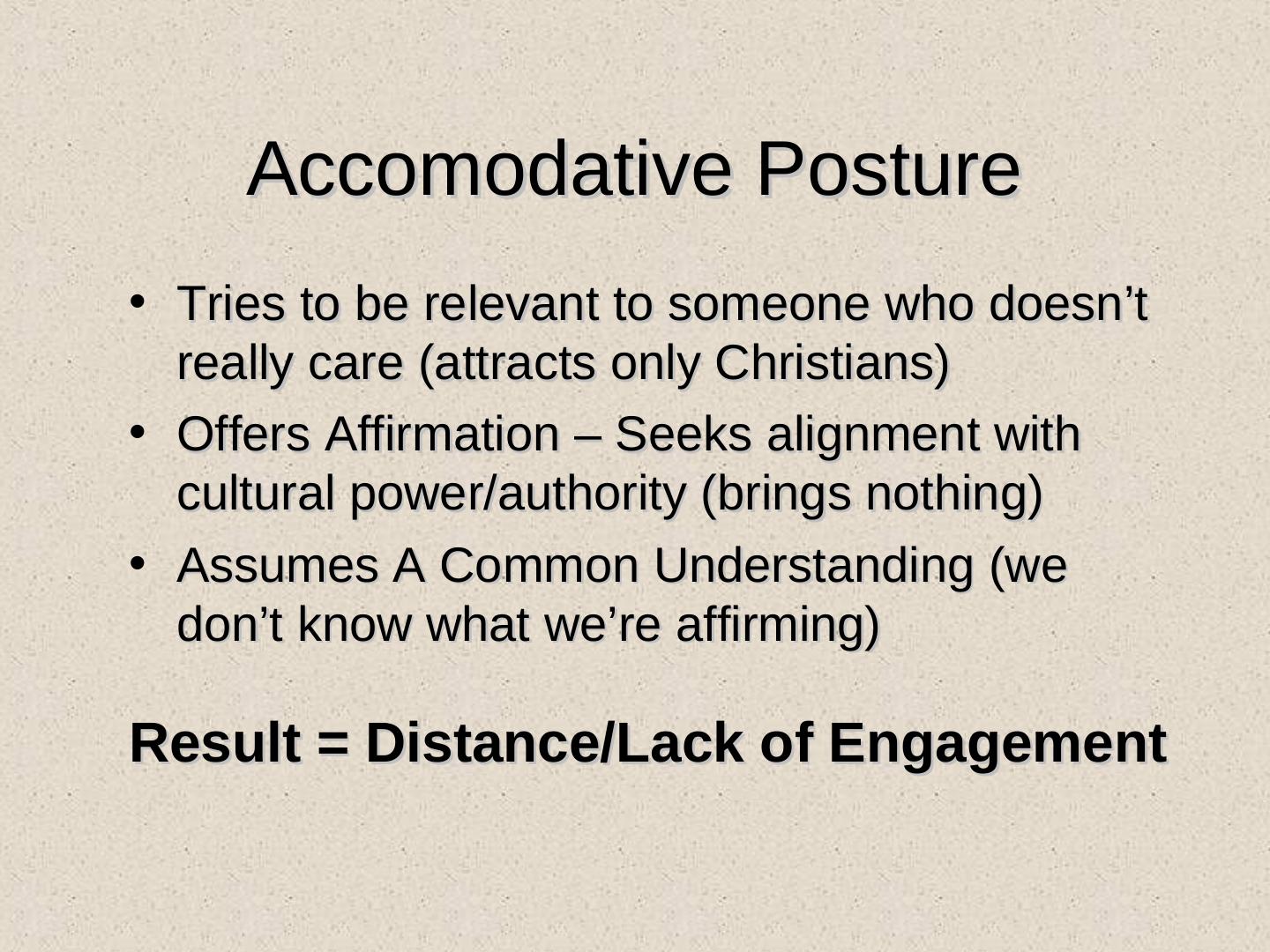
Defensive v. Accomodative:
Two ways people engage culture in unhelpful ways
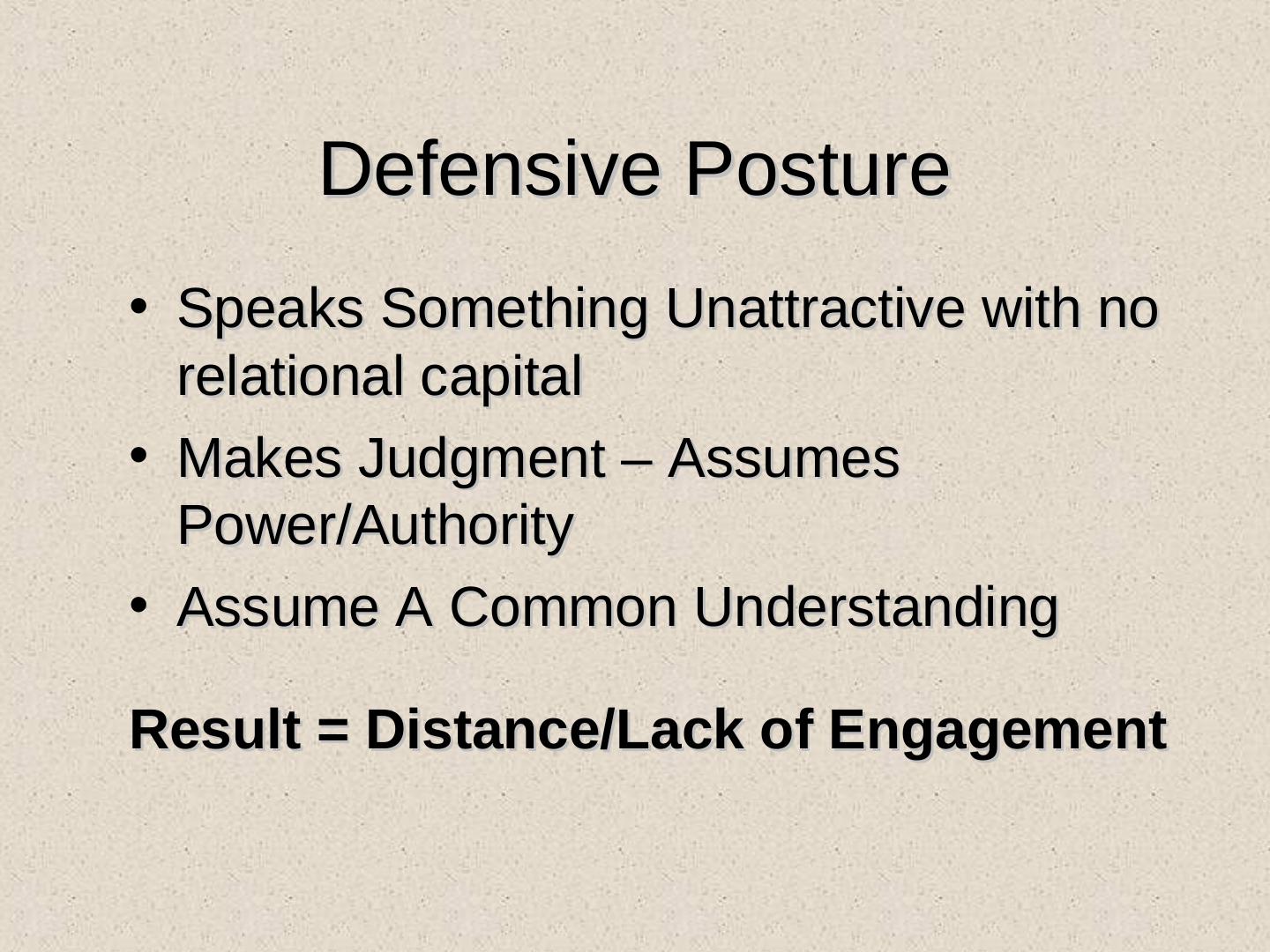
Defensive approach to culture results:
Accomodating approach to culture results:
A missional ecclesiology avoids both of these extremes.
Tuesday, July 02, 2019
Church is An Action Word
Church is an Action Word
Last month I
spent a week in the suburbs of Chicago taking a class called “Missional
Ecclesiology”. That term is a mouthful. So, let me explain the term a little
bit. “Ecclesiology” is a combination of two words. “Ekklesia” is one of the
words for the church in the New Testament. “Theology” is the study of God.
Ecclesiology is the part of theology that studies what the Bible says the
church is.
The word before “ecclesiology” is “missional”. This term
has been used so often and in so many ways, people often lose track of its
meaning. Most simply, however, it talks about the church being a “sent” people.
When people talk about a church being “missional”, we talk about going out in
the world around us, led by the Spirit, to live, act out, and share the gospel
among our neighbors and friends in their culture and their language and their
customs. The opposite of “missional” is “attractional”, which is where the
church expects people to come into the church instead of the church going out
into the world.
The church is, as David Fitch says, “defined by practices
that embody beliefs”. In other words, church is not a building or an
institution. It is a community of practice, or practices. We don’t go to
church. We do church.
The
practices that embody our beliefs are practices that connect us to God’s
faithful presence, that help us care for one another, that help us move out
into our homes and neighborhoods, and into the public sphere living our faith
in ancient and yet uniquely contemporary way. A church is a group of people who
live a certain way in fidelity to their commitment to the Lord, who has
transformed and is transforming their lives as apprentices of Jesus. The
practices that are most foundational are the practices we have discussed in
worship for the last few months, practices that are put in different
nomenclature in our mission and vision.
As I mentioned in worship last Sunday, this idea of a
church as a community of practices is not new. Whether is it the Greek word
“Ekklesia” that describes the habit of gathering, or the language of calling
God’s people the “Way”, Christian people have been known by their lived belief
since the beginning.
So, as we think and dream of ways to move forward as a
congregation, and as we consider God’s unique calling on our lives together,
let us remember to LIVE JESUS. Living as the body of Christ, exercising our
faith passionately and cooperatively will make all the difference.
Book Review of You Welcomed Me by Kent Annan
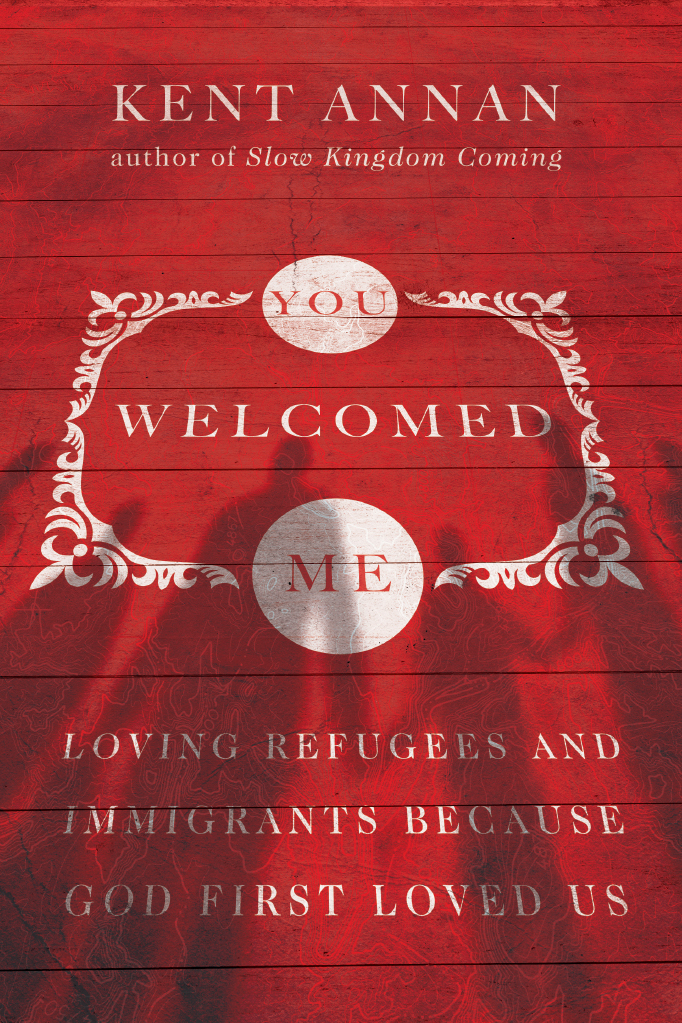
You Welcomed Me: Loving Refugees and Immigrants Because God First Loved Us
by Kent Annan
ISBN 978-0-8308-4553-8
IVP Books
Reviewed by Clint Walker
Kent Annan has written a thoughtful, grace-filled book on an issue that is difficult for many American believers to come to terms with, namely the issue of how do we deal with immigrants and refugees. He communicates winsomely about the plight of refugees by not only sharing bible verses and statistics, but by sharing stories of his personal experience and the experience of refugees. Throughout the book it becomes apparent that Annan wants us to move from seeing the immigration and refugee crises we face as issues or crisis to opportunities for real ministry with real people that need our support and love. He also wants us to encounter Christ through the practice of welcoming strangers.
From the start, Annan wants to ground his readers with empathy for other human beings, realizing that if for the grace of God, "that could be me" (p.5). He cautions us against letting fear blind us to real human connection. Early on, he asks readers to measure their lives by the "Dehumanizing Your Neighbor Scale" ( pp. 19-20) and the "Good Samaratin Scale (p. 20).
You Welcomed Me attempts to not just move us to awareness and agreement, but offers practices of welcome that will move us toward action in the Biblical command of welcoming the stranger. These practices are at the end of each chapter. Also, there are chapters dedicated to practical action, and an appendix with further resources and organizations that help refugees and immigrants.
I think this is a great book for a congregation to read about an important challenge the church faces. I hope small groups, Sunday School classes, and book clubs get a hold of it and take it to heart.
Saturday, June 29, 2019
When a calling becomes a career and a career becomes a calling
So, I was visiting with some friends the other day. They were folks from the church, and they were describing one of my pastoral predecessors (now deceased). They said that one time when they were talking with him about ministry he told them that ministry was a career, a job like any other. They pressed him, insisting that it must also be a mysterious, divine calling that drives his ministry. He insisted, although he did enter ministry with some sense of God's direction, it was a career choice.
I don't know what to make of these stories. I tend to doubt that most previous pastors were as bad or as wonderful as people described them. But, when you sit around people's tables and they tell you stories about previous ministers, they are often not simply telling stories. They are trying to communicate something more. In this case, my friends were trying to communicate what they have shared with me since I arrived in North Platte. They were trying to tell me that they had seen that God had placed his call on my life, that they believe I had embraced that call, and that this calling was evident by the approach I took to my ministerial tasks.
There are times when ministry has to be approached as a job. You have to pay your dues, put in your time, do the grunt work of ministry that nobody notices or remembers. Other times, when you have just escaped a difficult board meeting, or when you are trying to keep going through what feels like the rejection of a family that has left the church, you plod. You show up. You grind out a sermon. You make your visits. You teach your classes. You do your job. For me, ministry is the only career I have ever known.
Having said all that, my friends are right. If it was JUST a job, I would not be doing what I do. I do feel called.
What I did not say to them is this: my calling here has a lot to do with them. When I interviewed and candidated for the position here, it was a struggle to decide to come. More than once, there were times I really wanted to step away from the call to come to North Platte.
I loved Hot Springs and many of the people there. It was not a town I wanted to leave, nor did I want to leave many of the people of my congregation.
I was not sure I wanted to live in Western Nebraska.
I felt badly about having my wife reboot her career.
On the day I preached my sermon to come here, and before I accepted the position, we had a church potluck. As I ate, here came this chubby old farmer, red-faced and in his overalls, to speak to me. He asked to pray for me and my discernment of God's call, which he did. Then his eyes filled with tears as he finished and he placed his hands on my head. He said that he believed that God's Holy Spirit had called me to be this church's pastor, and that his hand was upon me and my life. Tears and snot and sweat dripping from him, he made a half-hearted apology for our awkwardness of our encounter, and then dismissed himself. Between that encounter and the nearly unanimous vote to extend the call to come here, I remember telling my wife that God's call was apparent because of the red-faced farmer who laid hands on me and anointed me with his sweat and tears.
Since I have come, we have become closer. He calls me with health updates. He drops by with produce and poultry from his farm. I have prayed for him and he for me. And now he is dying.
We almost lost the man who laid his hands on me and anointed me for the pastorate of North Platte this week. His blood sugar crashed. The hospice nurse came and got him back on the right track. Later his wife chatted with me. They were ready for me to come visit. I wasn't sure how I was going to fit the visit in this week, but I made it work.
That day, the drive out to the farm, worrying about getting lost, finding my way down dirt roads, that was a job.
Sitting at my friends' table, walking through their fields, taking pictures of their smiling faces and hard working bodies, listening to stories of how they have come to faith and shared it with others, talking about God's faithfulness even in the face of death and dying, and listening to how much a man loves all of his John Deere tractors, well, that is a calling. And, the best part of being called at that.
I don't know what to make of these stories. I tend to doubt that most previous pastors were as bad or as wonderful as people described them. But, when you sit around people's tables and they tell you stories about previous ministers, they are often not simply telling stories. They are trying to communicate something more. In this case, my friends were trying to communicate what they have shared with me since I arrived in North Platte. They were trying to tell me that they had seen that God had placed his call on my life, that they believe I had embraced that call, and that this calling was evident by the approach I took to my ministerial tasks.
There are times when ministry has to be approached as a job. You have to pay your dues, put in your time, do the grunt work of ministry that nobody notices or remembers. Other times, when you have just escaped a difficult board meeting, or when you are trying to keep going through what feels like the rejection of a family that has left the church, you plod. You show up. You grind out a sermon. You make your visits. You teach your classes. You do your job. For me, ministry is the only career I have ever known.
Having said all that, my friends are right. If it was JUST a job, I would not be doing what I do. I do feel called.
What I did not say to them is this: my calling here has a lot to do with them. When I interviewed and candidated for the position here, it was a struggle to decide to come. More than once, there were times I really wanted to step away from the call to come to North Platte.
I loved Hot Springs and many of the people there. It was not a town I wanted to leave, nor did I want to leave many of the people of my congregation.
I was not sure I wanted to live in Western Nebraska.
I felt badly about having my wife reboot her career.
On the day I preached my sermon to come here, and before I accepted the position, we had a church potluck. As I ate, here came this chubby old farmer, red-faced and in his overalls, to speak to me. He asked to pray for me and my discernment of God's call, which he did. Then his eyes filled with tears as he finished and he placed his hands on my head. He said that he believed that God's Holy Spirit had called me to be this church's pastor, and that his hand was upon me and my life. Tears and snot and sweat dripping from him, he made a half-hearted apology for our awkwardness of our encounter, and then dismissed himself. Between that encounter and the nearly unanimous vote to extend the call to come here, I remember telling my wife that God's call was apparent because of the red-faced farmer who laid hands on me and anointed me with his sweat and tears.
Since I have come, we have become closer. He calls me with health updates. He drops by with produce and poultry from his farm. I have prayed for him and he for me. And now he is dying.
We almost lost the man who laid his hands on me and anointed me for the pastorate of North Platte this week. His blood sugar crashed. The hospice nurse came and got him back on the right track. Later his wife chatted with me. They were ready for me to come visit. I wasn't sure how I was going to fit the visit in this week, but I made it work.
That day, the drive out to the farm, worrying about getting lost, finding my way down dirt roads, that was a job.
Sitting at my friends' table, walking through their fields, taking pictures of their smiling faces and hard working bodies, listening to stories of how they have come to faith and shared it with others, talking about God's faithfulness even in the face of death and dying, and listening to how much a man loves all of his John Deere tractors, well, that is a calling. And, the best part of being called at that.
Friday, June 28, 2019
What is Church--P2--When Christendom coopts the church

In the fourth and fifth century, several things happen
- Constantine converts to Christianity
- Constantine makes Christianity the Roman world's official religion
- Constantine takes initiative to make the church define itself through a belief system--CREEDS
- This unites the established church, and the belief system both solidifies governmental power and church power individually, and together
This had several results:
- "We go from thinking about church as something we do to a church as an article of belief"
- If we extract a belief out of practice is moves the church toward coercion"
Examples based on "one, holy, apostolic, catholic church"
- "one"
- What happens when unity becomes something we believe instead of something we do?
- Reconciliation becomes forced from the top down
- see confession, excommunication
- See Radner "Brutal Unity"
- "holy"
- Holiness becomes an article of faith that needs to be enforced
- "Whenever you extract belief out of practice of the church it becomes coercive. God cannot change people through coercion.
- "Catholic
- references a universal church made up of all believers
- "church is a way of life not a thing you go to"
- this establishes on church as THE institution
- "apostolic"
- Used two ways
- "sentness" of the church
- apostolic succession
- The practice of being sent gets lost in Constantinian church
- "Words only make sense by their use"
- "If we don't have a word that uses the practice to change lives we have lost its meaning"
- "We extract belief from practice and it turns into something enforced"
- "Coercion does not work in Post-Christendom"
- "Church is in mission if it starts with practices that embody beliefs as a way of life"
- FIND SLIDES: HOW ARE YOU ORGANIZING FOR MISSION
- Belief doesn't make sense apart from practice.
- Wittgenstein--"Words don't make sense apart from their use'
- James--Faith without works is dead
Monday, June 24, 2019
Quotes cited in "You Welcomed Me" by Annan
"The ache for home lives in all of us, the safe place where we can go as we are and not be questioned."--Maya Angelou (1)
"If we are to love our neighbors, before doing anything else we must see our neighbors. WIth our imagination as well as our eyes....we must see not just their faces but the life behind and within thri faces."--Fredrick Buechner
We are all strangers in a strange land, longing for home, but not quite knowing what or where home is.--Madeleine L'Engle
Friday, June 21, 2019
What Is Church?--Part 1 of Missional Ecclesiology Notes from David Fitch
A summary of my Day 1 notes:
see also church practices handout
Intro from a Facebook post on April 26:
"When a church gets old, often in three or four generations, as it carries on the traditions of its founding, it finds itself doing things in certain ways - “the way things always have been done.” Meanwhile the culture around has changed – sometimes significantly (like the country has turned post Christian in 50 years). The language of the culture has changed. The cultural assumptions about church, the sociological orbits upon which these traditions depended, have all changed, and so we need to ask the basic questions over again. What are we doing here? What is church? And why is it so important? And if the what and the why can be re-established all over again… we need to ask the how question all over again, how do we do this thing called church in a way that makes sense in our times?"
Key Statement:
"The church is defined by practices that embody beliefs"
Analysis of the Bible names for church and how they communicate the "key statement" above
- The Way--speaks to a set of practices
- The People of God--speaks to a way of life, a royal priesthood
- Body of Christ--speaks of an organism driven by participation
- Ekklesia--gathering of civic importance
New Testament Church was a practicing community under a different rule, a community where there is a "stunning lack of hierarchy"
Saturday, June 08, 2019
Podcasts
Today was my last day with the brand new truck that I drove to Chicago from Omaha and back. All tolled, I put over 1000 miles on that truck. If the darned thing didn't run about half of the cost of a new home, I might consider getting one for myself. I certainly loved driving it around.
One of the things I loved about driving the vehicle was its stereo system. I could run everything through it, including a lot apps off of my phone. So, today I listened to several podcasts.
I don't generally listen to podcasts. I have subscriptions to certain podcasts, but then I listen to them so infrequently that they ask me if I want to continue with the podcast everytime I get to the app and open a certain podcast.
There are several reasons why I don't listen to podcasts too often. One is, I don't really have the ability to stream them while I am driving and get anything out of it. I walk to work. Picking up the girls takes five minutes, as does a trip to Walmart. Furthermore, this week is the first time I have been out of town in around 5 months, or maybe longer. Listening to them today made me think I need to listen to podcasts more often.
When I do listen to podcasts, here are a few I tune into:
Our region podcast is quite well done by Greg Mamula. Its called Mission in 5
I listen to a podcast that is done once a week by "men of size" about issues pertaining to heavier fellas. It is called Heavy Conversation.
I have recently begun listening to a few podcasts from Northern Seminary. One is from the man who just taught my class and oversees my DMIN. His name is Dr. David Fitch. His podcast is called Theology on Mission. Also very popular is Scot McKnight's Kingdom Roots.
Onscript reviews scholarly Christian books, and I like that I can listen to this briefly and get an understanding of a text. And I like Freakonomics as well.
WHAT PODCASTS DO YOU LIKE? WHAT WOULD YOU RECOMMEND FOR ME?
One of the things I loved about driving the vehicle was its stereo system. I could run everything through it, including a lot apps off of my phone. So, today I listened to several podcasts.
I don't generally listen to podcasts. I have subscriptions to certain podcasts, but then I listen to them so infrequently that they ask me if I want to continue with the podcast everytime I get to the app and open a certain podcast.
There are several reasons why I don't listen to podcasts too often. One is, I don't really have the ability to stream them while I am driving and get anything out of it. I walk to work. Picking up the girls takes five minutes, as does a trip to Walmart. Furthermore, this week is the first time I have been out of town in around 5 months, or maybe longer. Listening to them today made me think I need to listen to podcasts more often.
When I do listen to podcasts, here are a few I tune into:
Our region podcast is quite well done by Greg Mamula. Its called Mission in 5
I listen to a podcast that is done once a week by "men of size" about issues pertaining to heavier fellas. It is called Heavy Conversation.
I have recently begun listening to a few podcasts from Northern Seminary. One is from the man who just taught my class and oversees my DMIN. His name is Dr. David Fitch. His podcast is called Theology on Mission. Also very popular is Scot McKnight's Kingdom Roots.
Onscript reviews scholarly Christian books, and I like that I can listen to this briefly and get an understanding of a text. And I like Freakonomics as well.
WHAT PODCASTS DO YOU LIKE? WHAT WOULD YOU RECOMMEND FOR ME?
Starting Over Again Again
I am going to try and use this platform more regularly again for several reasons.
1. I need to write for my doctoral stuff, and the best way to improve my writing is to write
2. I need to catalogue thoughts before they escape me.
3. I need a venue to think through things, this worked as well as any
4. Hopefully, if I do it right, this platform can help me network better, which has several benefits
1. I need to write for my doctoral stuff, and the best way to improve my writing is to write
2. I need to catalogue thoughts before they escape me.
3. I need a venue to think through things, this worked as well as any
4. Hopefully, if I do it right, this platform can help me network better, which has several benefits
Wednesday, March 27, 2019
Book Review of Bible and Mission by Richard Bauckham
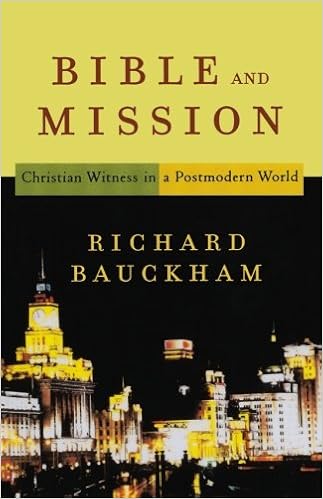
Bible and Mission: Christian Witness in a Postmodern World
by Richard Bauckham
ISBN 978-0-8010-2771-0
Baker Academic
Reviewed by Clint Walker
Preface:
This is the first of many book reviews related to my D.Min. class. It is also one of the books I have read cover to cover. My stated professional goal is to read 25 books this year.
Overview:
This is a rather short book (112 pages) by one of the world's leading scholars on theology and New Testament studies. This book is based on a series of lectures first delivered in England, and then again in Ethiopia about what the Bible says about Biblical truth, mission, and Christian witness in a postmodern age.
The thesis of this book is that, "the Bible itself embodies a kind of movement from the particular to the universal, which we as readers need to find ourselves inside" (11). Richard Bauckham goes on to say, "This is a universal direction that takes the particular with utmost seriousness. Christian communities or individuals are always setting of from the particular as both the Bible and our own situation defines it and following the biblical direction towards the universal that is to be found not apart from but within other particulars. This is mission" (11).
That is a mouthful. What he is trying to say is that God works with and calls individual persons or groups of people, which he refers to as the "particular". He chooses them. He chooses them not for their own benefit, but for the benefit of all (the universal). God chooses Abraham and gives him a blessing. He is a particular person. He chooses Abraham in order to bless the whole world through Abraham. A universal blessing through God's calling of a particular person to facilitate that blessing.
The same is true, Bauckham demonstrates, through David, and through the nation of Israel as "God's Son.". All of these blessings and choosings of God come to fulfillment through Jesus, who then creates a way for the whole world to have the opportunity to experience salvation.
The whole narrative arc of Scripture, Bauckham would teach, functions in this way. Thus, although the Bible deals with particular historical people and places, it calls us to see ourselves in that narrative, making the truths of the story as well as the cadence of the story our own. The church has been called as God's people. We have been called not to simply experience God's blessing and new life, rather, we have been blessed to bless others, called to call others into the community, and to be a transforming presence in the entire earth. This metanarrative of particular folks being called by God to live a holy life that will be a blessing to others and invite them into a transformative community. That community, Bauckham clearly states, must experience "a downward movement of solidarity with the on the bottom of the social scale of importance and wealth" (54)."
This "downward movement" is important because it shares a metanarrative that unlike the totalitarian, oppressive narratives of modernity, is empowering to the oppressed and open to diversity of persons, experiences, and cultures. Christianity "exhibits more cultural diversity than any other religion," Bauckham posits (9). It is not a narrative of "human mastery" over self or others (91). "It views history in terms of the freedom and purpose of God and of human freedom to obey or resist God," the text says.
Thus, we must understand that Godhead is at work throughout human history in real persons and real places. He uses those people in those places as folks that are chosen by him to demonstrate his will among the nations, so that all the nations can see his goodness, place their faith in him, and live healthy meaningful holy lives in the way God created them to be. He moves from those particular people, since they were blessed to be a blessing, out into the whole world. Holy ground moves from Israel to wherever God's people are gathered. God's holy people move from Abraham to Israel to all those who place faith in God through faith in his Son Jesus. And the kingdom keeps going out, as God seeks to continue to bless the whole world through imperfect people being transformed by his grace.
Ok that last sentence got a little preachy, but oh well.
Quotes:
"The Bible...tells a story that in some sense encompasses all other human stories." (5)
"the metanarrative of progress was significantly a narrative of domination, for all that it made freedom one of its values." (5)
Subscribe to:
Posts (Atom)
Reformation Commentary of the Bible: Old Testament Volume XIII--Psalms 73-150
Reformation Commentary of the Bible: Old Testament Volume XIII--Psalms 73-150 Edited by Herman J. Selderhuis IVP Academic ISBN 978-0-8308-2...

-
Book Discussion: The Shack Overview Questions If you were to rank the book: THE SHACK on a scale of 1-5, what would you rate it and why woul...
-
 Update: The problem, it turned out, was that the positive battery cable was not properly attached. Thankfully, the new mechanic did not char...
