Thursday, May 03, 2012

Book Review of Imperfect by Jim Abbot and Tim Brown


Imperfect: An Improbable Life
by Jim Abbot and Tim Brown
ISBN 978-0345523259
Ballentine Books
Reviewed by Clint and Jennifer Walker

Sports biographies are notoriously difficult books to write well. This is especially true with sports autobiographies. If the athlete says too much about their career accomplishments, it can sound like bragging. If they share the details of all the games they played, it can sound too much like shop talk, and be hard to relate to. Athletes can also share too much about themselves, and expose themselves to unecessary public ridicule. Who can forget Wilt Chamberlain's braggadocio about how many women he had sex with? Furthermore, many athletes, even with a co-author, do not know how to understand their lives as story, and communicate their journey with drama and intelligence.

Jim Abbott avoids many of these pitfalls in his book. Alternating between telling the story of his perfect game as a pitcher for the New York Yankees, and stories of his upbringing and how his parents raised him to accept and believe in himself, Abbot communicates a lot about who he was, who he is, and the journey that he continues to be on. Even avid fans of Abbot will perhaps find new parts of his story that inspire them to be more than they thought they could be. Abbot is honest about his struggles without sounding like a coward. The idea of using his experience as a pitcher with an imperfect body pitching a perfect game as a metaphor for his life is a master stroke.

Having said all of this, despite its inspirational quality, there are parts of the book that do drag along. The book could have used some better pacing to keep grabbing the readers attention. But then again...I could say the same about the sport of baseball in general. So it could just be me...

Other than that, this was a good book, and a book I would not mind passing on to a friend, or recommending it to the people I know that really love baseball.


Sunday, April 22, 2012

Book Review of Resignation of Eve by Jim Henderson

The Resignation of Eve: What if  Adam's rib is no longer willing to be the Church's backbone?
by Jim Henderson
ISBN 978-14143-3730-2
Tyndale Publishers
Barna Imprint
Reviewed by Clint Walker


If you walk into most churches on Sunday morning, it is easy to notice a few things In most churches, it doesn't take a highly observant person to notice that the age of membership in most congregations continues to get older and older. In many churches, it does also fairly obvious to most observers that there are a lot more women at most church events than there are men.

Jim Henderson has noticed this trend. He also noticed a few other things. First of all, the culture of the church tends to burden more and more of the work of the ministry to competent women in the congregation. Secondarily, there are many women in the church that are willing to serve in the church, but they are not honored with a place of influence in the church. Instead they are dismissed, their gifts are denied, and their ministry is demeaned simply because it is done by a woman.

To speak about this phenomenon, Jim Henderson uses the language of "resignation". This has a triple meaning in the title of The Resignation of Eve. In light of many churches intentionally or not so intentionally devaluing women, some women resign themselves to less than ideal circumstances. Others leave the church because they believe it is untenable--the "resign" from church. Still others find ways to renegotiate roles and expectations within congregations and "Re-sign" up for service in the family of God.

What I enjoy about this book is that it speaks about issues in general, but then it tells a specific person's story to show the truth in what is being said. The stories of these women transcend age, race, and socio-economic status. They are well-creafted, and at credibility to Henderson's argument.

The Resignation of Eve both advocates for fuller inclusion of women in leadership, as well as honoring women more often for all they do for the church. In both senses, I agree with Jim Henderson and what it says in this fine book.

Thursday, April 19, 2012

Book Review for For Calvinism by Michael Horton

For Calvinism
by Michael Horton
ISBN 978-0-310-32465-2
Published by Zondervan
Reviewed by Clint Walker

John Calvin walked the earth over 500 years ago. His Institutes of the Christian Religion still remains as the standard of systematic theology. One may agree with Calvin or disagree with him, but it is very hard to ignore his contributions to theology, church practice, and the development of Protestant Christendom.

At sometime after Calvin lived and developed his theology and ministry, people began to refer to themselves as "Calvinists". As "Calvinism" developed, it came to be defined with five certain viewpoints most clearly articulated by the Synod of Dordt in response to the rise of Armenianism. These five viewpoints are commonly summarized with the acronym TULIP, which stands for total depravity, unconditional election, limited atonement, irresistable grace, and perseverance of the saints.

Michael Horton, in his book For Calvinism does a great job of defending what has been labeled as Calvinist beliefs (although he would say Calvinist beliefs should be associated with orthodox Christianity before they are associated with a sect of Christianity called "Calvinism"). Horton spends the first half of the book defending what was articulated in the Synod of Dordt, although he prefers other language than what the TULIP acronym necessitates. He spends the second half of his defense of Calvinism addresssing particular concerns with how Calvinist belief is practiced in the church and in the lives of individual believers.

Calvinist belief is often unfairly caricatured. In addition to this, many of Calvinism's strongest proponents come across as very stern and angry. The strength of For Calvinism is Horton's ability to articulate Calvinist thought in a kinder, gentler manner without compromising the convictions he is representing.

Horton commends Calvinist thought by highlighting parts of Calvinist doctrine that other people ignore. For example, in regard to total depravity, Horton says, "Reformed theology never starts with the fall, but God's good creation" (p. 38). When Horton commends creation in this way, he at one time corrects a stereotype about Calvinism (that God made persons to sin), and describes how "free will" fits into a theology of complete divine sovereignty.

Over and over again, Horton continues to address stereotypes against Calvinism without compromising Calvinist doctrine. In relationship to unconditional election, he says that God does not arbitrarily "drag some people into heaven kicking and screaming, while telling others who want to be saved that they are simply not on the list" (p. 57). He discusses the doctrine of limited atonement in terms it "extent" and "nature" (p.80ff). Also, Horton's chapters about living the Calvinist faith defend Calvinism against many erroneous ideas. Many say that a Calvinist cannot believe in missions or evangelism. For Calvinism takes a whole chapter to destroy this myth.

For Calvism is a very informative book. As is its partner book Against Calvinism by Roger Olson. And with the rise of "New Calvinism" in American Christianity, it will be more and more important for Christians and church leaders to be conversant on issues of Reformed and Armenian theology. Horton may be one of Calvinism's best advocates, and one of its more clear communicators to everyday lay persons. For these reasons, I cannot commend this book more highly for anyone interested in such theological concerns.

Saturday, April 14, 2012

Book Review of Martin Luther's Basic Theological Writings edited by Timothy F. Lull and William R. Russell

Martin Luther's Basic Theological Writings (Third Edition)
edited by Timothy F. Lull and William R. Russell
ISBN 978-0-8006-9883-6
Fortress Press
Reviewed by Clint Walker


For several years now, I have become more interested in what the Reformer Martin Luther had to say in his writings. The problem is, I have not had any idea where to start in Luther's writings to hear what he had to say in his own words. So, when it became possible for me to get a copy of the new edition of the reader Martin Luther's Basic Theological Writings, I jumped at the opportunity.

For ease of reading, this collection of Luther's writings is organized thematically. This allows readers to quickly study what Martin Luther said on a certain subject, without having to wade through the chronological development of his thoughts. The subjects covered includes Luther's contributions to the academic disciplines of biblical studies, ethics, and theology, as well as more detailed discussion of certain issues, such as the sacraments, reform, and the nature of the gospel.

As is the case with many of the high quality academic works that Fortress publishes, the "extras" in the book are especially well done, and make the text even better. I especially enjoyed the timeline of the works of Luther in the front of the book, as well as glossary in the back.

Many of the entries in this book are excerpts from larger works by Luther. Other chapters contain entire "pamphlets" teaching about something or pursuading someone to a certain position. Together, the selections chosen give a well rounded picture of Luther as a man, a leader, a churchman, and theologian.

I think this book would be helpful for a number of people. For pastors who are like me, and believe that a pastor should be a pastor/theologian, this book will be great for becoming more familiar with Luther and his thought. For teachers and students in search of a textbook on Luther, this would be a great resource as well.


Friday, April 06, 2012

The faith and the practice of the Earliest Christians by Tony Jones

The Faith and Practice of the Earliest Christians
by Tony Jones
DVD Study
Paraclete Press
Reviewed by Clint Walker
The Faith and Practice of the Earliest Christians: a DVD Study on the Didache with Tony Jones

I have had an interest in the Didache for years. So, when I had the opportunity to read and follow a video study of this book that guided the practice of the early church, I seized that opportunity.

I was especially excited to watch The Faith and Practice of the Earliest Christians because Tony Jones was leading the DVD study. I did not know that he had also written a book on the Didache, and written a translation of the Didache himself. This made the study even more exciting to get into.

The Didache was, for lack of better words, the membership covenant of one of the earliest Christians in the ancient world. As such, it informs its readers what the early church did as they practiced their faith in the area near the border of Syria and Israel. The Didache gives believers clear instructions on how their faith should be practiced on a daily basis.

The video goes through the subject matter within the Didache in a clear and understandable manner. It rotates between Tony Jones talking to the viewer, him leading a small group discussing the Didache, and a few slides with quotes, questions, and subject headings as well.

My favorite sections of this study are in the middle of the video. The discussion of basic living in the Way of Jesus, and some practices of personal and spiritual formation were thought provoking.  The lessons on "how to be church" were instructive as well. I thought the pratice of praying the Lord's Prayer three times a day was an practice worth attempting. I also was interested in how the people at the time of the Didache practiced baptism. Some of the instructions about baptism would be helpful for the church to think about today, and to reinstitute into common church practice.

My least favorite sections of the video are the beginning and the end of the study. I felt like in these sections, not much of interest was said.

This video has low production value. Nowhere is this more evident than in the first and last sections of the video. For many students, the lack of budget will keep them from paying attention and learning as much in this study of the Didache as they could. Which is really too bad. Tony Jones does a great job of drawing lines between the people in that church and people in the church today, and of showing the relevance of the early church to our situation in the 21st century American church.

All in all, I commend Paraclete for puting this study together. The Didache needs to be discussed more, and referred to more, even though it is not holy writ. Maybe these resources with get the coversation beginning.

Monday, April 02, 2012

Changing Time


Over recent years, I have been working hard to slowly change my schedule.

When I was a youth pastor, I was a late to bed and late to rise kind of person. Much of my work was done in the evening. I did not have a social life outside of church. So, I would often go to bed well after midnight, I would get up mid-morning, I would put in another 10 hour day, and then I would start all over again. It worked well for me, and this schedule worked well in my ministerial context.

After I got married and became a solo pastor in a small town, I came to the conclusion that I needed to visibly working by 9am during the week. I would go to bed a little after midnight. This even worked well when our child was an infant. I could stay up and do her midnight feeding, then go to bed, and get up around 8am.

Today, I have a hard time sleeping much past 7am. I still hate mornings, but now I get to work a little after 8 instead of 9. I get a lot of my work done before my family gets home.

Has anyone else out there ever changed their sleeping schedule? What prompted this change?

Book Review of the Christ Connection by Roy Abraham Varghese


The Christ Connection
by Roy Abraham Varghese
ISBN 978-1-55725-699-7
Paraclete Press
Reviewed by Clint Walker

Roy Abraham Varghese is no stranger to the world of philosophy and apologetics. Most well known as the co-author of Anthony Flew's autobiographical journey toward theism entitled There is a God, Varghese has been commending the Christian faith in the marketplace of religions in this postmodern world for several years. Recently, Varghese has written a book where he seats Christianity as the fulfillment of much of the hopes and narratives of the world religions that predate Christianity from across the globe. In many ways The Christ Connection embodies the truth expressed in Galatians 4:4 that Jesus came "in the fullness of time"

The first part of this fine books discusses the orgin and development of religion in society around the globe. Contrary to many popular theories, Varghese presents ample evidence that most primitive religion today and throughout history was not as polytheistic as many think. In fact, many more "primitive" religions have a profound openness toward and anticipation of someone similar to Christ.

Much of the second part of the book draws lines between the world relgions and Christianity. Varghese effectively shows how Christ is the fullfilment of much of what ancient world religions were building toward.

The final section is a includes a discussion of the resurrection and the early church, and how each of these facts of history leads an objective thinker toward the logical truth of Christianity.

The Christ Connection is a fine book. It is a little heavy in its language and in its paradigmatic structure for many that might try and pick it up and read it off the shelf. However, those who take the time to actually read the book will be rewarded with much to think about and consider.

Book Review of The Future of the Global Church by Patrick Johnstone

The Future of the Global Church: History, Trends, and Possibilities
by Patrick Johnstone
ISBN 978-1-60657-132-3
Biblica Books from Intervarsity Press
Reviewed by Clint Walker

The Future of the Global Church

This year, Biblica (formerly known as the International Bible Society) formally sold the book publishing part of their ministry to Intervarsity Press. Intervarsity has been busy in promoting this partnership, and many of the new books they will be able to offer through the Biblica imprint. One of the first books released in this partnership is a smart, slick book on the state of the church around the world called The Future of the Global Church.


The Future of the Global Church is an excellent resource. It is primarily a statistical book. It begins by informing its readers about population changes and people movements throughout the world. Johnstone then clearly identifies in short bullet points what the challenges are for missions and evangelism in the midst of the changing world we live in. In the process, he clearly shows that the historic Christian West is in decline, and that the Muslim church in Asia and Africa is growing rapidly.

Johnstone also devotes a whole section of his book to the historic development and growth of the church from a global perspective. Want to know where the biggest revivals were in the world in the 20th century? The Future of the Global Church has a couple of pages devoted just to that topic. I am constantly amazed at how much detail and information is in this small book.

The Future of the Global Church also traces historic and global trends in the rise and decline of each of the world's major world religions. It also pays careful attention to how different sects within each of these religious groupings are growing or declining, and what that means for Christian witness in regions where those religious groups are strongest.

Johnstone also does a significant amount of work tracking and discussing the different "megablocs" within Christian circles. I learned, for instance, that that Anglican church is much more populous in Nigeria and Kenya than in the United States. I also learned that by 2050, Johnstone projects there will be more people in the Anglican Fellowship in Uganda and Nigeria than in the United Kingdom. Pretty fascinating information right there!

The Future of the Global Church also pays particular attention to the victories and challenges of the evangelical churches around the world. Did you know that China will have more evangelicals than the United States does by 2050? Johnstone also identifies the unchurched around the world not only by nations and regions within nations, but he also identifies those folks by people groups. For instance, in Africa the Pygmy folks are predominantly Muslim, but the Bantu folks are predominantly Christian.

Do you want to pray for the world? Do you have a passion for evangelistic mission in the church? Do you want to be a global Christian? If so, I would strongly recommend purchasing this fine book, and letting it inform your prayers, your giving, your evangelistic efforts and your worldview. Get to know the world God put you in, and begin to love and care for it with intelligence as a disciple of Jesus.

Thursday, March 29, 2012

Speaking of newly discovered weblogs...


Bensonian is a weblog written by a guy in Colorado doing some academic work and beginning his writing career. I find his quotes of Stegner and his study of the American West particularly interesting.

A new blog to check out


A few months ago, I stumbled upon a book review I thought was particularly well-written in Christianity Today. The review was written by Jake Meador, who is a thoughtful guy who has a fresh, interesting voice on a lot of matters. His blog is called Notes from a Small Place (he lives in Lincoln, NE). If you enjoy good thinking or just  good writing, I would check out what he has to say!

On visiting someone with Alzheimer's


Alzheimer's disease is a vicious ugly disease. It slowly strips away one's connection with one's memory, which makes it harder to maintain relational connections, one's connection to their history, and to their faith.

As a pastor who visits Alzheimer's patients at times, I can also tell you a very different story. My visits to some folks with limited access to their memories happens to be a grace to me, and helps to ground me and remind me of some very important things in life.

Today I visited Sarah Gordon. She is a member of our church here in United Churches. She fell and broke a few bones. She is recovering at Fall River Hospital.

I like to visit Sarah. My visits don't have to be awfully long. After all, she will not remember how long I visited for anyway! I introduce myself. Each time I introduce myself she is happy to meet a new friend and pastor. It is like meeting a new friend for the first time all over again.

I visit with her for a little bit. One time she tells me she is going to turn 66. A few minutes later she says she is going to turn 77. Since she is in her 90s, I am happy that she believes she is still so young and spry.

We pray a brief prayer. If we pray the Lord's Prayer, she can pick out some of the words and say them when I do. Much like my baby daughter has begun to do with some of the songs I sing her.

I leave. Sarah tells me how glad she is to meet me. I let her know how much I enjoyed spending time with her.

As I leave, I am struck by how Sarah's disease has forced her to live in each moment. Sarah is forced savor or suffer through each moment as if it is the only moment that matters to her. This is because Alzheimer's disease has made this moment the only moment Sarah has.

Maybe we can learn a little from our friends and our families living with dementia or Alzheimer's. Maybe we to need to embrace the moments that we are given, and truly live in those moments instead of longing for the past or being so future oriented that we miss what is going on in the "now". I think if we would let those with Alzheimer's teach us, and let their lives speak to us, we will find we have a lot to learn.

Monday, March 26, 2012

Best of the Bloggies

On "holy indifference"

The wifey updating about the coming little one

A wonderful picture from a skilled photographer

A great quote about the American West

How is it going?


"So, Clint, How is it going up there?"

This is a question I hear a lot. And that is to be expected. I am fairly new as the pastor of United Churches of Hot Springs, SD. Many of you who are reading this or who know me do not have a lot of experience with multi-denominational churches. Others of you just want to know what the new place is like compared to where we have been. So, here are a few highlights after the first few months.

Preaching and Teaching

I have never served at a church anywhere where I felt my preaching and teaching gifts are as encouraged or as appreciated as they are here. I realize I am in the honeymoon phase, so this may change. However, even in my "honeymoon" phase, I did not feel like I was connecting with my preaching and teaching in other places like I am here.

This is true for a number of reasons:
  • As a whole, this congregation is a congregation is more eager and hungry to learn than many I have served.
  • The congregations I have served previously have made me a better teacher and preacher
  • The Holy Spirit is blessing that part of my ministry here
  • My preaching compares favorably to the recent pastor, especially in his last few years heading toward retirement. That doesn't mean he wasn't a good pastor. He left big shoes to fill. But, preaching was not believed to be his strong suit.
Often, I have people asking me questions here about something I am teaching, or they quote my message back to me, or I see them taking notes all over their bullitens. This is all very encouraging, and I hope it continues.

Forms of Worship

The early service has a more liturgical feel. Our late service is fully contemporary.

I have been surprised on how easily I have adapted and feel comfortable in a more formal worship setting. This is in part because the congregation just comes to worship with a very positive vibe, something that I did not sense in my Colorado churches. But I have also adapted well, and enjoyed structuring a service with readings, and a more traditional "flow".

Another thing that has been well recieved in the traditional service is choosing hymns everyone knows. They enjoy singing those songs, which makes them more receptive to the message, etc etc.

Also, I cannot emphasize enough how nice it is to have a well-led choir.

My biggest challenge in worship has been leading the communion part of the service once a month. It has been a challenge to mesh what I am comfortable with, what feels like it flows, and what is logistically possible with what the church is ok with. I am still learning on this front, and probably this would have been easier if I had not arrived in January, and jumped right into everything leading up to Easter.

I still miss the blended styles of both Fowler and Colorado Springs. I miss the older praise songs (from the 80s and 90s) that we got to sing in Fowler. Our praise service is very contemporary, and our traditional is very traditional.

Administration
I have some administrative skills, but it is definitely not my gift. My predecessor was gifted with administrative abilities. Thus, the position currently is organized, in part, around his administrative abilities.

So far, I feel like much of the church feels "out of control" for me. Things happen before I can catch up to them, and more happens in a given week that I can keep up with and have a grasp on. There is not as much time to ponder and consider before I have to make a decision, and I don't have as much of a history or a knowlege of the church's history in order to alwasy make the right plans and to choose the right thing to do.

Relationships
In addition to being a stellar pastor for 8 years here, the previous pastor had very strong "political" and relational gifts. Many people were attached to him and his wife, and while they are careful not to compare us to the previous ministry family, it is very obvious they miss having them as their pastor and pastor's wife.

The previous pastor was much more "sanguine" in his personality style, and I am much more of a "melancholy" in personality. Many people talk about how friendly, positive, and easy going he was. He never let his feathers get ruffled publically. It will be very hard for a guy like me, who is more passionate, direct, and introverted to get where he is in relationship to this congregation.

Family

Karis is adaptable to about any situation. Generally though, I think she was more content at daycare with Annette in Fowler, and we felt better about Annette's attention toward Karis.

Karis seems to like our home here a lot more, she enjoys a lot of the church people, and I think on the whole she knows she is treasured by the people at United Churches.

Jennifer feels much more comfortable in this community than in Fowler, and possibly than in Colorado Springs as well. Her job has had its ups and downs, but it is easy to leave when she gets home, and then leave the job at the job. Of course, she both lives in this community, and works here, which helps her feel more at home here. She doesnt have to spend another 8 hours driving each week back and forth to work. She can come home for lunch. These things make my wife happy.

In general, I think Jennifer enjoys worship here as well. Especially the early worship service because she can put KK in the nursery and actually hear a message and participate in worship.

As far as the church goes, I think Jennifer feels more accepted as a person here than in Fowler. She often felt dismissed and judged in Fowler, and did not think she would be accepted by many people in the church if they knew who she was. This certainly was not true of her relationships with everyone there, but it was true of many. Although many people love Karis in Fowler, others clearly saw her as a nuisance and made no secret about it. When Fowler stopped funding Karis' health care without notice, several people said, "We did not tell them to start having children, I don't know why we should..." as a reason to cut this benefit. Jennifer overheard it. She never forgot it. And from that point on, she was willing and eager to leave.

Here Jennifer feels like she could make a home in Hot Springs. She feels like there are possibilities for supportive friendships. She feels like she belongs. And she feels like she matters to many people at church, and that they value her and Karis. This all makes me very happy.

"The Fit"

I am still trying to figure out if I really "fit" here as a pastor. I sometimes wonder I am better suited for a more earthy congregation like I had in Fowler. This is no FBC Colorado Springs, but it is definitely more fancy in a lot of ways that Fowler. I don't necessarily do fancy well.

Managing staff is a little more challenging than I thought. I question myself a lot, and I am trying to figure out what standards I have are appropriate and what is not, and what authority I actually have in actually leading staff.

There is definitely a lot of committee and policy work. I am a lot less formal in that sense than some folks want to be.

The Parsonage

  • Inside
On the whole, the parsonage in Hot Springs is larger, better maintained, and more family friendly. Jennifer likes the kitchen a lot. We both like having most of the bedrooms upstairs with the living space. I thought the Fowler parsonage was a little cozier for me to live in, but I have adapted.
  • Outside
The outside of the parsonage has been a frustration. The church really did not do as good of a job as they should have in fencing the yard, which has rendered the yard nearly useless for Jake.

Also, the residence is in more of a "public space". For a person like me who likes personal space and privacy, I feel like I live in a fishbowl. I don't like that a commonly used trail through town ends in our front yard. I don't like that if I open the windows, people can hear us talking down at the park, and that if we open our windows, our home is much more visible to the community.

Busyness

There is rarely a day in which the large parking lot in front of the church is not filled, and somehting is not going on at church. There is always some activity, some community meeting, or something else happening in our front yard. For the most part this is a good thing.

There are a lot more meetings than in Fowler, which makes it harder for me to take a day off or get away from it all. I have had a couple of times where I have not gotten a day off for nearly three weeks. I think this will slow down as I figure out the church enough to manage my priorities.

The Place

We love the Black Hills as a place to be. There is so much to do. It is pretty. There is so much to learn.

Many people live here because they have chosen to be in "this place". They are positive about being here. It makes it a nice place to be.

We like to spend time exploring the Hills when we have some down time. We have spent three days in the area driving around to different spots. We have still not felt like we have seen everything, or really done much more than "road trips". We are eager to do the Badlands and Wall Drug, Devil's Tower, and spend time at some of the lakes. I am still wanting to see the Reservation land. And none of the tourist traps have opened up yet. But so far, it is a wonderful part of God's creation to live in.

Well, I hope that summarizes it. This post is what it is. At times overly-honest and direct. But a true appraisal of the situation from where we see things at now.

Friday, March 23, 2012

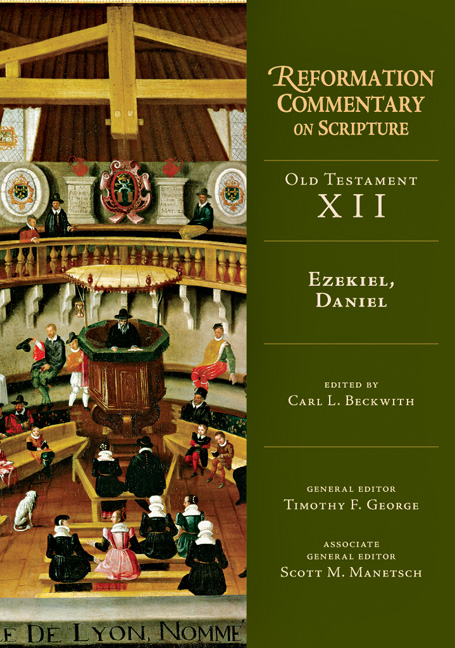
Book Review of Ezekiel, Daniel; Reformation Commentary on Scripture, Volume XII edited by Carl Beckwith


Ezekiel, Daniel


Ezekiel, Daniel
Volume XII
Reformation Commentary on Scripture
by Carl Beckwith
ISBN 978-0-8308-2962-0
Published by IVP Academic
Reviewed by Clint Walker

Ezekiel, Daniel by Carl Beckwith is the second book published in what is expected to be a twenty-eight volume commentary series entitled The Reformation Commentary on Scripture. In each volume the editors attempt to assemble the teachings of the leaders and theologians of the Reformation, paying attention to both the most influential leaders as well as the diversity of thinkers throughout the movement.

This is an excellent commentary. As is true with many of the best commentaries, the introduction is a must read, and lays the foundation for the rest of what follows. In this introduction, Carl Beckwith helps us understand that Exekiel was not a high priority for the reformers to write about for most of their lives. Neither Calvin or Luther wrote a complete work on Ezekiel, although Calvin was trying to preach through at the same time he was dying. Daniel is a little more commonly studied by the most well-known reformers, mostly because of its role in messianic and apocolyptic prophecy.

Another thing that you learn from the introduction to Ezekiel, Daniel is that the editor makes liberal use of the independent and Anabaptist reformers. At points, even John Bunyan is included in this commentary. I was happy to see Richard Baxter was used as a resource as well.

I think this may be the case for two reasons. First, I think resources in certain sections of Ezekiel was hard to find, and thus the editor had to be more generous in his sourcing. Also, I wonder if the fact that Beckwith serves at a seminary that has more independent and Baptist leanings makes him more interested in what the reformers from those backgrounds have to say.

Throughout the book, with sources many may have heard of, and reformers they have never heard about, the reader is challenged to come back to the basics of what the Bible is saying. There is something good and right about reading interpreters that are not from one's own era. It helps the teacher of Scripture see God's Word from outside of their narrow circumstances and world view, and to understand the Word of God in greater context.

I spent a lot of time looking up my favorite passages, and reading what the saints of old had to say about the passages that speak so much to me. Often times, because the writers of old seem to have a way with the written word that allows the teachings they share to hit me in a whole new way.

Tuesday, March 20, 2012

Book Review of Women and Redemption by Rosemary Radford Ruether


Women and Redemption: A Theology History
by Rosemary Radford Ruether
ISBN 978-0-8006-9816-4
Published by Fortress Press
Reviewed by Clint Walker

Rosemary Radford Ruether is one of the luminaries of feminist theology, especially Christian feminist theology. This year, Fortress Press is releasing a improved and updated second edition of Women and Redemption: A Theological History, which is a historical survey of the church from a feminist perspective.

As most of my readers know, I would consider myself an egalatarian, and in some sense of the word I might consider myself a feminist. I have advocated for use of inclusive language for humanity in Scripture and worship. I cringe when I hear people say "mankind" instead of "humankind" the same way I cringe when people say "colored" to refer to African-Americans. I have worked hard to find down-to-earth ways to support women in ministry in the local churches I have served, even when the theology of many in the church ran counter to the equal partnership of women. I would not, however, consider myself a "feminist theologian". I believe that much of the modern feminist theology has sought to neuter the gospel instead of release the full-gospel in its full power.

Having said that, I could not recommend Women and Redemption more highly for anyone who is interested in understanding feminist issues and their influence on the church. Ruether has put together an excellent summary of how women have influenced the church, and how concerns about the inclusion and importance of women and women's issues has influenced the church from ancient days until today. She rightly describes the many ways that women have been marginalized in the church, and she rightly describes feminine heroes of the church throughout the last 2000 years as well. Not all of us will resonate with Mary Daly, and her post-ecclesial feminist theology, but we may find a lot of admiration the women of the Women's Sufferage Movement and their grounding of their struggle for equality in the Christian movement.

To be honest, the importance of this book for pastor-theologians as well as academics and ministers-in-training is not its prescriptive function, but rather its descriptive function. It spells out, in language a freshman in college should easily be able to navigate, what feminist theology is, and how its concerns manifest themselves in historical theology, social activism, the field of biblical studies, as well as many other theological concerns. From there, readers should be able to have an educated idea of what feminist theology is, and what parts of it they may accept or reject, and why.

This book would be an excellent textbook, as well as a reference resource for pastors and Christian leaders.

Monday, March 19, 2012

Book Review of Jesus + Nothing = Everything by Tullian Tchividjian


Jesus+Nothing=Everything
By Tullian Tchividjian
ISBN 978-1-4335-0778-6
Published by Crossway Books
Reviewed by Clint Walker

Tullian Tchividjian was at a crossroads in his ministry. His church had recently merged with a nationally renowned church in his community. The church he founded was cutting edge, with a meaningful outreach to their metro-area. The church he was merging with was declining, and their founder and pastor had recently passed away. After a brief adjustment period, many people from the former church were disparaging him and his ministry. Some were even insistent that the church go another direction with their pastoral leadership. Slowly Tchividjian was reaching a breaking point. He took a vacation to have some time away from the stressful ministry he was leading, and to seek what God wanted him to do. During his devotional time, he began to read Colossians 1. As he read, Tchividjian became convinced of the supremacy of Christ over his situation, and became renewed in his faith and his ministry. He became convinced of the equation that is written into the title of the book: Jesus+Nothing=Everything.

Much of the book, after telling a little bit of this story of struggle, is an in-depth study of the book of Colossians.  Tchividjian is a wonderful teacher of this material, moving deftly between the meaning of the text, and the pastoral implications of what he is teaching. Throughout the entirety of this book, he teaches of the power of Jesus over everything in the universe, including our own little place in it.

A great book. Both inspirational and instructive.

Sunday, March 18, 2012

Book Review of Transforming Vision by Elisabeth Schussler Fiorenza


Transforming Vision: Explorations in Feminist The*logy
by Elisabeth Schussler Fiorenza
ISBN 978-0-8006-9806-5
Fortress Press
Reviewed by Clint Walker

Elisabeth Schussler Fiorenza is a well-known leader in feminist liberation theology. She has written a large number of books, and has also wrote many articles and essays in monographs over the years. Now in her mid-seventies, Fiorenza has signed a contract to publish three books that compile many of her shorter works into books. Transforming Vision is the first book in that series, bringing together some of Fiorenza's most well-written essays on feminist theology.

The essays in the book cover four main topical areas:

  • The relationship between feminist theory and feminist theology
  • How feminist theology leads to praxis of women's liberation within the church and the world
  • Areas of struggle and of hope for feminist theology within the ecclesiastical structure of Catholicism
  • How feminist theology effects our spirituality and our understanding about who God is
Fiorenza is a smart lady. This shows in her writing. Each essay is well-written. Many of the essays require the reader to slow down and really make a concentrated effort to understand what is being said. This is because she is philosophically sound, and very thorough in her arguments.

In multiple places in Transforming Vision, Fiorenza creates new spellings and words for the feminine that attempt to begin to cleanse the language of patriarchal oppression. I found this awkward, but not so much that it made reading the context of the book unreadable.

This book is bound to be a textbook for people seeking to learn about how to be a feminist theologian, or in many cases it might be on a pastor's bookshelf who has an interest in theological trends and gender equality. Transforming Vision in many ways is a "highlight reel" of Fiorenza's feminist work, and will be helpful to those that admire her work and/or share her viewpoint.


Friday, March 16, 2012

Book Review of Bloodlines by John Piper


Bloodlines: Race, Cross and the Christian
By John Piper
ISBN 978-1433528521
Published by Crossway Books
Reviewed by Clint Walker

I have read several of John Piper's books. I am never neutral about any of them. Some of his books I find myself in profound disagreement with, especially in regard to the egalitarian/complimentarian debate. Other books by Piper I have found extremely edifying. I place the book Bloodlines: Race, Cross and the Christian among those that I would recommend to anyone. Among Piper's books, I would place it second to Desiring God in its power, clarity of communication, and importance.

In this book, Piper openly shares how he came to the place where he felt he needed to write Bloodlines, and how his personal issues influence his interest and passion on the issues of racial and ethnic equality and justice, especially within the family of God. Many people will find the first few chapters, which share about Piper's personal journey on this issue, highly compelling and worth the price of the book. Those readers will also learn that his passion for this issue has had a profound impact on his life and his family. Piper has not just chosen to preach about this issues, he has also found ways to practice what he preaches.

Piper also clearly explains why racist attitudes are antithetical to the gospel of Jesus, and poisonous to the family of God. He approaches concerns about race from a number of angles, over and over again sharing about how the Bible speaks to this sin in our lives and in our society as a whole.

In the final few chapters of the book, Piper has chosen to address real-life issues in our society and in our churches that our influenced by our racial attitudes. Some of these issues are issues where he has had a conversion of sorts from his younger years. The appendices continue to aid readers in dealing with the issue in their congregations and everyday lives as well.

All in all a good book. And one that deserves a broad audience.

Thursday, March 15, 2012

Book Review of Teaching through the Art of Storytelling by Jon Huckins


By Jon Huckins
ISBN 978-0-310-49409-6
Zondervan Press
Reviewed by Clint Walker

I was a youth pastor for twelve years. As I Senior Pastor, I have also strove to be connected to the youth of my congregation, and to keep in touch with issues related to youth ministry. Imagine my surprise then, when I picked up Jon Huckins’ new book, and discovered a whole new method for doing youth ministry.  Teaching through the Art of Storytelling combines the old-fashioned “youth-talk” with sensitivity toward postmodern culture and a high regard for Jesus’ method of teaching into a fresh, innovative, story-driven pedagogy.

Huckins’ urges youth leaders to create and use fictional stories to communicate Biblical truth. He talks about how Jesus did this, primarily through parables, and how this kind of storytelling has precedence throughout Scripture. He teaches youth leaders a philosophy of how to teach through fictional narrative. After that, Huckins goes through the nuts and bolts of how create and implement these narratives. At the end of Teaching through the Art of Storytelling several examples of fictional narrative as teaching tools are provided for teachers to use, and to model the stories they create after.

I think that this book would be a helpful tool in a youth minister’s toolbox. It is thoughtful and creative. If used correctly, it will allow youth leaders to speak into their students’ lives in a whole different way. After all, who does not appreciate a well-crafted story? We all remember stories more than we do abstract truths and facts anyway.

I do think, however, that use of this technique requires some wisdom. If this way of teaching is used too often, it may diminish the effectiveness of the methodology as a whole. Also, I do not think everyone is gifted enough to use this way of teaching effectively. So, if creating and telling stories is not something you feel utilizes your gifts, you may want to find another way to reach the teens you are working with. As I said previously, this is one tool in a toolbox of teaching techniques. It is not a magic bullet.

All in all though, this is a great resource, and deserves to be on every youth leader’s bookshelf. Even if one is not a storytelling type, understanding the importance of narrative and narrative formation in adolescence is a key to reaching today’s youth.

Tuesday, March 13, 2012

Book Review of Folly, Grace, and Power by John Koessler


ISBN 978-0-310-32561-1

Published by Zondervan

Reviewed by Clint Walker


Most preaching books read like how to manuals. They instruct you on how to study your Bible as you prepare your sermon, they often give you helpful hints on how to use speech skills to communicate effectively, and many preaching books may give you ideas on how to be more “contemporary” or “user-friendly”. For people who grown have tired of books on preaching like this, Folly, Grace and Power by John Koessler will come as a breath of fresh air. Koessler asks and begins to answer the questions, “Just what is God doing when his word is preached?” and “How do we understand the preaching event theologically?”

These questions are essential in our day and time. Too much of what passes for teaching and preaching in our culture is pure drivel, with all of the appeal of an infomercial. Koessler brings us back to basics in Folly, Grace and Power, as he challenges us to notice what God does through preaching, and how the act of preaching can be done in a way that honors the mysterious power and work of Jesus Christ.

Much of this text is not easy for the typical preacher to hear. Folly, Grace and Power challenges its readers to pay more careful attention to what is happening when the gospel is preached, and to preach with excellence in order to please God and not to please human beings. Over and over again, in its own way, it challenges those that preach to have the courage to be honest, even when it is not easy. Koessler says toward the end of the book, “Preaching is having the last word. To preach is to take your stand before the pit and bear witness to the rubble of this ash-heap world that the kingdom of God is at hand….preaching is an eschatological act” (p. 130).

Koessler believes that most pastors have abdicated their posts as their church’s resident theologians. At times, he argues, this is because it is difficult to bridge the gap between the theology of the academy, and the lived theology of the lay person. So pastors either chose to preach over their congregation’s head, or they avoid theology entirely. Instead, Koessler encourages us to communicate good theology in ways that the average person can understand. In this sense, the pastor is a translator or intercessor of sorts between God and his people.

I believe that Folly, Grace, and Power is one of the best preaching books to come out in years. For the careful reader, it will encourage pastors and lay persons to put, “first things first.”

Friday, March 09, 2012

Book Review of Invitation to Biblical Interpretation by Kostenberger and Patterson


INVITATION TO BIBLICAL INTERPRETATION
by Andreas J. Kostenberger and Richard D. Patterson
ISBN 978-0-8254-3047-3
Kregel Academic and Professional
Reviewed by Clint Walker
(book provided for review by publisher)

I am not one of those people who disparage seminaries, or my seminary education. I believe I learned a lot of helpful things in seminary, and probably forgot even more things that would help me as a pastor today. I am sad, however, that we did not have a hermeneutics course when I was in seminary. In college, I had a class on biblical interpretation, which combined inductive Bible study techniques with some hermeneutical issues. In seminary, our school's philosophy was to integrate hermeneutical principles into our entire curriculum. Yet, every time I read and hear about the discipline of hermeneutics, I feel like there is a big gap in my theological education. Mainly, this is because I do not know the jargon, the lingo, and such.It is for this reason that I decided to get a hold of the book Invitation to Biblical Interpretation by Kostenberger and Patterson.

Kostenberger challenges his readers to use a triad of resources in interpreting Scripture's meaning. He argues that readers of Scripture must understand the Word of God in its literary context. He then challenges readers to put Scripture in its literary context. Finally, Kostenberger and Patterson argue that with these two tools we can begin to formulate a theology. That theology will then inform how we interpret other texts.

Although the authors' hermeneutic is a little bit more fundamental and (reportedly) patriarchal than mine, I think this is a great resource for introducing the practice of biblical theology. There are several things I like about this book. First, it has an uncanny ability to integrate academic concerns with real life interpretation for those leading  everyday working people.

Not only will I learn a lot by having this book on my shelf; I am also aided immensely by the way the authors have laid out the material in a way where I could communicate the truths of this book simply to others. For instance, the three parts of the triad are easily communicated when teaching others about interpreting Scripture. The extended outline at the beginning, as well as some of the hints in the introductory material of the book will make this book easy to use with a class in an academic setting. If one wanted to do a "baby hermeneutics" class in the church, this book would be a good resource to guide one's presentations (though the book itself might be less interesting to people in Sunday School).

If you are a biblical conservative, you want to understand how to interpret Scripture faithfully, and the flashy paperbacks on the issue did not go into enough depth, this might be the book for you. It would also be a great book for a college religion class.

Book Review of Mornings with Jesus 2012 from Guideposts


Written by Judy Baer, Gwen Ford Faulkenberry, Tricia Goyer, Sharon Hinck, Keri Wyatt Kent, Erin Keeley Marshall, and Camy Tang
ISBN 978-0824945046
Published by Guideposts
Reviewed by Clint Walker

Guideposts  has long been a leader in providing daily devotional material for folks in churches. I grew up with my mother having guideposts material on her nightstand, and with women in the church having Guideposts material on their end tables and coffee tables.

This year, the devotional “Mornings with Jesus 2012” has passed across my desk for review. There is much to commend about this fine devotional. First, it is authentic and down to earth. Many devotionals can come across as overly spiritual. Not this one. One devotional thought by Keri Wyatt Kent who was talking about a particularly difficult time in her marriage, and her need to win an argument particularly stood out to me. 

Also, included among the writers of these devotionals are competent, articulate women who are accomplished writers as well as younger women who are up and coming Christian leaders. Many of these women have name recognition through their writing and speaking ventures. Many Christian women will be already comfortable with their voices. On a personal note, I am also thankful that most of these devotionals are about real-life issues. Much of what I remember from Guideposts was about stories of encounters with angels by Guideposts readers. To be honest, all the Guidepost stories about angels have kind of burnt me out on angel stories.

What the reader needs to know before purchasing the book, and this should be obvious at this point, is that this devotional is geared toward women. It is written by women for women. It discusses issues from a woman’s point of view. And, the current cover looks like it could also be a stock photo for a feminine hygiene product. So, this would be a great gift for a mother or wife, or even a grandma. But if you are looking for a devotional for the man in your life, look elsewhere.

All in all though, Mornings with Jesus l accomplishes its purpose. It speaks to its audience in a way that not only touches their souls, but also gets into their lives with the intent of changing it. You can’t ask for much more than that.


I have two copies of this fine book to give away. If you want to win the book, leave a comment on facebook or on this blog, or email me about what devotionals you use, why you use them, and how you have found them helpful. Thanks!

Monday, March 05, 2012

Local Lakes and Campgrounds


What we are missing about the debate on birth control


I am a news junkie. I admit it. Lately I have been watching the surreal debate of the Republican Party on birth control. Unfortunately, I am not in a position to have enough information to make an informed statement on birth control in Catholic churches. Generally I think:

1. Catholic churches should not be required to have birth control in their insurance policy if they believe it violates their conscience.

2. If the Catholic churches choose not to offer birth control on their employee insurance policies, then they should be required to reject all government subsidies for insurance and completely fund all full-time employees' insurance without government help.

But really, this debate is not what intrigues me. Rather, I am fascinated at how a rather simple invention has utterly transformed our culture. Think about what our country and world would be like without birth control. I would venture to guess that without birth control:

1. We would have less women in the workplace
2. We would have less productivity as a nation
3. We would not have the relative wealth and power that we have in America

I also wonder if:
1. The cold war would have been won without the advent of birth control

What do you think? How has birth control changed the world? For the better or the worse?

The Cost of Community by Jamie Arpin-Ricci, C.J.

book cover

The Cost of Community: Jesus, St. Francis, and Life in the Kingdom
Jamie Arpin-Ricci C.J.
ISBN 978-0-8308-3635-2
IVP Books
Reviewed by Clint Walker

Many of my long-time readers may know that I have a long-time fascination with St. Francis and his organic mix of deep Christ-centered spirituality and a true commitment to ministries of compassion and mercy. As many of my friends I have served in ministry know, in the last 5-10 years I have also developed a little bit of a fascination with the Sermon on the Mount, and how it so succinctly and wisely shares about the power of the kingdom of God. So, when a book came along that tried to communicate how a intentional community of Christian disciples integrated these two streams of teaching into their daily life, I knew I had to have it.

The Cost of Community is written by Jamie Arpin-Ricci. Ricci is the leader of a Winnepeg community named "The Little Flowers Community". The community tries to reach out with mercy and grace in a neighborhood that desprately needs the presence of an invested Christian witness. This book, though, is not primarily about the work of this group of disciples in the difficult environment in which they live. Instead, it is about the kind of community God is calling them and us to be as followers of Jesus and St. Francis, combined with some clues on how the people of "Little Flowers" are forming this unique kind of community within their context.

The structure of the book follows the content of the Sermon on the Mount. Ricci takes the sermon section by section. He explores what kind of community Jesus is attempting to form through his words in the sermon. He then talks a little bit about how the values of St. Francis of Assisi modeled the truth of the gospel as taught by Jesus' Sermon on the Mount. Throughout this analysis, Ricci shares stories about how these concepts are lived out in the community he leads. Nearly every chapter ends with a chapter or two challenging readers to bring certain values, attitudes, and behaviors into the Christian communities of which they are a part.

The Cost of Community is a neat book. It will be inspiring for many avid Christian readers. I do think, however; that this book can be best used in the following ways.


  • Read a chapter of this book a week. Ponder it. Think on how to integrate the truths of this book into your everyday life.
  • Read a chapter a week as an intentional study group. Talk about how you can embody what you learned in each chapter within how your small group does discipleship and life together.
  • Form an intentional community of disciples that share a common life. Use this to guide you as you create a "rule of life" for your community.

Thursday, March 01, 2012

Book Review of You Lost Me by David Kinnaman

You Lost Me, David Kinnaman, 978-0-8010-1314-0


You Lost Me: Why Young Christians are Leaving the Church

By David Kinnaman

ISBN 978-0-8010-1314-0

Baker Books

Reviewed by Clint Walker


A few years ago, David Kinnaman and Gabe Lyons penned an insightful book entitled unChristian: What a New Generation Really Thinks about Christianity and Why it Matters. The book was a groundbreaking study on adults who graduated high school after the beginning of the new Millennium, often either called Millennials or Mosaics by generational theorists. Specifically, unChristian focused on the large amount of unchurched young adults, and the barriers that kept them from being receptive to the church.

Now, in the next book in the series, You Lost Me, Kinnaman takes the next step in his study of these emerging adults. You Lost Me explores how Christian young adults are becoming disaffected with the church. Specifically, Kinnaman discusses the reasons Mosaics have for distancing themselves from worshipping congregations, the ways that they have of taking space from involvement in traditional church organizations, and ideas to reach this generation that is leaving the church en masse. You Lost Me challenges believers to take time to understand the millennial generation, and find ways to reach them with the truth and the grace of God.

The first part of this book discusses who the “church dropouts” are, and why they are dropping out. Kinnaman points out that youth involvement in churches remains relatively strong, but that many people are leaving home after high school and never returning to the church. He correctly notes that this has happened in generations past as well, but believes that this generation does not have the foundation of family and cultural structures that will eventually lead them back into the fellowship of a worshipping Christian community.

You Lost Me categorized dropouts into three broad categories: exiles (actively Christian but have problems with church institutions), dropouts (people who love Jesus, but don’t make space in their lives for church), and prodigals (young adults who have made a conscious commitment to reject the faith they were raised in). Kinnaman makes a point that not everyone leaves churches for the same reason, and that we need to remember that “every story matters”, and that we should not be eager to lump all people disaffected by institutional Christianity together.

The second third of the book shares some issues that nudge people out of the doors of the church. Almost all of the issues that the author describes tend to revolve around an antipathy toward church communities claiming any sort of moral, personal or institutional authority.

I was a little concerned, as I am with all books coming out of the Barna Group, that perhaps the book and the study too easily categorized people into groups and gave those people labels. This, in my opinion, can defeat the purpose of challenging everyone to get to know each individual’s story.


All in all though, I thought that this book offered some poignant analysis. Much of it, if taken seriously, will be helpful for congregations that are eager to reach out to younger believers and keep them as a part of their church family. For pastors and church leaders eager to move their congregation toward reaching emerging generations, some of the statistics and insights in the book will be helpful in convincing their congregation to make some intelligent, healthy changes in what their churches do and how they function. And as a person in the age group that this book describes, I can see and hear examples of friends that mirror some of the descriptions in this book as well. You Lost Me is a book I will return to more than once as I attempt to explain people my age to family and fellow church members that just do not understand them.


Monday, February 27, 2012

Book Review of Rethinking the Trinity and Religious Pluaralism by Keith E. Johnson


Rethinking The Trinity and Religious Pluralism: An Augustinian Assesment
by Keith E. Johnson
ISBN 978-0-8308-3902-5
Published by IVP Academic
Reviewed by Clint Walker

Throughout much of the enlightenment, Christian theologians began to move away from a Trinitarian theology of the Godhead. Instead of embracing the Trinity, they often tried to reduce Christianity to an ethic for living modeled by the person of Jesus (see Schliermacher and Kant). In the 20th century, with the magisterial works of the Protestant Karl Barth, and the Catholic Theologian Karl Rahner, embrace and study of the Trinity experience a revival in Western Christian theology. This is a good thing.

What has been a negative consequence of a revival of interest in Trinitarian theology is people who use the Trinitarian language of God for their own ends. One of the ways this has been happening in recent decades is to use the language of the Trinity to promote some sort of semi-universalist Christian doctrine of salvation.

This kind of pluralism cannot be justified by any honest reading of Scripture and church tradition. Keith Johnson, in his book Rethinking the Trinity and Religious Pluralism, attempts to use logic, the teachings of Augustine, and orthodox Christian doctrine to show how a broad-based embrace of religious pluralism and the Christian doctrine of salvation are incompatable.

I think Johnson does an admirable job taking on a very tedious task. He methodically lays out his point of view, he addresses the theology of four theologians who embrace the Trinity as a tool for bringing an unbiblical theology of Christian pluralism into the church, and then he plots a future for articulating a Trinitarian evangelical theology of salvation in the context of interfaith dialogue.

This book was a challenge for me, but in a good way. The author is smart. His audience is definitely among those in academic and intellectual circles. His subject matter is tedious. To really understand what is happening in the context of this book, you need to take time to digest it and process it. It is a well-written book, but it is not for the average lay person in the pews.

This book is an excellent text for Christian pastors seeking to develop an intellectually grounded Christian apologetic. Not only will this book get its reader to get thinking about challenging issues relating to the Trinity, it will help them think more deeply about to communicate their faith in general. Which is, by the way, never a bad thing.

Friday, February 17, 2012

Book Review of the Desert Fathers and Mothers translated by Henri L. Carrigan


The Wisdom of the Desert Fathers and Mothers
translated by Henry L. Carrigan
ISBN 978-1-55725-780-2
Published by Paraclete Press
Reviewed by Clint Walker

There are many books out there that contain excepts of the teaching of Desert Mothers and Fathers. I have several of them. The Desert Fathers were brilliant thinkers as well as deeply spiritual women and men. Many of them left behind collections of teaching and aphorisms that people study today.

In The Wisdom of the Desert Fathers and Mothers Henry L. Carrigan collects and translates many of these wise words for a new generation. He chooses to translate the sayings in the kind of English that is used today. He also artfully arranges and organizes the sayings of the Desert Fathers and Mothers so that they are accessible to all of us.

The first challenge of a translator of this material is choosing what sayings and people to include, and what ones to exclude. Carrigan weights his material towards those who were most prominent, which is appropriate. He also includes many other Desert Fathers after the most prominent ones.

What I enjoyed was his organization of the "lesser fathers and mothers" sayings by who said them, and by alphabetical order of the desert parents' names. This made each individual person more accessible. It also showed the diversity of thinking among the Desert Fathers and Mothers, with some being less stern and more graceful, and others being more strict and legalistic. It becomes easy to understand which teacher would have spoke to you, and which of the desert fathers would have really challenged people like you and I.

The "extras" in this book make it even more valuable.The book has a forward by Jonathan Wilson-Hartgrove, who is a leader in what is called the "New Monastic Movement". His testimony of how the Desert Mothers and Fathers changed his life makes their teachings even more attractive for those who want to learn more about what they said. The introduction to these folks by the translator gives good historical context to these church luminaries in a way that is easy to understand.

I have several books containing the sayings of the Desert Fathers and Mothers. So far, I like this collection and Thomas Merton's the best.


Book Review of Mark: Gospel of Passion by Michael Card


Mark: The Gospel of Passion
by Michael Card
ISBN 978-0-8308-3813-4
Intervarsity Press
Reviewed by Clint Walker


I have long been an admirer of Michael Card. I first became familiar with him, as many Christians have, through his music. His music mixes simple acoustic melodies with lyrical profundity that touches the heart with conviction and comfort. Card's songs demonstrate what can happen when a creative mind that longs to communicate the good news of Jesus engages the Scripture and theology with intelligence and spiritual depth.

Now, Michael Card has begun to take on the task of writing commentaries on the gospel. Last year, Card released his commentary on Luke, which was very well received. This year, he is releasing Mark:The Gospel of Passion. I believe this commentary will also receive accolades and admiration for its combination of depth of thought and clarity of communication.

I am well-versed in Scripture. I have a degree in theology. Yet, as I read Michael Card's commentary on Mark each page jumps forward with a new insight and with new depth of meaning. In the introduction, Card does a good job with allowing his readers to enter into the story of the context in which the gospel of Mark is written. He notes several things about the text that many other commentaries miss. I was especially impressed with Card's discussion of the way Mark's description of Jesus puts the Lord's emotional life on his sleeve, and lets us not only hear what Jesus was saying, but how he was feeling.

Mark: The Gospel of Passion also presents an outline of the book that drives the readers understanding of the content of Mark. Through carefully expanding upon and using an outline of Mark in order to explain the gospel, he allows the reader to see the "movement" in the gospel from beginning to end. This is very helpful.

The appendices in the book are also well done and informative. Card argues well for the early ending for Mark in this section for example.

With the gospel of Mark so prominent in the lectionary this year, Card's commentary will be helpful to many Christian leaders in lesson and sermon preparation.  This book would also be helpful for someone trying to study the gospel of Mark on their own. This is a great commentary for lay persons,and should be picked up by anyone who wants to learn more about the Gospel of Mark,

Tuesday, February 14, 2012

Book Review of Straight to the Heart of 1 & 2 Corinthians


Straight to the Heart of 1 & 2 Corinthians
Phil Moore
ISBN 978-0-85721-002-9
Monarch Books
Reviewed by Clint Walker

Lately, there have been several devotional commentaries that have tried to make their way into the Christian book market. More and more people want to do a book by book study of Scripture, having the opportunity to study the Bible passages in context and get a feel of the narrative that book is embedded within.

One of the newest of these new commentaries comes to us from a pastor in England named Phil Moore. Pastor Moore leads a church in Wimbledon and works within a leadership of innovative churches. The series, entitled the "Straight to the Heart" series, attempts to offer "bite-sized" insights of specific sections of Scripture.

The book that I was given the opportunity to review is called Straight to the Heart of 1 & 2 Corinthians. It has sixty brief teachings on 60 different passages within Paul's correspondence to the Corinthians. In addition to the nuggets of wisdom on each of the passages, Rev. Moore introduces different sections of these books, noting movements of themes and purpose. This is especially helpful in the Corinthian correspondence.

The author writes in a way that catches the readers attention. He is earthy without being crass or vulgar. For instance, his titles for different sections both summarize the content and make the reader want to know more about what he is saying. Some of these sections are entitled "Sex in the City" and "Bread, Wine, and Poison".

The catchy titles also lead to well-written devotional summaries of specific passages that get right to the heart of what is happening and deftly relate the ancient text to modern life.

Although I enjoy this book, I do a have a few disappointments. First, I would have created a cover for the book that reflects the author's biblical yet edgy voice. The current cover is far too fuddy-duddy. Also, I was disappointed that the author was not as strongly progressive on the complimentarian-egalatarian issue as I would hope.

Other than that, I think this is a great text. I would recommend it to about anyone in the church I serve as pastor.

Reformation Commentary of the Bible: Old Testament Volume XIII--Psalms 73-150

Reformation Commentary of the Bible: Old Testament Volume XIII--Psalms 73-150  Edited by Herman J. Selderhuis IVP Academic ISBN 978-0-8308-2...