When I was just beginning my service for the kingdom of God while I was stationed in Belgrade, Montana, I had the privilege of serving 9 months with a pastor that was an awful supervisor, and a great mentor and pastor to his congregation. There are several sermons I still remember snippets of from memory of his sermons, which I can say about very few others. One of the sermons I remember best was his last sermon at Belgrade Community Church.
The sermon was based on the last sentence in I John "my little children, keep yourselves from idols". There was a lot about Dosteovesky and the novel the Brothers Karamazov. And, even more memorable, there was a lot about signposts.
In this part of the message, he warned against fads in spirituality, and about trying to build ourselves up into false gods of our own making. He also talked about how really what God has called us to be was signposts. Like John the Baptist in the famous painting where he is working to move to the sideline while pointing to Jesus, Pastor Dave compelled us to believe that we are called to be nothing more than an arrow pointing to Jesus Christ and his kingdom. Like roadsigns along the interstate, we are meant to provide direction for others to find Christ and his kingdom.
As I was rereading this concept from another author and preacher, I began to wonder about how this works in my own spriritual journey. I think about the whole roadsign metaphor, and so often I feel like I am this lowly roadsign announcing an upcoming turn, while surrounding me are larger, brighter and more colorful billboards announcing exciting destinations where people can gamble and put their kids on waterslides. Where once I was a bright and sturdy sign that was brand new, I am now a roadside sign battered by winter storms and peppered with bullet holes from a shotgun on my lower-right corner. These years in Colorado have certainly been the most trying of not only my calling, but of my faith in general.
And lately, I have been wondering, whether to honestly stand strong in the middle of storm after storm, seemingly worse for wear, is actually doing anyone else any good. Does my honesty about what is on my heart commend my faith, or push people away from it? Does my willingness to remain firmly rooted in the storm that seems to perpetually surround the ministry I am a part of make me a more effective signpost, or not?
These thoughts are unfinished, but this is what is on my heart today.
Thursday, March 01, 2007


Monday, February 26, 2007
Race, Entertainment and Spor\ts

I do not watch awards shows. They are boring, and watching the Oscars is about as masculine as dancing around the room listening to show tunes. However, as I watched the movie "Goodfellas" with Jen I also kept track of the academy awards on the computer (This seemed a little bit more manly than actually watching the show--and I did not have to watch all the foo-foo-a-roo waiting to watch the show)
One of the things that impressed me about the choices was that the racial diversity of the winners was not an issue, which makes it seem to me that we are making a little bit of progress. Forrest Whitaker is one of my favorite actors, so it was great to see him win for a movie I plan to see this week.
Even more, I thought it was interesting to see a book review on ESPN about the book BLACK ICE, which is about the black role in the development of modern hockey. It seems the hidden truth is that black folk may have been a part of the invention of hockey (part of an interracial group of people who was playing in the first game), and more clearly inventors of many modern innovations in the game (such as the slap shot) in Nova Scotia.
How cool!
Sunday, February 25, 2007
More Thinking on the Issue of Homosexuality

I have recently completed two books on the subject of homosexuality. One is edited by Walter Wink, and is called HOMOSEXUALITY AND THE CHRISTIAN FAITH. The other is called WELCOMING BUT NOT AFFIRMING and is written by the late Stanley Grenz.

Wink's book is affirming of homosexual behavior in the Christian community as an ethical lifestyle. Grenz seeks to have the church be as welcoming as possible without affiming that homosexual behavior is ethical according to biblical standards.
Wink's book had a few excellent points that I will have to give serious consideration to, however, I tend to lean more toward Grenz's book as the one that is more faithful to Scripture.
The affirming book tended to have a lot of good sentiment, but not a lot of strong theological foundation. It too easily skimmed over the writings of Paul on the matter, and then made an argument based on the silence of the gospels on homosexuality.
The welcoming book was well-written with cogent arguments, but needs a revision that speaks a little more to recent developments in historical scholarship on the issue of same-sex marriage.
All and all, the books when put together give a good picture of the issue as a whole.
On Custormer Service
Although there are several ways that I strive to be progressive, there are many other ways that I am simply an old fashioned guy. One of those is that I am a stickler for customer service. Lately, however, my standards for customer service have been lagging far behind those I seem to owe money too.
The other day, I was checking on an error on my American Express Credit Card. And it turned out that they had a crash on their computer, which they were working on, and that somehow my payment was registered under "payments" but not credited to my account. Needless to say, I was a little frustrated. But, because I try to be kind to customer service representatives, I was trying to be patient. Then, while we were discussing reversing late charges because of their error, I was told that my late fee would be "pardoned". This did not sit well with me. A pardon is something that one offers to a guilty person so they will not have to pay a penalty for their crime, not something that is offered to a person who is wrongly penalized for a wrongdoing. What they were offering, and rightly so, was eventual restitution, not pardon. I corrected them on this in a calm yet firm vocal cadence, and the Customer Service Person's mood immediately became more cooperative. I suppose this is partly because I prefaced my statement with "I know you are just reading from a customer service script and trying to do your job but..." Nevertheless, I began to wonder who was exactly training these folks.
Then I went into the office at my apartment complex to renew my lease. They informed me that if I decided to stay that my rent would go up but they would generously grant me a $30 "concession" if I chose to stay. I had to make a double-take as he used the word "concession". The previous ownership had used the words "discount" or "bonus", but now they are conceding me something. What a poor word to use in their customer service, especially as they are moving in thousands of dollars of fancy furniture at the expense of my raised rent? What ever happened to kindness, to customer service, to caring? Now I am left with a "concession"...like they are conscending to even offer me anything. I was so angry!
What trends have you noticed about customer service? Where have you been treated poorly? What has made you angry?
The other day, I was checking on an error on my American Express Credit Card. And it turned out that they had a crash on their computer, which they were working on, and that somehow my payment was registered under "payments" but not credited to my account. Needless to say, I was a little frustrated. But, because I try to be kind to customer service representatives, I was trying to be patient. Then, while we were discussing reversing late charges because of their error, I was told that my late fee would be "pardoned". This did not sit well with me. A pardon is something that one offers to a guilty person so they will not have to pay a penalty for their crime, not something that is offered to a person who is wrongly penalized for a wrongdoing. What they were offering, and rightly so, was eventual restitution, not pardon. I corrected them on this in a calm yet firm vocal cadence, and the Customer Service Person's mood immediately became more cooperative. I suppose this is partly because I prefaced my statement with "I know you are just reading from a customer service script and trying to do your job but..." Nevertheless, I began to wonder who was exactly training these folks.
Then I went into the office at my apartment complex to renew my lease. They informed me that if I decided to stay that my rent would go up but they would generously grant me a $30 "concession" if I chose to stay. I had to make a double-take as he used the word "concession". The previous ownership had used the words "discount" or "bonus", but now they are conceding me something. What a poor word to use in their customer service, especially as they are moving in thousands of dollars of fancy furniture at the expense of my raised rent? What ever happened to kindness, to customer service, to caring? Now I am left with a "concession"...like they are conscending to even offer me anything. I was so angry!
What trends have you noticed about customer service? Where have you been treated poorly? What has made you angry?
On Custormer Service
Although there are several ways that I strive to be progressive, there are many other ways that I am simply an old fashioned guy. One of those is that I am a stickler for customer service. Lately, however, my standards for customer service have been lagging far behind those I seem to owe money too.
The other day, I was checking on an error on my American Express Credit Card. And it turned out that they had a crash on their computer, which they were working on, and that somehow my payment was registered under "payments" but not credited to my account. Needless to say, I was a little frustrated. But, because I try to be kind to customer service representatives, I was trying to be patient. Then, while we were discussing reversing late charges because of their error, I was told that my late fee would be "pardoned". This did not sit well with me. A pardon is something that one offers to a guilty person so they will not have to pay a penalty for their crime, not something that is offered to a person who is wrongly penalized for a wrongdoing. What they were offering, and rightly so, was eventual restitution, not pardon. I corrected them on this in a calm yet firm vocal cadence, and the Customer Service Person's mood immediately became more cooperative. I suppose this is partly because I prefaced my statement with "I know you are just reading from a customer service script and trying to do your job but..." Nevertheless, I began to wonder who was exactly training these folks.
Then I went into the office at my apartment complex to renew my lease. They informed me that if I decided to stay that my rent would go up but they would generously grant me a $30 "concession" if I chose to stay. I had to make a double-take as he used the word "concession". The previous ownership had used the words "discount" or "bonus", but now they are conceding me something. What a poor word to use in their customer service, especially as they are moving in thousands of dollars of fancy furniture at the expense of my raised rent? What ever happened to kindness, to customer service, to caring? Now I am left with a "concession"...like they are conscending to even offer me anything. I was so angry!
What trends have you noticed about customer service? Where have you been treated poorly? What has made you angry?
The other day, I was checking on an error on my American Express Credit Card. And it turned out that they had a crash on their computer, which they were working on, and that somehow my payment was registered under "payments" but not credited to my account. Needless to say, I was a little frustrated. But, because I try to be kind to customer service representatives, I was trying to be patient. Then, while we were discussing reversing late charges because of their error, I was told that my late fee would be "pardoned". This did not sit well with me. A pardon is something that one offers to a guilty person so they will not have to pay a penalty for their crime, not something that is offered to a person who is wrongly penalized for a wrongdoing. What they were offering, and rightly so, was eventual restitution, not pardon. I corrected them on this in a calm yet firm vocal cadence, and the Customer Service Person's mood immediately became more cooperative. I suppose this is partly because I prefaced my statement with "I know you are just reading from a customer service script and trying to do your job but..." Nevertheless, I began to wonder who was exactly training these folks.
Then I went into the office at my apartment complex to renew my lease. They informed me that if I decided to stay that my rent would go up but they would generously grant me a $30 "concession" if I chose to stay. I had to make a double-take as he used the word "concession". The previous ownership had used the words "discount" or "bonus", but now they are conceding me something. What a poor word to use in their customer service, especially as they are moving in thousands of dollars of fancy furniture at the expense of my raised rent? What ever happened to kindness, to customer service, to caring? Now I am left with a "concession"...like they are conscending to even offer me anything. I was so angry!
What trends have you noticed about customer service? Where have you been treated poorly? What has made you angry?
Wednesday, February 21, 2007


Tuesday, February 13, 2007
NT Wright Quotes from Evil and the Justice of God

the relentless quest for sexual pleasure--and sex, of course, is a way of laughing in the face of death (26)
the self-contradictory state of affairs--increased demands for truth and increased difficulty in discerning it--is the result of a slow-growing but now all-pervasive culture of suspicion. (31)
The more imperitive left over from low-grade existentialism (that one should be true to one's deepest self) collides with the postmodern claim that one's deepest self is a fluid, unstable thing (31)
you can't escape evil in postmodernity (as opposed to modernity), but you cannot find anyone to blame either. (32)
It is possible for humans to be taken over by evil, to believe a lie and then live by it, to forget that it is a lie and make it the foundation of one's being.
Thursday, February 08, 2007

Amazon Associate
I have registered to be an Amazon Associate. What this means is that if you order a book from Amazon through my site, I get a commission. Please order as much as you can from Amazon through here to feed my book buying and music purchasing addictions.
Top 5 Technology
I have been thinking lately about how the nature of technology has changed our lives. I began to wonder, what are the top 5 technological inventions that have changed our world since 1850. Here is my list. Tell me what you think...
1. Birth Control Pill (dhanged nature of family in Western world, economics etc.)
2. Internet (ecomonic, social impacts)
3. Modern Transportation (jet plane, auto)
4. Modern Farm Implementation
5. Refrigeration (for food but also air-conditioning for homes)
What would you add? What would you remove?
1. Birth Control Pill (dhanged nature of family in Western world, economics etc.)
2. Internet (ecomonic, social impacts)
3. Modern Transportation (jet plane, auto)
4. Modern Farm Implementation
5. Refrigeration (for food but also air-conditioning for homes)
What would you add? What would you remove?
Sunday, February 04, 2007
Reluctant Saint: St. Francis of Assisi
I have been doing a little freelance writing again, which has kept me away from writing as much on my blog. I am currently working on writing theological reflections on movies that pastors can use in sermons. Here is my first example, from a documentary called Reluctant Saint, which is also a book that I own:
LOOK AROUND YOU
Have you ever been driving down a road and saw a beautiful sunset over a field of winter wheat, and you had to simply pull off of the side of the road and watch as the sun slips under the horizon? Have you ever been driving toward the hills, turned around a corner, and been amazed by the beauty that you see? Do you remember climbing a tree as a child and looking down on everything around you and feeling like you perceived the world in a whole new way? I hope you have.
I remember being a young man taking a number of children on a camping trip as a reward for good behavior in our summer outreach program. One of our tents did not have all the equipment it needed, so the boys slept in their cabins and I slept out under the stars. As I did this I noticed the world in a whole new way. I started hearing things I had not heard and seeing things happen that I had previously ignored. And somehow, alone, under the stars, God seemed strangely present. It made me want to sing a song, but I did not know what song to sing.
In the Bible, we find several places where the natural world around us proclaims God’s glory, and teaches more about how awesome and wonderful God’s world is. Several passages from Scripture like this are found in the Psalms.
Psalm 148 says this:
1 Praise the LORD. Praise the LORD from the heavens, praise him in the heights above.
2 Praise him, all his angels, praise him, all his heavenly hosts.
3 Praise him, sun and moon, praise him, all you shining stars.
4 Praise him, you highest heavens and you waters above the skies.
5 Let them praise the name of the LORD, for he commanded and they were created.
6 He set them in place for ever and ever; he gave a decree that will never pass away.
7 Praise the LORD from the earth, you great sea creatures and all ocean depths,
8 lightning and hail, snow and clouds, stormy winds that do his bidding,
9 you mountains and all hills, fruit trees and all cedars,
10 wild animals and all cattle, small creatures and flying birds,
11 kings of the earth and all nations, you princes and all rulers on earth,
12 young men and maidens, old men and children.
13 Let them praise the name of the LORD, for his name alone is exalted; his splendor is above the earth and the heavens.
14 He has raised up for his people a horn, the praise of all his saints, of Israel, the people close to his heart Praise the LORD.
(New International Version)
The Bible, from beginning to end, points to nature as giving evidence to God the Creator. In the Old Testament Law, we are to take times after planting and after harvest to remember God’s goodness (Leviticus 25). We are told to consider the lilies of the field when we are tempted to worry (Matthew 6:25-34). When Jesus wants to teach something, he is always talking about a field or calming some waves. We are encouraged to think of God as our Rock (Psalm 19:14), or look at our own spiritual lives as like a tree planted by a good water source (Psalm 1).
The problem throughout history is that it becomes easy to go from seeing God’s presence all around us through what he is doing in nature, and worshipping the natural world itself. This has certainly been an issue with friends of mine, who say that spending a morning on a hike in the woods is as much church as they will ever need. It was also a challenge throughout history, including Bible times. The apostle Paul said in the book of Romans that we can often move from worshipping the Creator to worshipping the creation (Romans 1:18-32). How do we find the balance of seeing God at work in creation, without going to the point of worshipping what God made?
One of my personal heroes from church history helps a lot in this matter. His name is Francis of Assisi. And recently, I just watched a documentary about him called “The Reluctant Saint”, which is loosely based upon a book with the same title by Donald Spoto.
Francis was a social activist and an itinerant preacher in the 1400s in a small town in the northern part of Italy. After living a wild life in his teen years, he felt called to give up everything to follow Jesus. He spent a lot of his time caring for lepers. But he also spent a lot of his time preaching along the countryside to people about Jesus.
His most famous creation is what we know as the nativity scene or the crèche, which he created to help people understand more about the birth of Jesus. So he gathered up farm animals, dressed up some of his disciples, and talked about the love God had for us by sending us Jesus as a little child born in a manger.
As he was dying, he decided to create one final song of praise to God for his goodness. And like many Psalmists before and songwriters after, he chose to describe the goodness of God through what he saw in nature. The movie “Reluctant Saint” shows this poem, called “Canticle to the Sun” in video form as it recounts the life of Francis. Look up to the screen as we hear Francis of Assisi’s final prayer (Go to special features, and show the “Canticle to the Sun” excerpt. It should last about 2 minutes).
Do you notice how he thanks God for “Brother Sun” and “Sister Moon” without lifting them up to be worshipped? He thanks God for how the things in nature have blessed him and served him, and reminded him of God’s goodness to all of us.
A lot of us sometimes wonder where God is, and why he does not seem to be as present as we want him to be in difficult times. And, we wonder if he is even there at all. Yet, the Scripture says that we can learn a lot about God simply by looking at the world around us. We can see his power. We can see his beauty. We can see how creative he is. And, occasionally when seeking God in the midst of his creation we can see his sense of humor (if you disagree, consider the duckbilled platypus).
Romans says it this way, “For since the creation of the world God’s invisible qualities—his eternal power and divine nature—have been clearly seen, being understood from what was made, so that people are without excuse.” (TNIV).
So, as you go through your week the next week, don’t fall down and worship a pretty flower. There is no need to hug a tree. However, it is important that you do take time to go to a place away from people in a park, or out in the woods, and just look around. As you are sitting or walking in that place, take time to give God thanks and praise. He deserves it! Then, let the things that he has made all around you be your prompts to remind you of things to be thankful and praise-filled about.
LOOK AROUND YOU
Have you ever been driving down a road and saw a beautiful sunset over a field of winter wheat, and you had to simply pull off of the side of the road and watch as the sun slips under the horizon? Have you ever been driving toward the hills, turned around a corner, and been amazed by the beauty that you see? Do you remember climbing a tree as a child and looking down on everything around you and feeling like you perceived the world in a whole new way? I hope you have.
I remember being a young man taking a number of children on a camping trip as a reward for good behavior in our summer outreach program. One of our tents did not have all the equipment it needed, so the boys slept in their cabins and I slept out under the stars. As I did this I noticed the world in a whole new way. I started hearing things I had not heard and seeing things happen that I had previously ignored. And somehow, alone, under the stars, God seemed strangely present. It made me want to sing a song, but I did not know what song to sing.
In the Bible, we find several places where the natural world around us proclaims God’s glory, and teaches more about how awesome and wonderful God’s world is. Several passages from Scripture like this are found in the Psalms.
Psalm 148 says this:
1 Praise the LORD. Praise the LORD from the heavens, praise him in the heights above.
2 Praise him, all his angels, praise him, all his heavenly hosts.
3 Praise him, sun and moon, praise him, all you shining stars.
4 Praise him, you highest heavens and you waters above the skies.
5 Let them praise the name of the LORD, for he commanded and they were created.
6 He set them in place for ever and ever; he gave a decree that will never pass away.
7 Praise the LORD from the earth, you great sea creatures and all ocean depths,
8 lightning and hail, snow and clouds, stormy winds that do his bidding,
9 you mountains and all hills, fruit trees and all cedars,
10 wild animals and all cattle, small creatures and flying birds,
11 kings of the earth and all nations, you princes and all rulers on earth,
12 young men and maidens, old men and children.
13 Let them praise the name of the LORD, for his name alone is exalted; his splendor is above the earth and the heavens.
14 He has raised up for his people a horn, the praise of all his saints, of Israel, the people close to his heart Praise the LORD.
(New International Version)
The Bible, from beginning to end, points to nature as giving evidence to God the Creator. In the Old Testament Law, we are to take times after planting and after harvest to remember God’s goodness (Leviticus 25). We are told to consider the lilies of the field when we are tempted to worry (Matthew 6:25-34). When Jesus wants to teach something, he is always talking about a field or calming some waves. We are encouraged to think of God as our Rock (Psalm 19:14), or look at our own spiritual lives as like a tree planted by a good water source (Psalm 1).
The problem throughout history is that it becomes easy to go from seeing God’s presence all around us through what he is doing in nature, and worshipping the natural world itself. This has certainly been an issue with friends of mine, who say that spending a morning on a hike in the woods is as much church as they will ever need. It was also a challenge throughout history, including Bible times. The apostle Paul said in the book of Romans that we can often move from worshipping the Creator to worshipping the creation (Romans 1:18-32). How do we find the balance of seeing God at work in creation, without going to the point of worshipping what God made?
One of my personal heroes from church history helps a lot in this matter. His name is Francis of Assisi. And recently, I just watched a documentary about him called “The Reluctant Saint”, which is loosely based upon a book with the same title by Donald Spoto.
Francis was a social activist and an itinerant preacher in the 1400s in a small town in the northern part of Italy. After living a wild life in his teen years, he felt called to give up everything to follow Jesus. He spent a lot of his time caring for lepers. But he also spent a lot of his time preaching along the countryside to people about Jesus.
His most famous creation is what we know as the nativity scene or the crèche, which he created to help people understand more about the birth of Jesus. So he gathered up farm animals, dressed up some of his disciples, and talked about the love God had for us by sending us Jesus as a little child born in a manger.
As he was dying, he decided to create one final song of praise to God for his goodness. And like many Psalmists before and songwriters after, he chose to describe the goodness of God through what he saw in nature. The movie “Reluctant Saint” shows this poem, called “Canticle to the Sun” in video form as it recounts the life of Francis. Look up to the screen as we hear Francis of Assisi’s final prayer (Go to special features, and show the “Canticle to the Sun” excerpt. It should last about 2 minutes).
Do you notice how he thanks God for “Brother Sun” and “Sister Moon” without lifting them up to be worshipped? He thanks God for how the things in nature have blessed him and served him, and reminded him of God’s goodness to all of us.
A lot of us sometimes wonder where God is, and why he does not seem to be as present as we want him to be in difficult times. And, we wonder if he is even there at all. Yet, the Scripture says that we can learn a lot about God simply by looking at the world around us. We can see his power. We can see his beauty. We can see how creative he is. And, occasionally when seeking God in the midst of his creation we can see his sense of humor (if you disagree, consider the duckbilled platypus).
Romans says it this way, “For since the creation of the world God’s invisible qualities—his eternal power and divine nature—have been clearly seen, being understood from what was made, so that people are without excuse.” (TNIV).
So, as you go through your week the next week, don’t fall down and worship a pretty flower. There is no need to hug a tree. However, it is important that you do take time to go to a place away from people in a park, or out in the woods, and just look around. As you are sitting or walking in that place, take time to give God thanks and praise. He deserves it! Then, let the things that he has made all around you be your prompts to remind you of things to be thankful and praise-filled about.
Sunday, January 28, 2007
My moto robs my mojo
Update: The problem, it turned out, was that the positive battery cable was not properly attached. Thankfully, the new mechanic did not charge me. It makes me very thankful that I was well taken care of, and very angry at Walmart. I am trying my best to boycott Wally World now.

There are lots of wonderful things about my car. She has a wonderful heads up display, a fairly decent stereo, she handles fairly well, and she gets fairly decent gas mileage. But right now I am angry with her. And Walmart.
All of this started in November, when I discovered everytime a storm mosied through our area, my battery would have a hard time getting the car started. So, I would be flagging down folks here and there to help me get her batteries recharged.
Well, the frequency of these difficulties became such that I had to take my car in to get a new battery the night before my mother was scheduled to arrive for Christmas. And, the only place affordable to get a battery that was open was Walmart. So I drove up the hill in the beginning of the big blizzard on the 18th to get a new battery in the car just in time for my mother to arrive.
Mom did not arrive until the 26th. And on the 27th we went to a movie and as we came out from the late movie the car was dead and once again needed a jump. After we got home and we could not get the car started the next day, I called a tow truck to get the car to a shop to get the battery looked at again. As the tow guy came out, he recognized that my problem was a loose battery cable and fixed the problem temporarily. He recommended I take it back to the shop I got the battery from and have it reinstalled. When I went back to Walmart they told me that the problem was not the battery but the alternator. In the middle of another blizzard I slid down the road to the nearest Firestone. They ran an electrical system check. Guess what the problem was! Loose battery cable.
Fast forward to this week. This time my car died completely. With passengers heading home from Bible Study. My friend Ken came to jump me, and in order to get it started he had to wiggle the fuse box. Everything seemed fine. Then, Saturday I am showing Jen the clubhouse at my apartment, and we jump in the car to go watch a DVD at my place. Again, the car goes blank. The key is stuck in the ignition, and this time the doors are locked with no possibility of unlocking them. We are stuck in the car! Once again, I had a friend come bail us out, and he gets the car started by moving the fuse box around.
The car died again this morning. Luckily the door was unlocked. And as I investigated the wire work I noticed that the fuse box is completely unmounted in my vehicle, and that although none of the cords seem damaged, the plastic tube all of the electrical wire was bundled in has a clear cut (as opposed to a break) in it for 2-3 inches. In other words, the folks at Walmart not only messed up installing my battery cables, they messed up my fuse box and electrical system in my car. And, from the looks of things they did this knowelgably and without communicating with me what they did. The problem is, I have no recourse since I had to go to Firestone to get the vehicle running right.
So now, until I can get in at the shop I have start the car with the door open, and keep the doors unlocked most of the time. I have to be prepared to go manipulate the fuse box to charge the battery to get myself from point a to point b.
This car is now both embarrassing and scary. The sad thing is....I still have a ways to go to pay the darned thing off.
Let the Conversation Begin
 I have a friend named Shawn. He is a married man with 4 kids, and a pastor in Iowa. And he says the worst 5 words he can ever hear is "Honey, we have to talk." We laugh afterward, but we both know there is a certain truth to the whole thing.
I recently had a gal I was dating say that we needed to "have a talk" as well. I started getting panicky. I stuttered. I stalled. I got agitated. And, although I eventually caved into having "the talk", I avoided "the talk" like the plague.
Neither my friend Shawn and I are unique. I think a majority of men avoid "the talk" whenever possible. Why then, would a woman with a reputation like Hillary Clinton's have as one of her key campaign slogans "Let The Conversation Begin". Does she have a bunch of therapists working for her? Is she trying to appeal exclusively to her feminine base as she launches campaign? (Notice the pink power in the picture above)
I don't know about you, but when the poster child for angry, bitter old women starts trying to win my vote by saying that we have to sit down and have a talk, I want to run the other way. I want to hide. I want to point to the guy next to me and ask, "Are you talking to him?"
Let the conversation begin? Just when you think it couldn't get worse, you realize that this is going to be an ongoing conversation where Hillary tells America what's wrong with it, and how she in all her wisdom can fix us. We are just at the beginning of having "the talk" because we will not just have one "talk" we will have several over and over and over again.
I really think this is a strategic error that will backfire on the Clinton for President campaign.
Friday, January 26, 2007
Surrendering

I have been reading THE PURPOSE DRIVEN LIFE in preparation for our 40 DAYS OF PURPOSE here at First Baptist. And I was just reading the chapter about the importance of surrendering ourselves to God's will. In the chapter, it emphasized the concept (although this was not explicitly stated) of downward mobility. Simply put, downward mobility means that part of following Jesus is being willing to surrender ourselves to God's will no matter where that leads us. Often that means being in places that are insignificant, doing things that seem insignificant, instead of pursuing things like financial security, power, and the noteriety and admiration of others.
When I came here, I kept feeling like I was supposed to go to the place I was most needed for God's , a place where there were challenges, instead of a place of glory and significance. So I came to Colorado Springs, feeling like I was surrendering myself. I kept thinking that somehow, someway God would use me for his greater purpose. And then I would be rewarded.
I did not expect that the way of surrender and downward mobility feels like you are going through a very long tunnel, and that when you are in the middle of it your vocational hopes ahead look as dark as forboding as looking behind you. In other words, I thought the challenge would be to go somewhere where you were really needed , and then somehow the bliss of knowing you were in God's will and doing what God wanted you to do would carry you through. What I did not know was that somewhere in the middle of the journey of downward mobility you would feel alone, doubt you heard God right, and struggle just to keep your chin above water emotionally.
Yet, somehow thinking again of this decision process has given me encouragement and hope that I in someway was doing the right thing in at least attempting to be obiedient by coming here and staying here as long as I have. There is still the hope, though, that something new comes along soon.
Tuesday, January 23, 2007
NT Wright quotes

I am reading Evil and the Justice of God by NT Wright. He is talking about Job right now and he says this and I wonder what all of your responses would be. It will help be familiar with the story of Job from the Hebrew Scriptures, since both quotes are discussing the theology of that book:
"We are invited to look at Job's torment, and his questions with the priviledged knowledge that this is not a contest between Job and God (who, knowing himself to be innocent believes God to have made a terrible blunder) and his would-be comforters (who, confident that God doesn't make mistakes assumes somehow Job must be guilty) think it is. It is also not--not straighforwardly--a contest between God and Satan, as a dualist might imagine. No, it is a contest between Satan and Job. Satan is trying to get Job in his power, to demonstrate that humans are not worth God's trouble, while Job for his part continues to insist both that God ought to be just and that he himself is in the right" (p.69)"
...and in response why Job starts over in life on earth instead of going to heaven after his trials..
"The question is about God's moral governance of this world not about the way in which we should leave this world behind and find consolation in a different one. That is the high road to Buddhism, not to biblical theology." (p. 70)
Thursday, January 18, 2007
Wallflowers and my Nephews--a Beautiful Combination
One of my emerging favorite bands in the Wallflowers. So you will imagine my glee when I punched in my second favorite song by them and out came a video based on the series Dexter, of which my nephews have a recurring role as Dexter as a young child. The clearest picture of the acting twins that you can see is at 1:47 in the video, but they show up several times after as well.
The song is a beautiful lament, not meant as a statement of theology, but rather a prayer of the heart. Here are the lyrics:
Seems like the world's gone underground
No gods or heroes
Dare to go down
Tear drops from a hole in heaven come
Overhead like ravens
Dropping down like bombs
Through the mornings silver frosted glow
God says nothing back
But I told you so
I told you so
God bless the void
Of my daydreams
Back in the snow
Making angel wings
Slow motion dancing lights have gone
Sail beneath the burning yellow sun
I'm calling out to the deep ends of my bones
Time says nothing back
But I told you so
I told you so
Still waters rising in my mind
Black and deep
Smoke behind my eyes
Last night I could not sleep at all
I hallucinated that you were in my arms
To be in your heart
I filled my own
Love says nothing back
But I told you so
I told you so
I'm still here
And climbing every rung
If someone saw something
Now Someone speak up
Back over the rotted bridge I cross
Open up these graves
Let these bodies talk
I'm Burried under leaves blood red and gold
Death says nothing back
But I told you so
I told you so....
Dreams and Covenant or What I learned from Al Sharpton
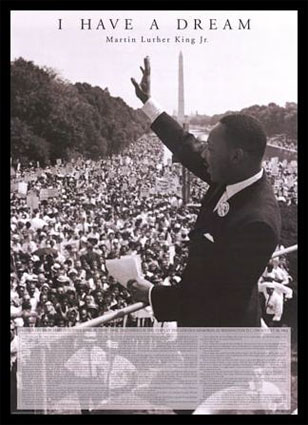
This week I had the opportunity to think a little more deeply about the "I Have a Dream" speech that sits on a poster at the entrance to my office. And that deeper thinking is thanks to Rev. Al Sharpton.
One of my favorite news shows is HARDBALL with Chris Matthews. On Monday, Chris was talking to Al Sharpton about many issues. He was especially talking about Barak Obama in the context of the MLK Day Holiday.
As Sharpton shared some of his thoughts on a wide range of issues, he made a little comment about the "I Have A Dream" speech. Sharpton said that most of us, regardless of ethnicity, rush too quickly to the "DREAM" part of the speech. He went on to say that we need to spend more time contemplating the first part of the "I Have A Dream" speech which talks about recieving a bad check, and the "promisory note" that freedom entails.
What Rev. Sharpton said intrigued me, so I watched a YOUTUBE video of the event. In the process I discovered Sharpton was a very insighful man, and that led me to think about several things in relation to this part of the speech.
I think it is interesting that the dream speech is grounded in covenant theology. We tend to run forward to the eschatology closing stanza, and forget the call to covenant that is in the first part of the speech.
This makes the speech so much deeper. Why? First of all, simply by calling for the renewal of covenant he is basing his whole argument on Biblical grounds and on the basic covenant of our life together as a nation. No other image of community in Scripture is more foundational than the concept of covenant.
Covenant theology is also important because it does not call for the kind of justice that separates us from one another once our agreement is set right. It compels us to believe that the destiny of all us tied together. Thus, the central vision of Martin Luther King Jr.'s theology that undergirds his civil rights is not establishing one groups rights over against one another. Instead, it is a vision that requires us to be reconciled with one another and be in right relationship with one another. It is not simply a call to a cessation of conflict and recognition of rights, it is a call to renewed friendship and brotherhood. In other words, much like the practice of non-violent protest, the "I Have a Dream" speech calls us to passionately love enemies as alienated friends that we need to get close to again.
I think too often we go straight to the inspiration, and forget the intellectual meat of the speech, which is really what makes it beautiful. Rev. Al Sharpton was right.
Quotes from Stardust Universe by Jakob Dylan

"We were born to stumble and to yearn in a stardust covered universe, where you will find troubles, but you will not be the first."
"You've got to slow your engines when God is in pursuit"
"...stardust universe. Where the end is certain but it will not be rehearsed."
Tuesday, January 16, 2007
Taken By Surprise
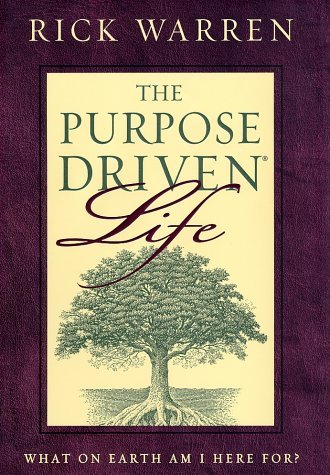
We are starting a Purpose-Driven Life Campaign on February 17th at our church. There are a lot of exciting things going on with the program, namely it is getting several of our church people off their rear ends and hard at work doing something productive to support their church instead of simply being pew fodder. Furthermore, we are all working together on something, which builds a little bit of momentum for us.
So, in order to be on top of things that are happening in my church, I have been reading ahead in the book. And, to my suprise, I am enjoying reading it a lot. Especially bit by bit as it is designed. Usually, I am a book snob, and choose not to read stuff that everyone is buying at the Christian bookstore. Thus, I had a little apprehension when I started reading it. But, I have been pleasantly pleased by what I have read so far.
One thing I like is that the book is written so that what you are to remember is in the first sentence of every chapter. It is a lot like most of us were taught to write two to three page essays in high school.
It is also good at relaying simple truths of what living the Christian faith is all about. It is not so much about twisting your arm into a decision to follow Jesus as it is inviting all people, no matter what age, into a process of choosing to follow Jesus by beginning to put some basic principles that he taught into practice.
Monday, January 15, 2007
| What American accent do you have? Your Result: The Midland "You have a Midland accent" is just another way of saying "you don't have an accent." You probably are from the Midland (Pennsylvania, southern Ohio, southern Indiana, southern Illinois, and Missouri) but then for all we know you could be from Florida or Charleston or one of those big southern cities like Atlanta or Dallas. You have a good voice for TV and radio. | |
| The West | |
| Boston | |
| North Central | |
| The Inland North | |
| The South | |
| Philadelphia | |
| The Northeast | |
| What'>http://www.gotoquiz.com/what_american_accent_do_you_have">What American accent do you have? Quiz'>http://www.gotoquiz.com/">Quiz Created on GoToQuiz | |
Tuesday, January 09, 2007
POT AND PREACHING

This is the car I parked next to getting lunch today. I found it humorous.
On the other side it said..."Jesus is coming soon, pass the joint around"
Saturday, January 06, 2007
Window in the Skies Video
Lyrics
The shackles are undone
The bullets quit the gun
The heat thats in the sun
Will keep us when there's none
The rule has been disproved
The stone has been moved
The grain is now a groove
All debts are removed, ooh
Oh can't you see what our love has done
Oh can't you see what our love has done
Oh can't you see what our love has done
What it's doing to me
Love makes strange enemies
Makes love when love may please
Soul in a strip tease
Hate brought to its knees
Sky over our head
Can reach it from our bed
If you let me in your heart
And out of my head
Oh can't you see what our love has done
[ these lyrics found on http://www.completealbumlyrics.com ]
Oh can't you see what our love has done
Oh can't you see what our love has done
What it's doing to me
Oh oh oh hhhhhhhhhhh
Oh oh oh hhhhhhhhhhh
Please don't ever let me out of here
I've got no shame
oh no oh no
Oh can't you see what love has done
Oh can't you see
Oh can't you see what love has done
What it's doing to me
Oh I know I hurt you and I made you cry
Did everything but murder but you and I
But love left a window in the skies
And to love I rhapsodize
Oh can't you see what love has done to every broken heart
Oh can't you see what love has done for every heart that cries
Love left a window in the skies
And to love I rhapsodize
Oh can't you see
Lyrics
The shackles are undone
The bullets quit the gun
The heat thats in the sun
Will keep us when there's none
The rule has been disproved
The stone has been moved
The grain is now a groove
All debts are removed, ooh
Oh can't you see what our love has done
Oh can't you see what our love has done
Oh can't you see what our love has done
What it's doing to me
Love makes strange enemies
Makes love when love may please
Soul in a strip tease
Hate brought to its knees
Sky over our head
Can reach it from our bed
If you let me in your heart
And out of my head
Oh can't you see what our love has done
[ these lyrics found on http://www.completealbumlyrics.com ]
Oh can't you see what our love has done
Oh can't you see what our love has done
What it's doing to me
Oh oh oh hhhhhhhhhhh
Oh oh oh hhhhhhhhhhh
Please don't ever let me out of here
I've got no shame
oh no oh no
Oh can't you see what love has done
Oh can't you see
Oh can't you see what love has done
What it's doing to me
Oh I know I hurt you and I made you cry
Did everything but murder but you and I
But love left a window in the skies
And to love I rhapsodize
Oh can't you see what love has done to every broken heart
Oh can't you see what love has done for every heart that cries
Love left a window in the skies
And to love I rhapsodize
Oh can't you see
Thursday, January 04, 2007
Compassion
Sometimes I get tired of being in my office to do my computer work, so I decided to take a day to work in Panera Bread Store. So I checked in with the secretary in the afternoon I made my way down to the Southgate Panera Bread Store to get some work done.
While I was reading an email, I looked up and noticed a couple. The woman was facing me, and the man was facing the other direction. She seemed giddy to see him. As a matter of fact she was positively glowing. Since I hate seeing lovey dovey couples and public displays of affection other than hand holding, I rolled my eyes and sighed.
I continued on with other work, and then looked up again. All of the sudden her face went from giddy, to quizzical, to angry, to crestfallen. I assumed the guy had broken up with the woman. She ran out of the place crying. He looked around, grabbed the meals, quickly threw them away and followed soon after. All of the sudden my judgements changed. Instead of thinking the mushy couple was disgusting and annoying, I began to think the guy was a jerk. He made a beautiful woman cry after all. How uncompassionate! How rude!
Then I realized that I had made people cry at times too. And while sometimes I felt like they were crying because I was a jerk (and I can be that), there are other times I have made people so upset that they cried and I felt like I said and did the right thing. Whats more, sometimes I have made people cry and felt like I was very compassionate. This leads me to believe that there are times when we confuse compassion and love with niceness and popularity. Maybe making the woman cry at that moment was the most compassionate thing for her in the long run. Who knows?
Let me give you an example that does not have that much importance. Their have been times where I rushed out of the house and threw on a shirt as I went. I went through my day. I was wearing the shirt for hours. Then, in the middle of the afternoon I notice that my shirt is on backwards. People notice, but nobody points this out to me. Are they being compassionate? Not really. They are just avoiding dealing with a situation that might embarrass them.
As I see it, true compassion includes speaking the truth in love. It at times includes confronting people who are doing immoral, self-destructive, or hurtful things, and realizing that this act of compassion may cause the other party to be less invested in that relationship. They may even abandon it all together.
Compassion is about caring so much about somebody that their hurt in some way pains you as well, and in turn spurs you to action. Sometimes that may mean giving money to a homeless person. Sometimes that may mean discontinuing helping someone who is using your help in an unhealthy way. Sometimes that means offering a guilt ridden person God's grace and love. Sometimes that means holding up a mirror to someone's sin and asking them to stop. Being nice doesn't always mean being kind. Sometimes being nice is just a cover for the selfishness of being a classic conflict avoider.
We are often good at being nice and being polite. But sometimes we struggle to be truly compassionate. We need to be compassionate enough to be both completely grace-filled and brutally honest when it is appropriate. May God bless us in the journey.
While I was reading an email, I looked up and noticed a couple. The woman was facing me, and the man was facing the other direction. She seemed giddy to see him. As a matter of fact she was positively glowing. Since I hate seeing lovey dovey couples and public displays of affection other than hand holding, I rolled my eyes and sighed.
I continued on with other work, and then looked up again. All of the sudden her face went from giddy, to quizzical, to angry, to crestfallen. I assumed the guy had broken up with the woman. She ran out of the place crying. He looked around, grabbed the meals, quickly threw them away and followed soon after. All of the sudden my judgements changed. Instead of thinking the mushy couple was disgusting and annoying, I began to think the guy was a jerk. He made a beautiful woman cry after all. How uncompassionate! How rude!
Then I realized that I had made people cry at times too. And while sometimes I felt like they were crying because I was a jerk (and I can be that), there are other times I have made people so upset that they cried and I felt like I said and did the right thing. Whats more, sometimes I have made people cry and felt like I was very compassionate. This leads me to believe that there are times when we confuse compassion and love with niceness and popularity. Maybe making the woman cry at that moment was the most compassionate thing for her in the long run. Who knows?
Let me give you an example that does not have that much importance. Their have been times where I rushed out of the house and threw on a shirt as I went. I went through my day. I was wearing the shirt for hours. Then, in the middle of the afternoon I notice that my shirt is on backwards. People notice, but nobody points this out to me. Are they being compassionate? Not really. They are just avoiding dealing with a situation that might embarrass them.
As I see it, true compassion includes speaking the truth in love. It at times includes confronting people who are doing immoral, self-destructive, or hurtful things, and realizing that this act of compassion may cause the other party to be less invested in that relationship. They may even abandon it all together.
Compassion is about caring so much about somebody that their hurt in some way pains you as well, and in turn spurs you to action. Sometimes that may mean giving money to a homeless person. Sometimes that may mean discontinuing helping someone who is using your help in an unhealthy way. Sometimes that means offering a guilt ridden person God's grace and love. Sometimes that means holding up a mirror to someone's sin and asking them to stop. Being nice doesn't always mean being kind. Sometimes being nice is just a cover for the selfishness of being a classic conflict avoider.
We are often good at being nice and being polite. But sometimes we struggle to be truly compassionate. We need to be compassionate enough to be both completely grace-filled and brutally honest when it is appropriate. May God bless us in the journey.
Tuesday, January 02, 2007
Out of the Darkness--Light
My work life has been a little chaotic lately, and thankfully this time it doesn't center around me. Although it does present challenges to everyone in our church.
The first Sunday in November (which coincidentally was both the week after our church planning meeting and the week of the fiasco at New Life Church with Ted Haggard), a couple of men started attending First Baptist. These men arrive together and leave together. They sit next to one another, and they have the same address. They are impeccably well-groomed, and they have jumped into the life of our congregation almost immediately.They especially enjoyed jumping in with our church decorating party, as well as our choir.
Now, our choir has always been an "open" choir. What I mean by that is that anyone can join our choir. It is not a leadership position, it functions more as a church small group than it does a deacon board. Thus, when these men joined the choir the Sunday after Thanksgiving, we were not prepared for what was about to unfold.
What did unfold? Well, because two men who appear to be homosexual (though nobody knows if they are or they are not) have joined the choir, about 12-20 of our 200 regular attenders have left the church. Some of those regular attenders are long time members with deep pockets. Others are people who have regularly attenders who have invested a lot of time in nearly every facet of our congregational life. Most, though not all, are members of one influential family that helped found our denomination at about the same time our nation was founded. Last Sunday, with our other ordained pastoral staff on vacation, several of them chose to leave our congregation. Some wrote letters saying they were leaving.
Others chose to take their last Sunday leading their sunday school class to explain why they were leaving and convince others to join them. This surprised us. We expected that is was a possibility they would leave. But we felt ambushed. And when they left before the worship service we felt violated.
Too be honest, I have mixed feelings about their departures. On one hand, in part through difficult tensions, I have become friends with several of them. On the other hand, most of the insults, frustration and difficulty that has come my way over the last 3 1/2 years has been spearheaded by the meanspirited nature of those that left and/or are leaving. I am sad to see them leave, I am scared about our church finances, and I feel a heavy burden has been lifted from being the target of their annialating contempt all at the same time.
Most of our congregation is a conservative church in their theology, but compassionate and open-minded. So, wheras they believe that homosexual behavior is immoral, they at the same time recognize that they themselves have moral struggles as well. Thus, most are open to welcoming anyone into our choir and even membership. However, many are struggling.
Into was into this environment that I was assigned to do preach on Sunday. There was also a blizzard earlier in the week, so several of our more mature members were struggling to dig out. So many people were sad, discouraged and low. You could physically feel the congregational sadness and depression.
At the same time, I felt led to at the same time acknowlege our difficulties and remain enthusiastic and positive about our church and mission. I preached a very average sermon on the flight of Jesus to Egypt and God's desire to deliver us---both his church and those who are outside of his church (It will be posted in segments below).
At the end of the service, two unexpected things transpired. First, at the end of the service, the congregation erupted in clapping. This has never happened to me, and this has never happened in anyone's memory in the history of the church. So this was both very encouraging and very disconcerting. The second thing that happened was that members of the congregation came forward during the invitation simply for prayer and to connect with God.
It seems that out of difficult circumstances, good things are happening.
The first Sunday in November (which coincidentally was both the week after our church planning meeting and the week of the fiasco at New Life Church with Ted Haggard), a couple of men started attending First Baptist. These men arrive together and leave together. They sit next to one another, and they have the same address. They are impeccably well-groomed, and they have jumped into the life of our congregation almost immediately.They especially enjoyed jumping in with our church decorating party, as well as our choir.
Now, our choir has always been an "open" choir. What I mean by that is that anyone can join our choir. It is not a leadership position, it functions more as a church small group than it does a deacon board. Thus, when these men joined the choir the Sunday after Thanksgiving, we were not prepared for what was about to unfold.
What did unfold? Well, because two men who appear to be homosexual (though nobody knows if they are or they are not) have joined the choir, about 12-20 of our 200 regular attenders have left the church. Some of those regular attenders are long time members with deep pockets. Others are people who have regularly attenders who have invested a lot of time in nearly every facet of our congregational life. Most, though not all, are members of one influential family that helped found our denomination at about the same time our nation was founded. Last Sunday, with our other ordained pastoral staff on vacation, several of them chose to leave our congregation. Some wrote letters saying they were leaving.
Others chose to take their last Sunday leading their sunday school class to explain why they were leaving and convince others to join them. This surprised us. We expected that is was a possibility they would leave. But we felt ambushed. And when they left before the worship service we felt violated.
Too be honest, I have mixed feelings about their departures. On one hand, in part through difficult tensions, I have become friends with several of them. On the other hand, most of the insults, frustration and difficulty that has come my way over the last 3 1/2 years has been spearheaded by the meanspirited nature of those that left and/or are leaving. I am sad to see them leave, I am scared about our church finances, and I feel a heavy burden has been lifted from being the target of their annialating contempt all at the same time.
Most of our congregation is a conservative church in their theology, but compassionate and open-minded. So, wheras they believe that homosexual behavior is immoral, they at the same time recognize that they themselves have moral struggles as well. Thus, most are open to welcoming anyone into our choir and even membership. However, many are struggling.
Into was into this environment that I was assigned to do preach on Sunday. There was also a blizzard earlier in the week, so several of our more mature members were struggling to dig out. So many people were sad, discouraged and low. You could physically feel the congregational sadness and depression.
At the same time, I felt led to at the same time acknowlege our difficulties and remain enthusiastic and positive about our church and mission. I preached a very average sermon on the flight of Jesus to Egypt and God's desire to deliver us---both his church and those who are outside of his church (It will be posted in segments below).
At the end of the service, two unexpected things transpired. First, at the end of the service, the congregation erupted in clapping. This has never happened to me, and this has never happened in anyone's memory in the history of the church. So this was both very encouraging and very disconcerting. The second thing that happened was that members of the congregation came forward during the invitation simply for prayer and to connect with God.
It seems that out of difficult circumstances, good things are happening.
Monday, January 01, 2007
A Deliverer
Please follow along with me as I look at our screen and read our Scripture text for this morning.
(Turn and read Matthew 2:13ff with fine art)
This morning I want to take you on a different kind of journey as we look at what God has to say to us this morning. I want to take you through my process of discovering what exactly this short story seems to be about. For some of you this may feel more like Bible study than your normal preaching fare, and that is ok.
This method also means that you are going to have to pay careful attention, because we are going on a journey to discover what God has to say to us together, and like a good detective story or mystery, each thing we will learn will help us build toward our ultimate discovery of just what God seems to be saying to us through this text.
Are you ready?? I hope so.
I originally felt led to do this sermon because of a Christmas song I was listening to. Bruce Cockburn was the person I heard it from, but I am sure several other people sing the song as well. The song that really captured my heart was “Mary had a Baby”. It is a Negro Spiritual about the birth story of Christ and the deliverance of slaves to freedom through the underground railroad. Toward the end of the song it talks about coming out of Egypt. Over the last month I have pondered, what has Christmas to do with deliverance? And what role does Jesus’ impromptu road trip to Egypt have to do with the overall message of the Good News of Jesus Christ.
So I started exploring Matthew 2:13-26.
One of the most interesting things that we notice as we start looking over the passage are these Old Testament quotations that Matthew 2. There are three of them in the passage that we have chosen.
Out of Egypt I called my Son—From Hosea 11
Rachel Weeping in Rama for her children who are no more—Jeremiah 31
The passage that says Jesus will be from Nazereth—Isaiah 11
As we dig deeper we notice that these quotes are very significant for a number of reasons. Throughout Matthew 1-4, Jesus is presented to us as Israel personified. Israel is referred to as the Son of God in several places in Scripture including the one quoted here from Hosea. In fact, as you dig into the geneology in Chapter 1, it is organized in triplets of fourteen, to personify the three stages of Israel’s history—the period of the patriarchs, the period of the kings, and the period of the exile.
The implication from Matthew is clear. The history of the people of God is like a funnel. And slowly all of his people who are faithful has been slowly whittled down to a remnant of one. And when I use the word remnant, I don’t mean to use this word like we do in sewing circles where it is the scrap left over. I mean to use the word like we would understand it in Luke Skywalker Star Wars or Frodo Baggins in the Lord of the Rings. Where there is only one who is worthy to stand for us all, one worthy to represent us all, one able to save us. And in the history of that universe that one that stands for us all is Jesus. In other words, what we see here is that Jesus, by fulfilling the prophecies, by going into exile, by being delivered from the sword of Herod and the pain of exile, and by doing so in faithfulness to the instructions of God, proves himself worthy to be our deliverer. Our messiah.
Its interesting isn’t it? That the cross shows up so quickly in the story of Jesus. We tend to think of the manger and the early years of Jesus as some peaceful, blissful experience. Yet, as we see here, Jesus is a marked man from early on. He begins his life as a refugee and as the focal point of a brutal massacre. Mark Lackey was gracious enough to do our little powerpoint scripture reading at the beginning of this message, and it was interesting. We kept looking at pictures of the violence that Jesus was born into, and it took a long time to find the right picture. Couldn’t have too much nudity. Couldn’t look too violent. Might offend people’s sensibilities.
Jesus as our deliverer has no such qualms. He is born a middle eastern peasant is a barn full of manure with animals in a ruckus over a screaming woman trying to find anyplace with any sort of shelter and privacy to give birth. Far away from home because of the government made them traverse over rocks and around robbers to go register themselves to give Rome more money in taxes and tribute.
From the cradle to the cross he is surrounded by thieves and murderers, and the masses longing and seeking for something to hold on to.
Our time is no different. We need a deliverer too.
And whether it is in Bethlehem or Colorado Springs, God has no qualms in looking at our messy, confusing lives and entering into them in an effort to deliver us.
We tend to think that we have to have ourselves and our churches all cleaned up before we can be “God’s people”. And we look at our lives, and sometimes at our church and wonder why it is full of so many sinners. We wonder why there are so many people with wrongheaded ideas and sinful lives.
I remember struggling to build a young adult ministry in a previous church. We had a number of launches and restart. Finally, one time we caught fire with a core group of about six people. Half of them were related to one another. One of them was a former member of my youth group. And I will be direct with you…there lives were not where they needed to be. They were recovering drug addicts, mothers who had their children out of wedlock, racists, they were belligerent drunks who got into fights on the weekends and who called me to help deal with drugged up friends at 2 in the morning. And sometimes they helped out at church to do their court ordered community service.
As I tried to get other people involved in joining this group I found we had another struggle. And it had nothing to do with the rough and tumble lives they lived the rest of the week. It had to do with the fact that our core group could not get through our meal and bible study without a smoke break in between.
As we went this went from a concern of mine to a concern by some of my young adults and their parents that were involved in the church. And I shared my plight with a mentor of mine. And as I finished sharing she said something very wise. She said, God calls us to be fishers of men, and yet so often we expect the fish to leap into the boat of the church cleaned up and ready to go. But, she said, if we follow Jesus’ command to be fishers of men we should expect it to be difficult, messy, smelly work full of people who have all sorts of problems and in needs of all kinds of deliverance.
I would add to what my mentor said. It is about time you as a church become more real and honest about how you are here at First Baptist. You are a people desperately in need of deliverance. And it about time we become the kind of church that enthusiastically welcomes other people, like me and hundreds like me, who need deliverance as much as you do.
I need a deliverer. So do you. Even though things look bleak, we are called to have the hope that Jesus is preparing to deliver us. That is the first thing we learn when we look at the flight of Jesus.
Sunday, December 31, 2006
A Battle
As I continued to look into the Scripture, I noticed that angels’ wings were fluttering all around the first few chapters of Matthew and all through the narratives of the conception and early childhood of Jesus. And I wondered what this might have to add to the truth that I discovered about Jesus being declared as our deliverer from the very start.
The root word for Angel is messenger. Angels are simply messengers of God if you go simply by their name. And this truth is both helpful, and somewhat deceiving if you just stop there.
One of the books I utterly hated when I went to a Christian college was a series of novels with all sorts of angels and demons called THIS PRESENT DARKNESS. From the moment it came out, everyone seemed to be seeing angels and demons in everything. If something went bad in their life, it was because of demons. If they narrowly avoided car accidents, it was because a host of angels protected the vehicle. I remember a friend invoking angelic protection as we were about to drive from Sterling, KS to Lawrence in a small hatchback in the middle of a blizzard. I kept wondering why God did not advance the angels ahead of time to give him a vision to get snow tires for the death trap we called his vehicle. Providentially, we made our journey safely.
There is a lot of angelology and demonology that is based on extra-biblical philosophy and experience. But much of these stories reflected a truth I often ignore, and that I rediscovered in preparing for this sermon.
You see I did a little study on angels through the Bible and biblical history. And one thing you notice right away about the angels in scripture is that they are always in the middle of a cosmic battle. Read Daniel and Revelation. Look at what is implied in the passage on spiritual warfare in what Paul said to the Ephesian church.
As we look at this passage, we see right away that there is a power struggle happening. From the beginning, Jesus is under attack. From the beginning, Jesus is in the middle of a battle.
This should not have surprised me, because deliverers often are engaged in a great struggle or battle in order to deliver those in bondage. But it was a surprise nonetheless.
As a young Christian, I used to think that when I became more mature and knowlegable in my faith, that somehow following Jesus would become easier. That it would go from being a daily battle to second nature.
I have since come to agree with renowned Christian leaders like CS Lewis and Thomas a Kempis who say the opposite. The more I grow in my faith, the more it is a battle to continue to strive to be faithful. With increase in faith, I also find increase in temptation. The more I seem to press forward in my journey of faith, the more acute the attacks of the enemy seem to be at the same time. And the more attractive running away from everything I have built my life on seems to be. Because even though I am called into the battle of faith, a lot of times it seems easier to be a coward.
One of my favorite modern Christian leaders, Eugene Peterson, puts it this way. He says that there is no place in the universe that is not contested ground. Each and every moment is a battle. Each and every decision has not only personal but cosmic importance.
At the risk of being overly direct and transparent, or sounding weak or complaining, I feel compelled to share something with you. My experience in ministry has felt like a battle. There is not a year that I have not struggled with the fear that all of my efforts have not made a bit of difference. There has not been a year in over 11 years of ministry where I have not been ambushed by an unexpected attack. I have been lied about and lied to. I have been picked at and picked apart. I have been criticized about everything from my svelt physical appearance and my choice of footwear to how peppy or somber I am to the fact that I am not married. And everything in between. Sometimes these difficult experiences that feel like attacks are used by God’s grace to allow him to work victory in my life and my ministry. Other times they can be classified as nothing more than spiritual attack in my mind. Either way, I guess I see part of being called to ministry and to follow Jesus is a call to be a good soldier in the spiritual battlefield I am assigned to.
It’s interesting. In continuing in the struggle, at least in my ministry and spiritual journey, I have over and over seen the grace of reconciliation and forgiveness at work. Through persisting in love and hope I have seen students who were dead set on doing everything they could to see me fired by my church (and some have made valiant efforts) become friends, supportive youth leaders as they got older. In fact, one such student now meets with a mutual friend and prays for me and my family specifically on a weekly basis. The same has happened with parents, church leaders, peers in ministry, and even leaders in the community. And this is no surprise to us. The thing is, I don’t get deserve any credit for this. My deliverer does. Because his invasion into this world is about this kind of thing. This is because even though Christ comes as our deliverer, and joins into spiritual battle along side us to deliver us, he is a different kind of leader than the leaders of this world. And he fights a different kind of battle than we expect.
The root word for Angel is messenger. Angels are simply messengers of God if you go simply by their name. And this truth is both helpful, and somewhat deceiving if you just stop there.
One of the books I utterly hated when I went to a Christian college was a series of novels with all sorts of angels and demons called THIS PRESENT DARKNESS. From the moment it came out, everyone seemed to be seeing angels and demons in everything. If something went bad in their life, it was because of demons. If they narrowly avoided car accidents, it was because a host of angels protected the vehicle. I remember a friend invoking angelic protection as we were about to drive from Sterling, KS to Lawrence in a small hatchback in the middle of a blizzard. I kept wondering why God did not advance the angels ahead of time to give him a vision to get snow tires for the death trap we called his vehicle. Providentially, we made our journey safely.
There is a lot of angelology and demonology that is based on extra-biblical philosophy and experience. But much of these stories reflected a truth I often ignore, and that I rediscovered in preparing for this sermon.
You see I did a little study on angels through the Bible and biblical history. And one thing you notice right away about the angels in scripture is that they are always in the middle of a cosmic battle. Read Daniel and Revelation. Look at what is implied in the passage on spiritual warfare in what Paul said to the Ephesian church.
As we look at this passage, we see right away that there is a power struggle happening. From the beginning, Jesus is under attack. From the beginning, Jesus is in the middle of a battle.
This should not have surprised me, because deliverers often are engaged in a great struggle or battle in order to deliver those in bondage. But it was a surprise nonetheless.
As a young Christian, I used to think that when I became more mature and knowlegable in my faith, that somehow following Jesus would become easier. That it would go from being a daily battle to second nature.
I have since come to agree with renowned Christian leaders like CS Lewis and Thomas a Kempis who say the opposite. The more I grow in my faith, the more it is a battle to continue to strive to be faithful. With increase in faith, I also find increase in temptation. The more I seem to press forward in my journey of faith, the more acute the attacks of the enemy seem to be at the same time. And the more attractive running away from everything I have built my life on seems to be. Because even though I am called into the battle of faith, a lot of times it seems easier to be a coward.
One of my favorite modern Christian leaders, Eugene Peterson, puts it this way. He says that there is no place in the universe that is not contested ground. Each and every moment is a battle. Each and every decision has not only personal but cosmic importance.
At the risk of being overly direct and transparent, or sounding weak or complaining, I feel compelled to share something with you. My experience in ministry has felt like a battle. There is not a year that I have not struggled with the fear that all of my efforts have not made a bit of difference. There has not been a year in over 11 years of ministry where I have not been ambushed by an unexpected attack. I have been lied about and lied to. I have been picked at and picked apart. I have been criticized about everything from my svelt physical appearance and my choice of footwear to how peppy or somber I am to the fact that I am not married. And everything in between. Sometimes these difficult experiences that feel like attacks are used by God’s grace to allow him to work victory in my life and my ministry. Other times they can be classified as nothing more than spiritual attack in my mind. Either way, I guess I see part of being called to ministry and to follow Jesus is a call to be a good soldier in the spiritual battlefield I am assigned to.
It’s interesting. In continuing in the struggle, at least in my ministry and spiritual journey, I have over and over seen the grace of reconciliation and forgiveness at work. Through persisting in love and hope I have seen students who were dead set on doing everything they could to see me fired by my church (and some have made valiant efforts) become friends, supportive youth leaders as they got older. In fact, one such student now meets with a mutual friend and prays for me and my family specifically on a weekly basis. The same has happened with parents, church leaders, peers in ministry, and even leaders in the community. And this is no surprise to us. The thing is, I don’t get deserve any credit for this. My deliverer does. Because his invasion into this world is about this kind of thing. This is because even though Christ comes as our deliverer, and joins into spiritual battle along side us to deliver us, he is a different kind of leader than the leaders of this world. And he fights a different kind of battle than we expect.
Saturday, December 30, 2006
A Different Kind of King
Which brings me to the final thing I noticed as I began to study this passage. There is a contrast between the kingdom of Herod and the kingdom of this world and the kingdom of heaven and the kingdom of Jesus. There are two kings in this passage…with different claims to authority, different agendas, striving for different kinds of influence.
The Hebrew people expect a military leader that will help them overthrow the world’s powers by force. They get a deliverer who is a suffering servant that delivers the world through entering its suffering in Bethlehem and taking the world’s sin upon himself at the cross on Calvary.
Herod is the kind of king that attempts to overcome his enemies through violence and force. Jesus delivers the world through love and compassion.
Herod is now dead. His palace is in ruins. His kingdom has long faded away. And if it had not been for his relationship to Jesus, nobody would have remembered him.
Jesus is risen from the dead and reigns at the right hand of God. His kingdom continues to grow. People today still worship him, and await the fullness of his deliverance.
Loyalists of the kingdom of Herod inherit the fate of Herod.
Followers of Jesus have an eternal inheritance to look forward to. And they begin to help bring it about even now as they join Jesus’ revolution of justice, love, and compassion—even for our enemies. In being delivered, we get to become a heralds of the good news of our continuing and impending deliverance to others.
Herod rules by staying above the fray and collecting more and more money and political control through fear and moral compromise.
Jesus enters into the sin and suffering of this world, befriending the moral compromisers he hopes to lead, in order to deliver them to a life of hope and complete transformation.
The picture we have of the church, the one full of perfect people who have things all figured out and have everything in their lives all together, that church does not exist and it never has. That is not the kind of church that we see in the Bible. The church we see in the Bible is a church full sinful people who have made total messes of their lives who discover a community that is about proclaiming a deliverer and embodying the love of a King who seeks to deliver us.
The people of God that Jesus comes to deliver are sinners all. Sinners who fall on their knees and cry out for deliverance to the one who is coming out of Egypt to rescue them from their pain and heartache, their oppression and affliction. Even more than they cry out to be delivered from their self-righteous, self-justifying selves and march into a kingdom of humility and love.
May God find me in that number. May God find you in that number, May God find us in that number together. Amen.
The Hebrew people expect a military leader that will help them overthrow the world’s powers by force. They get a deliverer who is a suffering servant that delivers the world through entering its suffering in Bethlehem and taking the world’s sin upon himself at the cross on Calvary.
Herod is the kind of king that attempts to overcome his enemies through violence and force. Jesus delivers the world through love and compassion.
Herod is now dead. His palace is in ruins. His kingdom has long faded away. And if it had not been for his relationship to Jesus, nobody would have remembered him.
Jesus is risen from the dead and reigns at the right hand of God. His kingdom continues to grow. People today still worship him, and await the fullness of his deliverance.
Loyalists of the kingdom of Herod inherit the fate of Herod.
Followers of Jesus have an eternal inheritance to look forward to. And they begin to help bring it about even now as they join Jesus’ revolution of justice, love, and compassion—even for our enemies. In being delivered, we get to become a heralds of the good news of our continuing and impending deliverance to others.
Herod rules by staying above the fray and collecting more and more money and political control through fear and moral compromise.
Jesus enters into the sin and suffering of this world, befriending the moral compromisers he hopes to lead, in order to deliver them to a life of hope and complete transformation.
The picture we have of the church, the one full of perfect people who have things all figured out and have everything in their lives all together, that church does not exist and it never has. That is not the kind of church that we see in the Bible. The church we see in the Bible is a church full sinful people who have made total messes of their lives who discover a community that is about proclaiming a deliverer and embodying the love of a King who seeks to deliver us.
The people of God that Jesus comes to deliver are sinners all. Sinners who fall on their knees and cry out for deliverance to the one who is coming out of Egypt to rescue them from their pain and heartache, their oppression and affliction. Even more than they cry out to be delivered from their self-righteous, self-justifying selves and march into a kingdom of humility and love.
May God find me in that number. May God find you in that number, May God find us in that number together. Amen.
Wednesday, December 20, 2006
Money Waters

is a guy I played college football with. His name when I knew him was Ian "Money" Johnson. Not sure I would call him a buddy. He was mad at me for writing him up for dormitory rules infractions our junior year, which led to a one game suspension from the football team (walking the halls on a dry campus with a bottle of malt liquor). But we seemed to get along well about the time of graduation from Sterling College. Now he is an independant rapper in Texas with an apparently bright future in rap. When "Money"
 was in college he was our star wide reciever.
Friday, December 15, 2006
Me and God
That is the title of a fairly recent release by Josh Turner. The lyrics of the song can be found here. The thing is, there is something that disturbs me about this song. Do I disagree with it? Not necessarily. But the chumminess of which he speaks of the divine somehow disturbs me. I couldn't figure out why until I thought about it a bit.
What bothers me is in the title. Its "Me and God". Its too self-centered. God is my buddy. He's got my back, so don't mess with me. This sentiment is so wrongheaded. Yet, whether it is American Christianity, American Buddhism, the New Age movement, or whatever is around me, it seems to echo the same religious sentiment. "Me and God".
The strange thing is that Jesus brought in "love your neighbor as yourself" into that whole "me and God" equation. The "me and God" equation is all about God using me to love others on his behalf. We are not partners. God is God and I am not. I am God's servant and his vessel.
And it is not just about me. It is about the world I love in that is in need. The person who needs someone to listen to. Yet, much of pop spirituality is tied up in this me and God motif. And for some reason it rubs me the wrong way.
What bothers me is in the title. Its "Me and God". Its too self-centered. God is my buddy. He's got my back, so don't mess with me. This sentiment is so wrongheaded. Yet, whether it is American Christianity, American Buddhism, the New Age movement, or whatever is around me, it seems to echo the same religious sentiment. "Me and God".
The strange thing is that Jesus brought in "love your neighbor as yourself" into that whole "me and God" equation. The "me and God" equation is all about God using me to love others on his behalf. We are not partners. God is God and I am not. I am God's servant and his vessel.
And it is not just about me. It is about the world I love in that is in need. The person who needs someone to listen to. Yet, much of pop spirituality is tied up in this me and God motif. And for some reason it rubs me the wrong way.
I made the evening news
The other night I got a call from Scott Harrison of Channel 13 in Colorado Springs. He asked me to comment on the new Left Behind game.I said a lot of things that I thought were really smart, but the clips made me look a little like a dumb ox. You can link to a transcript of the report here.
Wednesday, December 13, 2006
Current Reading: Welcoming But Not Affirming
I just finished reading "Welcoming But Not Affirming: An Evangelical Response to Homosexuality". It is a comprehensive book that states this position well. It is written by the deceased Stanley Grenz, who was a prolific writer and theologian.
Perhaps most interesting in his thesis was the relationship throughout human history between faith viewpoints and the related sexual behavior to that faith viewpoint. His position is that one's views and behavior sexually in some strange way almost always integrated to one's spirituality/relationship with God. In the process, he shows historical basis for "ritual enactment" across cultures, and then points out Scriptures to show that one's sexual behavior is intimately tied to one's worship life. This kind of creeps me out, but it also seems to have a lot of truth to it.
Overall, it was helpful in giving me some perspective about related community issues and struggles our church is having.
Brainwashed--a humorous story with a point by NT Wright which appears in the John for Everyone commentary
A story from NT Wright:
A friend of mine described the reaction when he went home, as a young teenager, and announced to his mother that he'd become a Christian.Alarmed, she thought he'd joined some kind of cult.'They've brainwashed you!' she said.He was ready with the right answer.'If you'd have seen what was in my brain,' he replied, 'you'd have realized it needed washing!'Of course, he hadn't been brainwashed. In fact, again and again - and this was certainly the case with my friend - when people bring their lives , their outer lives and inner lives, into the light of Jesus the Messiah, things begin to become clear.If anything, it is the surrounding culture that brainwashes us, persuading us in a thousand subtle ways that this present world is the only one there is. This is seldom argued. Rather, a mood is created in which it is easier to go with the flow. That's what happens in brainwashing. What the gospel does is to administer a sharp jolt, to shine a bright light, to kick-start the brain, and the moral sensibility, into working properly for the first time.
A friend of mine described the reaction when he went home, as a young teenager, and announced to his mother that he'd become a Christian.Alarmed, she thought he'd joined some kind of cult.'They've brainwashed you!' she said.He was ready with the right answer.'If you'd have seen what was in my brain,' he replied, 'you'd have realized it needed washing!'Of course, he hadn't been brainwashed. In fact, again and again - and this was certainly the case with my friend - when people bring their lives , their outer lives and inner lives, into the light of Jesus the Messiah, things begin to become clear.If anything, it is the surrounding culture that brainwashes us, persuading us in a thousand subtle ways that this present world is the only one there is. This is seldom argued. Rather, a mood is created in which it is easier to go with the flow. That's what happens in brainwashing. What the gospel does is to administer a sharp jolt, to shine a bright light, to kick-start the brain, and the moral sensibility, into working properly for the first time.
Tuesday, December 12, 2006
Something is in the water
ht to Non-Prophet
It seems that there are a lot of people who are coming out in the open about their lifestyles these days.
First, there was the announcement from Emmanuel Missionary Baptist Church's Senior Pastor about his choice to step down because of his sexual orientation. Dr. Reynolds was a leading advocate for civil rights in Colorado Springs, and his church is dually aligned with National Baptists and American Baptists (my denomination).
Then, Ted Haggard and New Life made national news with the same issue.
Now another megachurch in South Denver has had its senior pastor forced to resign for the same reason. Wow.
Whose next?
It seems that there are a lot of people who are coming out in the open about their lifestyles these days.
First, there was the announcement from Emmanuel Missionary Baptist Church's Senior Pastor about his choice to step down because of his sexual orientation. Dr. Reynolds was a leading advocate for civil rights in Colorado Springs, and his church is dually aligned with National Baptists and American Baptists (my denomination).
Then, Ted Haggard and New Life made national news with the same issue.
Now another megachurch in South Denver has had its senior pastor forced to resign for the same reason. Wow.
Whose next?
Monday, December 11, 2006
Special Links to Read
For some helpful writing advice
Passing on the passive voice (ht Ivan Wolfe)
Kindergarten Romeo (ht Brotha Buck)
Sarah's Christmas Wish (ht Ruby Rocks)
Elf Yourself (ht Marko)
The Best New Christmas Present You Could Buy for your child (ht John)
Passing on the passive voice (ht Ivan Wolfe)
Kindergarten Romeo (ht Brotha Buck)
Sarah's Christmas Wish (ht Ruby Rocks)
Elf Yourself (ht Marko)
The Best New Christmas Present You Could Buy for your child (ht John)
Blue Christmas

I was listening to Christmas music and noticed how much several songs of Christmas are different than I expected. Of course,there are a lot of Christmas songs that are all about frolicking in the snow, or falling in love while getting close to someone on a winter's night. To my surprise there are also a number of songs that have a more somber mood. Even more surprising, almost all of the more somber songs are more directly related to the spiritual side of Christmas.
I am no musical expert, but have you noticed how many songs of the season have minor chord arrangements? I do not think O Come, O Come Emmanuel can be sung well as a joyous and celebrative piece. It is meant to be a song that is somber and full of heartfelt longing for redemption and new life. I have also come to love "Mary, Did You Know?", which is a song that makes one think both of the hope to come and the suffering that must be endured to get to that point. Sting sings what appears to be a classic lesser known hymn called "Gabriel's Message" which is a hauntingly beautiful meditation on Gabriel's telling Mary she was going to have a child that was going to die to save the world. Ever listen to "Down in Yon Forest" sung by Bruce Cockburn? That is downright creepy, bloody story of the Holy Grail and Christmas. Speaking of Bruce Cockburn, I have also enjoyed Mary Had A Baby. This song has a more celebrative tone, but the message is a Negro Spiritual communicating that the Underground Railroad has "left the station" to head north.
Also, have you noticed how many Christmas songs are filled with questions and mystery? Do you hear what I hear? Mary Did You Know? What Child Is This? These are all titles of songs that begin with and ponder questions. There is even a sense of apprehension and doubt in Little Drummer Boy, which reminds of our own insecurities and doubts of acceptability in the eyes of a God become man.
Finally, there are a lot of songs that are simply filled with wonder. Even the Christmas song is filled with meditative wonder at the gifts and the blessings of God in our lives.
In our eagerness to celebrate Christmas, I have begun to think we need to take time to ponder at Christmas time a little more. There is a lot of emphasis by persons of faith that we need to remember the "reason for the season", but a lot of time that does not change much of how we remember. The remembering just goes from us getting a bunch of stuff from Santa to associating our materialism and parties with Jesus.
Maybe at Christmas time, especially in the Advent season that precedes Christmas, we need to rediscover the importance of wonder, of coming to terms with our spiritual emptiness and longing that we feel, and to give voice to our desparate longing for renewal and redemption.
Something to think about anyway.
Sunday, December 10, 2006
Fallen
I wrote this poem on Saturday evening after going up in the mountains for the afternoon. I have to warn you, it is an angst ridden poem full of doubt, confusion, regret, and a longing for hope. (And Mom and sis, don't worry about me I am fine). Much of the poem is playing around with the metaphor of the verb to fall. I was thinking about fallenness in a theological sense (separation from God) and the guilt that comes with a profound sense of that fallen state, taking leaps of faith (falling into the arms of God). It is also a little about what it means to fall in love, and to fall on your face in failure. I hope as you read you will identify with the feelings expressed and how they relate to your own life. Here it is:
FALLEN
I'm
fallen
and
I
don't
know how
to
get back
up
on firm
footing
and
solid ground
I'm
fallin'
I'm
fallen
corrupted
and
wasted
in the
fetid
water
of
half-hearted
existence
I'm
fallin'
I'm
fallen
fealing
breakable
and
malleable
fragile
and
flexible
all at the
same
time
I'm
fallin'
I'm
fallen
from
my harbor
of safety
and knowledge
into a
whirlpool
of mystery
and
fear
I'm
fallin'
I'm
fallen
tears of
fears of
regret
pangs
of doubt
circle
overhead
and
churn
in my
heart
I'm
fallin'
I'm
fallen
boundaries
down
weakness
exposed
my
heart
tumbling
like socks
in the
dryer
I'm fallin'
I'm
fallen
Not sure
what's right
(or left)
or wrong
caught in
a riptide
where effort
seems useless
and surrender
an unacceptable failure
I'm
fallin'
I'm
fallen
don't know
what part
of me
to trust
what to
believe
how to
turn to
a new
path
I'm
fallin'
Help me
up
help
me know
where to
jump
how to
trust
what to
know
whether to
say yes
or no.
FALLEN
I'm
fallen
and
I
don't
know how
to
get back
up
on firm
footing
and
solid ground
I'm
fallin'
I'm
fallen
corrupted
and
wasted
in the
fetid
water
of
half-hearted
existence
I'm
fallin'
I'm
fallen
fealing
breakable
and
malleable
fragile
and
flexible
all at the
same
time
I'm
fallin'
I'm
fallen
from
my harbor
of safety
and knowledge
into a
whirlpool
of mystery
and
fear
I'm
fallin'
I'm
fallen
tears of
fears of
regret
pangs
of doubt
circle
overhead
and
churn
in my
heart
I'm
fallin'
I'm
fallen
boundaries
down
weakness
exposed
my
heart
tumbling
like socks
in the
dryer
I'm fallin'
I'm
fallen
Not sure
what's right
(or left)
or wrong
caught in
a riptide
where effort
seems useless
and surrender
an unacceptable failure
I'm
fallin'
I'm
fallen
don't know
what part
of me
to trust
what to
believe
how to
turn to
a new
path
I'm
fallin'
Help me
up
help
me know
where to
jump
how to
trust
what to
know
whether to
say yes
or no.
Thursday, December 07, 2006
Something stinks about this.
Most of us have some sort of gastrointestinal struggles while travelling. If you happen to become malodorous as a result of these struggles, it is still important to follow safety rules on our friendly skies. If you click HERE, you will see an example of someone who lacks a little common sense.
(ht to marko)
(ht to marko)
Meet an old friend of mine....
Scholar, armchair Mormon theologian, Battlestar Galactica buff, Ph D student Ivan Wolfe. Also teammate and high school chum of yours truly, Friar Tuck.
Drop by, say hi, and discuss the musical group Tears for Fears with him. He will soon be added to the blogroll.
Drop by, say hi, and discuss the musical group Tears for Fears with him. He will soon be added to the blogroll.
God's Good Earth, Part 2
I grew up in the logging center of the world when I was a child. Douglas County, OR, which received its name about the same time as the Douglas Fir. So until late grade school, most of my childhood was spent with people who worked at the lumber mill, were loggers out in the forest, or were involved in other logging related industry.
If one listened to modern environmentalists, they would say that I would have learned abuse for the environment and disrespect for the land from these often hard-drinking, hard living folks. Infact, nothing could be further from the truth.
Early logging was all about pillaging the forests for rapid expansion, but most of the people that I grew up with in the logging industry had a deep respect for natural places. For instance, most of the men I have grown up with were hunters. So, they killed a few deer for their meet every year. However, they also spent hours making their ways to remote places just to look at herds of antelope and deer, and asses the relative health of the animal population. They were not about to eliminate modern forests from the world around them, because the forests were where they made their living. It was also the place where they spent a lot of their time, and a place where they loved to be.
Part of what has bothered me about the environmental movement, even though I have great sympathy for it, is the arrogance of non-local people coming in and inposing arbitrary rules about a land that they knew little about. Also, there is a sense in America in which there is great bias in who and where we chose to use environmental distinctions.
Let me give an example. I grew up in the Northwestern United States. And there is a lot of concern in not touching forests and leaving them as pristine as possible (which at times is a healthy impulse to preserve places of rare beauty, and at other times causes major environmental concerns due to overgrowth.). When I went to school, I spent 7 years in the breadbasket of the United States, and in Colorado Springs I am on the border of the Western Plains. In these two environments, from a Western perspective, I percieved an injustice.
All one has to do is read stories and narratives about the dustbowl to realize the damage that excessive farming has done to the grassland environment of the Midwest. Much of the Great Depression in America could have been averted if we had chosen to give proper care to plains ecosystems. Many environmentalists believe the Ogalla aquifer (The massive underground lake that makes the midwest able to produce and sustain crops from North Dakota to Oklahoma), is being dangerously depleted to such an extent that it may run completely dry in 100 years. Also, due to overfarming, topsoil is being depleted in the midwest at a rapid rate. The best thing to do to avert this is to surrender more and more land in the midwest to seeding the natural grassland that was there until about 130-150 years ago.
Another example is that 200 years ago a lot of the land from the Appalachian mountains to the Mississippi River was land that was forested. Yet, there is not a large movement to reforest much of the land there. Why not? Why not reforest large parts of the Rust Belt where factories have closed, and employ former factory workers to do the work? Why not raze the blocks of abandoned buildings in places like Detroit and St. Louis and create arboreteums in the city.
Yet, where do we pick on? The Northwestern forests. Where people are very knowledgable and skilled on how to harvest trees, while still being sensitive to ecosystems.
One of the frustrations of environmental groups and movements, along with many outreach endeavors (religious, economic development) is that people don't use local people to develop creative solutions to environmental dilemas that can support ecosystems and people that depend on the land around them simultaneously. We need to do better in this regard, both to support people who need to live and eat, and to gain support for responsible, realistic help for the environment.
If one listened to modern environmentalists, they would say that I would have learned abuse for the environment and disrespect for the land from these often hard-drinking, hard living folks. Infact, nothing could be further from the truth.
Early logging was all about pillaging the forests for rapid expansion, but most of the people that I grew up with in the logging industry had a deep respect for natural places. For instance, most of the men I have grown up with were hunters. So, they killed a few deer for their meet every year. However, they also spent hours making their ways to remote places just to look at herds of antelope and deer, and asses the relative health of the animal population. They were not about to eliminate modern forests from the world around them, because the forests were where they made their living. It was also the place where they spent a lot of their time, and a place where they loved to be.
Part of what has bothered me about the environmental movement, even though I have great sympathy for it, is the arrogance of non-local people coming in and inposing arbitrary rules about a land that they knew little about. Also, there is a sense in America in which there is great bias in who and where we chose to use environmental distinctions.
Let me give an example. I grew up in the Northwestern United States. And there is a lot of concern in not touching forests and leaving them as pristine as possible (which at times is a healthy impulse to preserve places of rare beauty, and at other times causes major environmental concerns due to overgrowth.). When I went to school, I spent 7 years in the breadbasket of the United States, and in Colorado Springs I am on the border of the Western Plains. In these two environments, from a Western perspective, I percieved an injustice.
All one has to do is read stories and narratives about the dustbowl to realize the damage that excessive farming has done to the grassland environment of the Midwest. Much of the Great Depression in America could have been averted if we had chosen to give proper care to plains ecosystems. Many environmentalists believe the Ogalla aquifer (The massive underground lake that makes the midwest able to produce and sustain crops from North Dakota to Oklahoma), is being dangerously depleted to such an extent that it may run completely dry in 100 years. Also, due to overfarming, topsoil is being depleted in the midwest at a rapid rate. The best thing to do to avert this is to surrender more and more land in the midwest to seeding the natural grassland that was there until about 130-150 years ago.
Another example is that 200 years ago a lot of the land from the Appalachian mountains to the Mississippi River was land that was forested. Yet, there is not a large movement to reforest much of the land there. Why not? Why not reforest large parts of the Rust Belt where factories have closed, and employ former factory workers to do the work? Why not raze the blocks of abandoned buildings in places like Detroit and St. Louis and create arboreteums in the city.
Yet, where do we pick on? The Northwestern forests. Where people are very knowledgable and skilled on how to harvest trees, while still being sensitive to ecosystems.
One of the frustrations of environmental groups and movements, along with many outreach endeavors (religious, economic development) is that people don't use local people to develop creative solutions to environmental dilemas that can support ecosystems and people that depend on the land around them simultaneously. We need to do better in this regard, both to support people who need to live and eat, and to gain support for responsible, realistic help for the environment.
Friday, December 01, 2006
God's Good Earth Part 1
My sister is an environmentalist. I mean that both in a political and a vocational sense. She works for a non-profit agency seeking to support and preserve sea life and coastal habitat. I am proud of her for that. Actually, I am proud of her for a lot about the woman she has turned out to be, including her calling take baby steps to help heal the damage humans have done to the earth.
When my sister was in high school, and I was in college, I worked to find her resources in our college library and through interlibrary loan to find articles about how the Christian faith relates to the environmental movement (this is when most of us did not have internet capability). There was a lot about St. Francis and his care for animals, which I thought was a credible yet lame example of Christian care for the environment--if that was all their was. In Science magazine in 1967 published an article by Lynn White Jr. called "The Roots of our Ecological Crisis", in which White lays the blame of environmental exploitation on the hands of the Judeo-Christian worldview. And he had some credible arguments.
Since White's seminal article on the relation of religion and environmentalism, Christians have tried to find a narrative of environmental care from Scripture. I believe the pro-environment narrative is there in God's word.
Throughout Scripture there is a sense in which God refers to the natural world as revealing truth about him, and of being witnesses to his glory. When God makes his case about evil done by humans, he asks the mountains and the natural world to be witnesses of what he says. When he gives his law in Leviticus, he makes sure he commands us to let fields lie fallow on a regular basis. And when people command Jesus to silence the crowds, he says that if they were to be quiet the rocks would cry out. Jesus asks us to consider lillies and sparrows (Matt. 5), uses monstrous sea animals as examples of his splendor and his creativity (Job), and gives us trees as role models (Psalm 1). Christ came to earth welcomed by barn animals because people would not give him a place to stay.And the first people that come to meet him are people who care for sheep.
Tony Campolo has shared in his lectures and writings that when a species of animal dies somehow we silence the voice of God. Not because each animal and human is part divine (which is more pantheism than Christianity), but because each creation was spoken into existence by God (Gen 1-3), and creation is meant to give God glory and ascribe worship to him (Revelation 4). I think to a certain point I agree with Dr. Campolo, and it informs my attitude of care for the environment.
The challenge of the issue is this for me right now. It seems fairly clear to me that much of big business and oil have formed an unholy alliance with the religious right in many ways (although that is changing). It also seems very clear to me that the political left, often the radical political left, is closely aligned with a some environmental projects that are at worst dishonest, and at best unjust toward the immediate needs of the working class, the poor and the destititute. And changes are often advocated by children of yuppies who live off trust funds so they can have the luxury of making not wearing deodorant or washing their hair in the name of their ideals. But when the Kjoto treaty tries to address this in giving China a little more time to catch up, then the right steps in (supported by the extreme religous right) to push America away from ratifying the treaty. In other worlds, I think when people are beholden to a political agenda as their moral voice when it comes to environmental concerns, they end up decieved and used by both conservatives (the industrial elite) and liberals (the over-"educated" elite).
Which leaves me to share where environmental concerns inform my lifestlyle and when they do not. Which is a forthcoming post.
When my sister was in high school, and I was in college, I worked to find her resources in our college library and through interlibrary loan to find articles about how the Christian faith relates to the environmental movement (this is when most of us did not have internet capability). There was a lot about St. Francis and his care for animals, which I thought was a credible yet lame example of Christian care for the environment--if that was all their was. In Science magazine in 1967 published an article by Lynn White Jr. called "The Roots of our Ecological Crisis", in which White lays the blame of environmental exploitation on the hands of the Judeo-Christian worldview. And he had some credible arguments.
Since White's seminal article on the relation of religion and environmentalism, Christians have tried to find a narrative of environmental care from Scripture. I believe the pro-environment narrative is there in God's word.
Throughout Scripture there is a sense in which God refers to the natural world as revealing truth about him, and of being witnesses to his glory. When God makes his case about evil done by humans, he asks the mountains and the natural world to be witnesses of what he says. When he gives his law in Leviticus, he makes sure he commands us to let fields lie fallow on a regular basis. And when people command Jesus to silence the crowds, he says that if they were to be quiet the rocks would cry out. Jesus asks us to consider lillies and sparrows (Matt. 5), uses monstrous sea animals as examples of his splendor and his creativity (Job), and gives us trees as role models (Psalm 1). Christ came to earth welcomed by barn animals because people would not give him a place to stay.And the first people that come to meet him are people who care for sheep.
Tony Campolo has shared in his lectures and writings that when a species of animal dies somehow we silence the voice of God. Not because each animal and human is part divine (which is more pantheism than Christianity), but because each creation was spoken into existence by God (Gen 1-3), and creation is meant to give God glory and ascribe worship to him (Revelation 4). I think to a certain point I agree with Dr. Campolo, and it informs my attitude of care for the environment.
The challenge of the issue is this for me right now. It seems fairly clear to me that much of big business and oil have formed an unholy alliance with the religious right in many ways (although that is changing). It also seems very clear to me that the political left, often the radical political left, is closely aligned with a some environmental projects that are at worst dishonest, and at best unjust toward the immediate needs of the working class, the poor and the destititute. And changes are often advocated by children of yuppies who live off trust funds so they can have the luxury of making not wearing deodorant or washing their hair in the name of their ideals. But when the Kjoto treaty tries to address this in giving China a little more time to catch up, then the right steps in (supported by the extreme religous right) to push America away from ratifying the treaty. In other worlds, I think when people are beholden to a political agenda as their moral voice when it comes to environmental concerns, they end up decieved and used by both conservatives (the industrial elite) and liberals (the over-"educated" elite).
Which leaves me to share where environmental concerns inform my lifestlyle and when they do not. Which is a forthcoming post.
Who Said It? Jesus or someone else?
This is a quiz I am developing for Sunday school in a couple of days. Tell me which quotes you think are from Jesus, and which quotes you think are from someone else. Write them down. The answers appear in the comment section once you have taken the quiz. See how you do, and then tell me how you did.
1.The Truth shall set you free
2.The Soul of a man is immortal and imperishable
3.The unexamined life is not worth living
4.Love never claims, it ever gives
5.He who does not love God does not know God, for God is love
6.I have come that they may have life
7.What does it profit a man to gain the whole world and lose their soul
8.From each according to his ability, to each according to his needs
9.The spirit is willing, but the flesh is weak
10.Over the soul God will not suffer any man to rule, only he himself will rule there
11.Both heaven and hell are within us
12.The kingdom of God is within you
1.The Truth shall set you free
2.The Soul of a man is immortal and imperishable
3.The unexamined life is not worth living
4.Love never claims, it ever gives
5.He who does not love God does not know God, for God is love
6.I have come that they may have life
7.What does it profit a man to gain the whole world and lose their soul
8.From each according to his ability, to each according to his needs
9.The spirit is willing, but the flesh is weak
10.Over the soul God will not suffer any man to rule, only he himself will rule there
11.Both heaven and hell are within us
12.The kingdom of God is within you
Thursday, November 30, 2006
Quotes rumbling through my head about creation
It is not possible to love an unseen God while mistreating God's visible creation .
(John Woolman, Journal as quoted in Sept 2006 Christianity Today, page 112)
All creation is a song of praise to God.
(Hildegaard of Bingen)
Every natural object is a conductor of divinity
(John Muir)
(John Woolman, Journal as quoted in Sept 2006 Christianity Today, page 112)
All creation is a song of praise to God.
(Hildegaard of Bingen)
Every natural object is a conductor of divinity
(John Muir)
Quotes from Dead Christian Leaders
It is a serious waste to let a day go by without allowing God to change us.
Richard Rolle
If you put up with yourself, why not put up with everyone else?
Guigo I
The best teachers are trouble and affliction. these alone give us understanding.
John Foxe
I have seen a fraction of God's glory, and it is awesome
Bernard of Clairveaux
Our bodies have one fault, the more we cater to them the more they want.
Teresa of Avila
Fire tests iron; temptation tests an honest person. Sometimes we dont't know what we can do until temptation shows us who we are.
Thomas a Kempis
Sin is the only empirically provable Christian doctrine
Reinhold Neibuhr
Richard Rolle
If you put up with yourself, why not put up with everyone else?
Guigo I
The best teachers are trouble and affliction. these alone give us understanding.
John Foxe
I have seen a fraction of God's glory, and it is awesome
Bernard of Clairveaux
Our bodies have one fault, the more we cater to them the more they want.
Teresa of Avila
Fire tests iron; temptation tests an honest person. Sometimes we dont't know what we can do until temptation shows us who we are.
Thomas a Kempis
Sin is the only empirically provable Christian doctrine
Reinhold Neibuhr
Wednesday, November 29, 2006
Inconceivable!

Last weekend, while laid up in the house with a knee injury my friend Jen brought over some movies and we watched the movie "An Inconvienient Truth" featuring former Vice President Albert Gore Jr.
In spite of the surprising outakes from Futurama, it was a worthwhile movie to watch. It is especially valuable as a DVD because you can talk to each other and to Al (even though he is not listening) about what is being said. We both thought that Al's personal story was a rather lame insertion into the documentary and wish he would not have included it.
He makes the very clear argument that global warming is not in any way even debated in scientific circles, but rather it is assumed as a known fact. Statistically he shows how this bears out. For the most part I agree with him here, except that the scientific world can be elitist and often does not accept divergent opinions in its most elite magazines. What I found ironic is that after this they show him in some gas guzzling, high emisssions vehicle lecuring us about global warming. This seemed a little hypocritical to me.
The arguments about the melting of ice caps was also compelling as you watched ice melting into the ocean. Gore showed how glaciers kept time in years like trees, and how scientists can notice the significant difference in the health of the ice in Antartica after the Clean Air Act was passed.
I catalogued a few quotes here from the movie that I thought were good and well-researched.
Since the movie, I have been rethinking the relationship between the Christian faith and the environmental movement, and hope to share more in the next few days.
Tuesday, November 28, 2006
Its in my hands as we speak
Even though it pays very little, and they may have low standards to actually publish what I wrote, I am happy to share that I have been published by a curriculum group that does Christian youth curriculum based upon the messages in music.
One goal I wanted to reach by 30 I have now reached. At 33.

One goal I wanted to reach by 30 I have now reached. At 33.


Wednesday, November 22, 2006
Getting by with a little help from your friends
I read this article today, and found it fascinating. And as I read, I wonder if television and movies effect humans, especially young people in the same ways??? Maybe all the conservative hub-ub about the evils of media is not that far off to begin with?
Monday, November 20, 2006
Christmas List
This will be a continually updating post, and is for you my dear mother:
MUSIC
U218--released Nov 21
Anything by Nickel Creek
ACDC--Back In Black
Best of Frank Sinatra
Classic U2 Albums such as October, Rattle and Hum, Zooropa, and War
Brad Paisley--Time Well Wasted
Three Days Grace--One-X
Willie Nelson--Songbird
Johnny Cash--The Legend of Johnny Cash, American I, II, and III, and V,
Walk the Line Soundtrack
Best of Rolling Stones
Best of John Mellencamp
The New John Legend Album
Target CROONERS album
SUBSCRIPTIONS
Blockbuster (in-store)
AT&T or T-Moblile Wireless
Interpretation or NIV Application Commentary Series
TOYS
I-Pod
Atari Flashback
Console Cooler for the car
VIDEOS
McClintock (John Wayne)
Da Vinci Code
Second Season of LOST
Any year of Simpsons
Nacho Libre
The Third Miracle
The Passion of the Christ
Better Off Dead
Gospel Road (Johnny Cash's movie)
BOOKS
J-Pod by Douglas Coupland
The Divine Conspiracy by Dallas Willard
The Worst Hard Time by Timothy Egan
GIFT CERTIFICATES
Safeway
Firestone
Casual Male XL
King Size Male
Itunes
Best Buy
Target
Walmart
Albertsons
Starbucks
Subway
Applebees
MUSIC
U218--released Nov 21
Anything by Nickel Creek
ACDC--Back In Black
Best of Frank Sinatra
Classic U2 Albums such as October, Rattle and Hum, Zooropa, and War
Brad Paisley--Time Well Wasted
Three Days Grace--One-X
Willie Nelson--Songbird
Johnny Cash--The Legend of Johnny Cash, American I, II, and III, and V,
Walk the Line Soundtrack
Best of Rolling Stones
Best of John Mellencamp
The New John Legend Album
Target CROONERS album
SUBSCRIPTIONS
Blockbuster (in-store)
AT&T or T-Moblile Wireless
Interpretation or NIV Application Commentary Series
TOYS
I-Pod
Atari Flashback
Console Cooler for the car
VIDEOS
McClintock (John Wayne)
Da Vinci Code
Second Season of LOST
Any year of Simpsons
Nacho Libre
The Third Miracle
The Passion of the Christ
Better Off Dead
Gospel Road (Johnny Cash's movie)
BOOKS
J-Pod by Douglas Coupland
The Divine Conspiracy by Dallas Willard
The Worst Hard Time by Timothy Egan
GIFT CERTIFICATES
Safeway
Firestone
Casual Male XL
King Size Male
Itunes
Best Buy
Target
Walmart
Albertsons
Starbucks
Subway
Applebees
Subscribe to:
Posts (Atom)
Reformation Commentary of the Bible: Old Testament Volume XIII--Psalms 73-150
Reformation Commentary of the Bible: Old Testament Volume XIII--Psalms 73-150 Edited by Herman J. Selderhuis IVP Academic ISBN 978-0-8308-2...

-
Book Discussion: The Shack Overview Questions If you were to rank the book: THE SHACK on a scale of 1-5, what would you rate it and why woul...
-
This will be a continually updating post, and is for you my dear mother: MUSIC U218--released Nov 21 Anything by Nickel Creek ACDC--Back In ...
